Have you ever opened a blank digital document, only to find your mind drifting into total numbness? Your fingers hover over a plastic keyboard while a dozen browser tabs hum quietly in the background. You type a sentence, delete it immediately, and click away to check an email or a notification. By the end of […]
Have you ever opened a blank digital document, only to find your mind drifting into total numbness?
Your fingers hover over a plastic keyboard while a dozen browser tabs hum quietly in the background.
You type a sentence, delete it immediately, and click away to check an email or a notification.
By the end of the day, you have generated thousands of words, yet you feel strangely hollow and mentally unanchored.
Our thoughts seem to vanish into the cloud the moment we close the laptop lid.
We live in an age of frictionless input, where text can be copied, deleted, and reformatted in milliseconds.
Yet this lack of physical resistance often robs our ideas of weight, permanence, and emotional resonance.
When your thinking feels scattered across an ocean of pixels, your nervous system is not failing.
It is simply longing for the grounding friction of the physical world.
The Neural Friction of Ink: Why Your Brain Craves Resistance
Practicing a deliberate pen and paper digital detox re-engages the brain’s sensorimotor circuits through tactile friction. When you write by hand, the resistance of the nib against fibrous paper anchors cognitive attention, slowing down racing thoughts and transforming fleeting abstract ideas into embodied, durable understanding.
In the realm of cognitive neuroscience, this phenomenon is known as haptic embodiment.
When you type on a mechanical keyboard or tap a glass touchscreen, every letter requires the exact same physical movement.
Your brain receives almost no tactile feedback to distinguish between a heartfelt confession and a grocery list.
Handwriting, however, demands a complex choreography of fine motor control, spatial awareness, and muscular pressure.
Each letter requires a distinct physical movement, carving a unique neural pathway in your motor cortex.
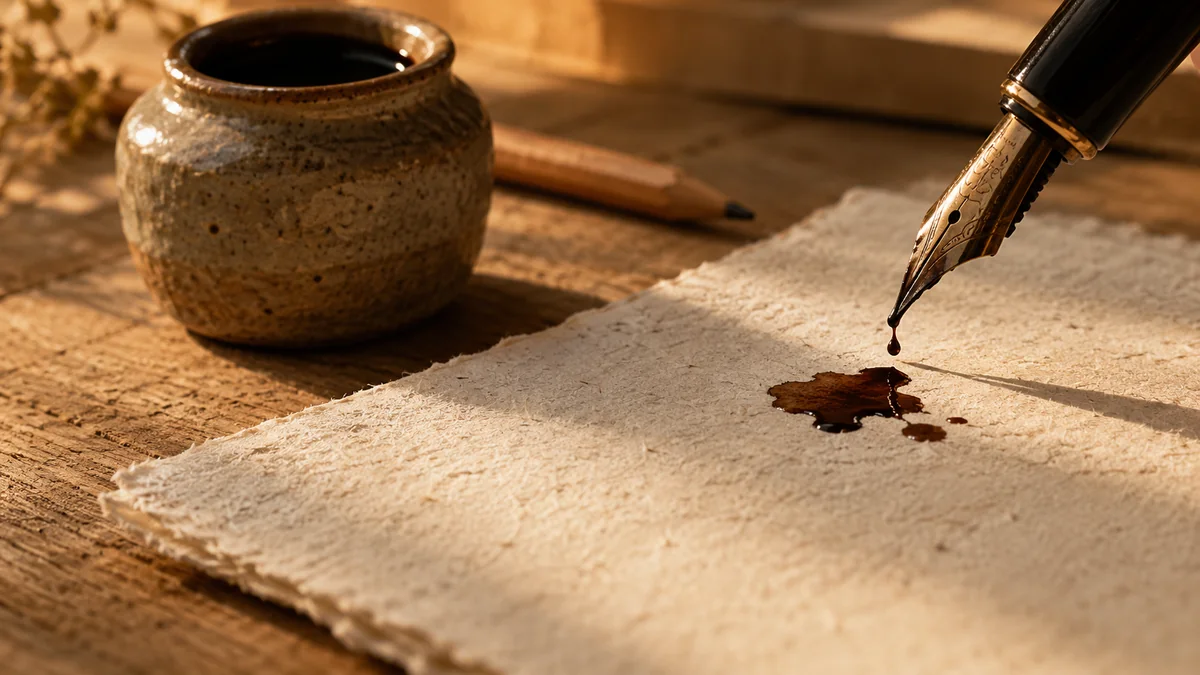
The gentle drag of a nib across cotton paper produces micro-vibrations that travel directly through your fingers.
These subtle physical sensations send immediate signals of safety and presence to your autonomic nervous system.
You are no longer merely processing data in a virtual void.
You are crafting a physical artifact with your own living hands.
Sacred Containment: The Quiet Relief of the Finite Page
Modern digital productivity tools promise infinite canvases and limitless cloud storage.
Yet for an already overwhelmed human psyche, infinity is not liberating; it is deeply exhausting.
An infinite digital scroll constantly whispers that there is always more to collect, tag, and organize.
A physical notebook, by contrast, offers the comforting grace of finite containment.
A single page has an unmistakable border, a tactile edge beyond which nothing more can be squeezed.
This biological boundary forces the mind to prioritize, synthesize, and embrace simplicity.
Furthermore, a blank sheet of paper makes no demands upon your attention.
It will never ping you with a software update, track your reading metrics, or algorithmically recommend another task.
Within the silent perimeter of an open journal, your mind is finally allowed to be unhurried and whole.
| Dimension of Thought | Digital Screen & Keyboard | Analog Pen & Paper Sanctuary |
|---|---|---|
| Kinetic Friction | Frictionless, identical keystrokes on glass or plastic. | Varied physical resistance, rich textural feedback, unique strokes. |
| Spatial Boundary | Infinite scrolling canvas triggering subconscious overwhelm. | Finite, elegant physical borders that encourage deliberate curation. |
| Cognitive Retention | Superficial transcription, rapid scanning, low memory recall. | Deep semantic synthesis, emotional processing, durable retention. |
| Attentional Field | Constant threat of digital notifications and multitasking. | Zero algorithms, quiet focus, unhurried sensory immersion. |
Four Low-Friction Analog Rituals for Mental Grounding
Reclaiming the sanctuary of pen and paper does not require abandoning modern technology altogether.
It is about creating intentional spaces where your mind can breathe away from screens.
Here are four gentle analog rituals to restore your cognitive peace:
- The Morning Brain Dump: Before touching your smartphone, open an unlined notebook and write a single page of unstructured thoughts. Let your anxieties, dreams, and fragments flow freely without self-censorship.
- The Single-Task Index Card: Rather than managing an endless digital to-do list, write your top three intentions on a small paper card. Keep it beside your keyboard as an unshakeable anchor throughout the day.
- The Slow Idea Incubator: Reserve a pocket notebook exclusively for raw insights and musings. Let ideas rest quietly on the page for days before judging or polishing them.
- The Evening Analog Wind-Down: When your workday ends, physically close your laptop and pick up a fountain pen. Write three brief lines of gratitude to signal to your nervous system that work is complete.

Mindful Wealth & Slow Living Grace Note
True wealth is not measured by the speed at which you produce data, but by the depth of your presence while living.
In an economy obsessed with instantaneous digital output, choosing to slow down and write by hand is a quiet act of rebellion. It declares that your thoughts deserve more than a fleeting flash of pixels—they deserve the weight, beauty, and permanence of real matter.
Frequently Asked Questions About Analog Tools and Focus
Why does writing by hand improve memory and emotional clarity?
Handwriting forces the brain to synthesize information rather than merely recording it verbatim. The physical movement of forming letters stimulates complex neural networks, allowing emotional centers to process stress with greater calm.
How can I integrate pen and paper if my job requires screens all day?
You do not need to replace your work tools entirely. Use paper for the initial thinking phases—such as sketching ideas, mapping strategies, and daily prioritization—before transferring the finished work into digital software.
Does writing by hand slow down my daily productivity?
While handwriting is physically slower than typing, it saves hours of mental fatigue by preventing impulsive multitasking and digital distractions. The deliberate pace allows you to make clearer, more grounded decisions the first time.
Take a deep breath. Close the glowing screen for a moment, take a pen in hand, and discover the quiet sanctuary waiting on the blank page.