





You open your phone late at night, and there it is: a quiet announcement about a former colleague who accepted the exact career offer you once declined. They are standing on a sunlit stage at an international summit, newly appointed as vice president, or celebrating the public rollout of a venture you chose not to […]
You open your phone late at night, and there it is: a quiet announcement about a former colleague who accepted the exact career offer you once declined.
They are standing on a sunlit stage at an international summit, newly appointed as vice president, or celebrating the public rollout of a venture you chose not to join.
A sudden, cold hollow opens in the pit of your stomach.
A haunting question echoes through the quiet room: If you had stepped onto that train years ago, where would your life be today?
This ache is one of the most pervasive psychological burdens of modern work.
It is not simple envy; it is the silent grief of career paths not taken.
The Phantom Life: Why the Road Not Taken Looks So Perfect
Career FOMO thrives on cognitive asymmetry. We compare the messy, mundane realities of our daily work with idealized, friction-free phantom versions of alternative paths. Mourning career paths not taken dissolves only when we realize unchosen lives appear flawless simply because they were never tested by real-world friction.
In his book Missing Out, psychoanalyst Adam Phillips observes that modern humans spend much of their lives mourning unlived possibilities.
We construct cinematic daydreams of the jobs we rejected and the cities we never moved to.
In those phantom realities, the commute is never draining, politics never toxic, and creative energy never depleted.
We forget the primary optical illusion of the imagination.
The road not taken always looks immaculate because nobody ever had to walk on it in the rain.
Your current path feels heavy precisely because it is real, filled with gravity, friction, and biological limits.
The Dizziness of Freedom: Kierkegaard and the Modern Career Trap
Nearly two centuries ago, Danish philosopher Søren Kierkegaard defined anxiety as “the dizziness of freedom.”
When society tells us our potential is limitless, every choice feels like a betrayal of a thousand alternative futures.
To choose one craft is to let dozens of other plausible identities quietly starve.
Digital connectivity transforms this philosophical dizziness into an acute emotional crisis.
Professional networks function as curated showrooms of departed trains, displaying only the gleaming first-class cabins of other people’s decisions.
You witness their public milestones, but never the hidden sleeplessness, indigestion, or quiet alienation behind their achievements.
Judging your inside reality against someone else’s external résumé traps your nervous system in chronic scarcity.
| Dimension | The Phantom Career Track | The Agony of Career FOMO | The Grounded Sovereign Path |
|---|---|---|---|
| View of Untaken Paths | Idyllic fantasy of effortless wealth and recognition. | Obsessive rumination over missed promotions and status symbols. | Realistic recognition that every path carries hidden trade-offs and fatigue. |
| Inner Emotional State | Detached daydreaming that drains vitality from current work. | Persistent inadequacy and anxiety of falling behind. | Quiet contentment, emotional stability, and gratitude for chosen boundaries. |
| Relationship with Work | Viewed as an inferior compromise or consolation prize. | Compulsive overworking driven by the need to prove worth. | Intentional engagement, craftsmanship, and alignment with personal peace. |

4 Grounded Shifts to Release the Trains You Didn’t Board
Healing career FOMO does not require you to pretend alternative choices held zero value.
Instead, it invites you to build an unshakeable sanctuary within the life you have chosen.
1. Mourn the Phantom Self with Quiet Grace
Give yourself permission to acknowledge that turning down a path was a genuine loss.
Stop keeping a ghost on your mental payroll by constantly asking what might have been.
Release that alternate version with a soft whisper: “That was a plausible life, but it was not mine to live.”
2. Deconstruct the Frictionless Illusion
Whenever an untaken opportunity begins to shimmer with effortless perfection, deliberately introduce reality back into the frame.
Recall why you hesitated: the eighty-hour workweeks, the loss of autonomy, or the compromise of values.
Every golden corporate carriage carries its own invisible iron bars.
3. Taste the Ground Beneath Your Actual Boots
Direct your sensory attention toward the tangible blessings your present work affords.
Perhaps it is unhurried morning breakfasts, the freedom to log off at five, or deep presence with loved ones.
Wealth is measured by the hours of personal peace you own, not the titles on your business card.
4. Take the Vow of Singular Presence
You inhabit only one mortal body and possess a finite allotment of heartbeats.
Maturity is the courageous acceptance of your own singularity.
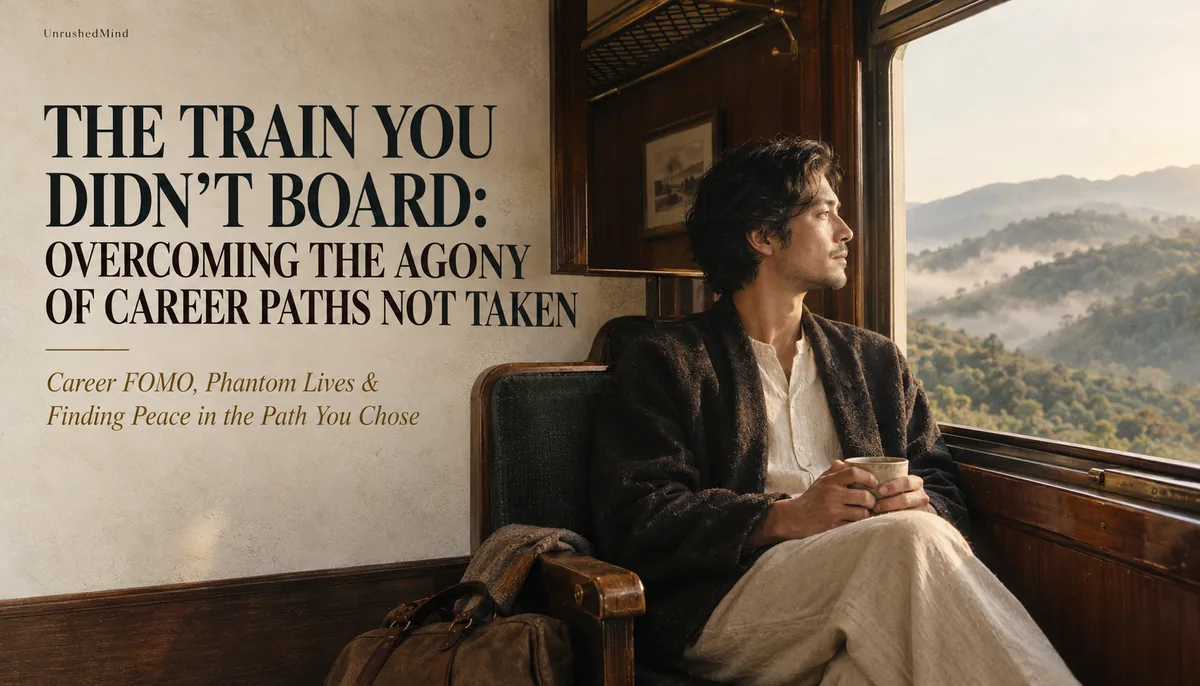
True freedom is not collecting every ticket at the station; it is looking out the window of the carriage you occupy and savoring the landscape.

The Train You Are On Is the Only Real Journey
There is no parallel universe where a superior version of you lives without heartbreak, boredom, or physical limits.
Those unlived lives do not breathe air, do not laugh with close friends, and do not feel the warmth of autumn sunlight.
The work resting in front of your hands right now—however humble or quiet it may seem—is sacred ground.
When you stop running backward down the platform chasing departed ghosts, your present life finally has room to expand.
The journey you are on is the only one that truly exists.
A Sanctuary Note on Vocation: You did not miss the train of your destiny. The carriage you sit in right now is the only one carrying real air, real love, and real purpose.
Frequently Asked Questions