There is a deep exhaustion that comes from being perpetually available to the world. From the moment you wake, your attention is summoned and consumed by external duties. You answer messages, resolve crises, and bend your schedule to accommodate endless requests. By evening, you sit in silence, yet your mind continues to hum with frantic, […]
There is a deep exhaustion that comes from being perpetually available to the world.
From the moment you wake, your attention is summoned and consumed by external duties.
You answer messages, resolve crises, and bend your schedule to accommodate endless requests.
By evening, you sit in silence, yet your mind continues to hum with frantic, nervous static.
You feel like a tenant in your own life, renting out every waking hour to tasks that leave you hollow.
Deep inside, a quiet hunger emerges: the longing for an impenetrable door you can close behind you.
Over four centuries ago, one man decided to construct a physical answer to this timeless ache.
The Tower of Solitude: Why Montaigne Built an Arrière-Boutique for the Mind
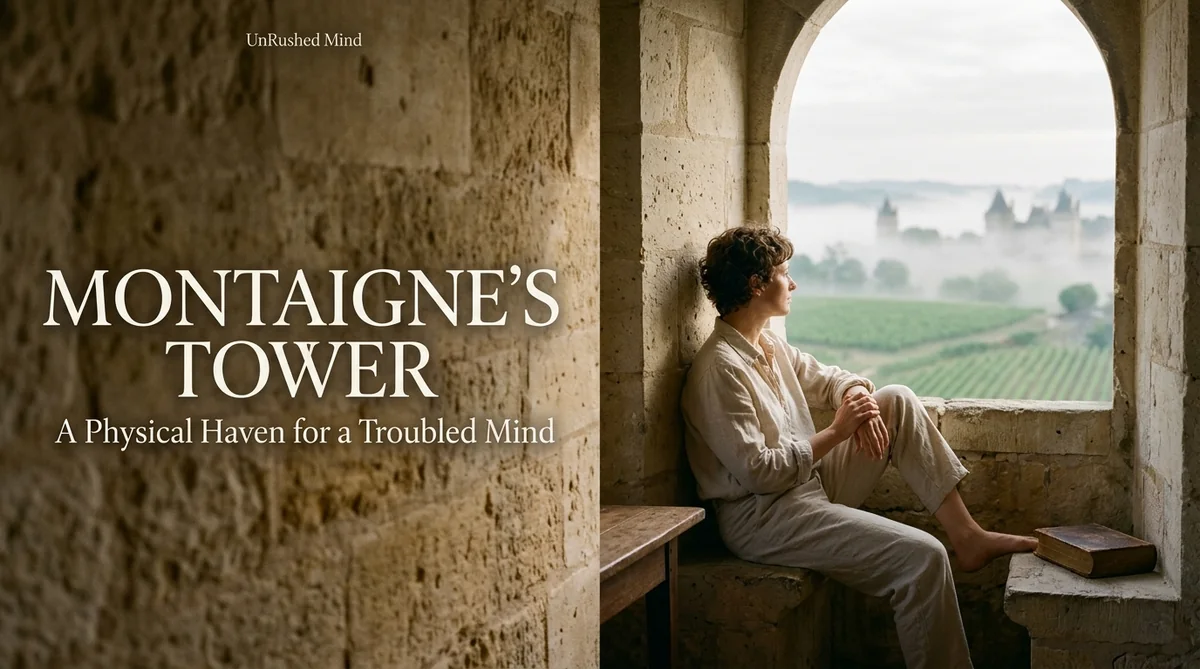
Michel de Montaigne built his tower of solitude to escape overwhelming public obligations and examine his restless soul. Beyond stone walls, he created an arrière-boutique—a private mental retreat where one belongs entirely to oneself, cultivating unshakable peace untouched by external opinion.
In 1571, at thirty-eight years of age, French nobleman Michel de Montaigne walked away from public office.
France was tearing itself apart in religious wars, and the courts were thick with political vanity.
Exhausted by the theater of public duty, Montaigne retreated to his family estate in the quiet hills of the Dordogne.
He ascended to the third floor of a circular stone tower and locked the heavy door.
Yet physical isolation did not bring immediate serenity.
Left entirely to itself, his mind galloped like a runaway horse, throwing up frantic anxieties and dark phantoms.
Montaigne made an essential discovery: physical seclusion alone cannot cure a troubled spirit.
To find true freedom, one must deliberately cultivate an arrière-boutique—a private room behind the shop of life.
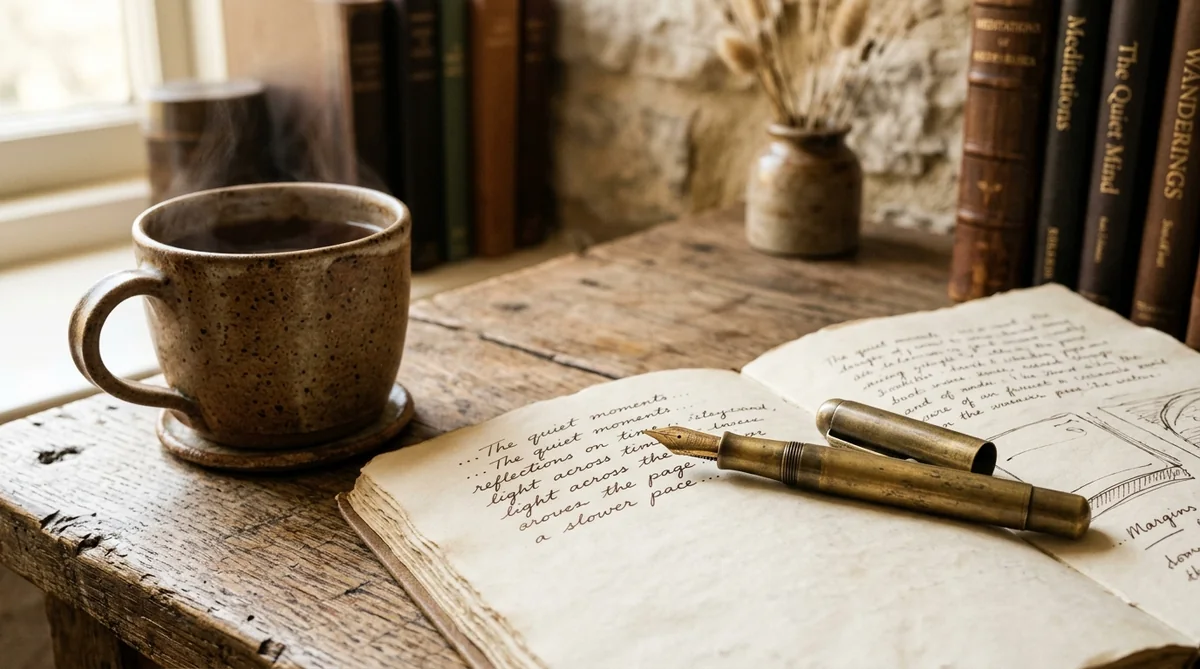
Performative Isolation vs. Soulful Solitude
Understanding Montaigne requires distinguishing between mere escapism and intentional retreat.
| Dimension of Stillness | Performative Isolation (The Escape) | Soulful Solitude (The Arrière-Boutique) |
|---|---|---|
| Spatial Relation | Fleeing to distant hotels while remaining glued to your screen. | Carving an intentional boundary that signals biological safety. |
| Internal Dialogue | Restless boredom, guilt over lost productivity, and phantom worry. | Gentle, curious self-inquiry and unhurried ease with one’s thoughts. |
| Attachment to the World | Brooding over social standing, reputation, and public debates. | Reclaiming sovereign ownership over your attention and emotional energy. |
| Psychological Outcome | Deepened alienation, exhaustion, and continued internal noise. | Restored mental clarity, nervous system reset, and profound inner ease. |
Three Enduring Lessons from the Tower Library
Montaigne spent decades in his circular study, writing his legendary Essays and befriending his own thoughts.
His stone retreat offers timeless blueprints for navigating modern sensory overload.
1. The Geometry of Stillness
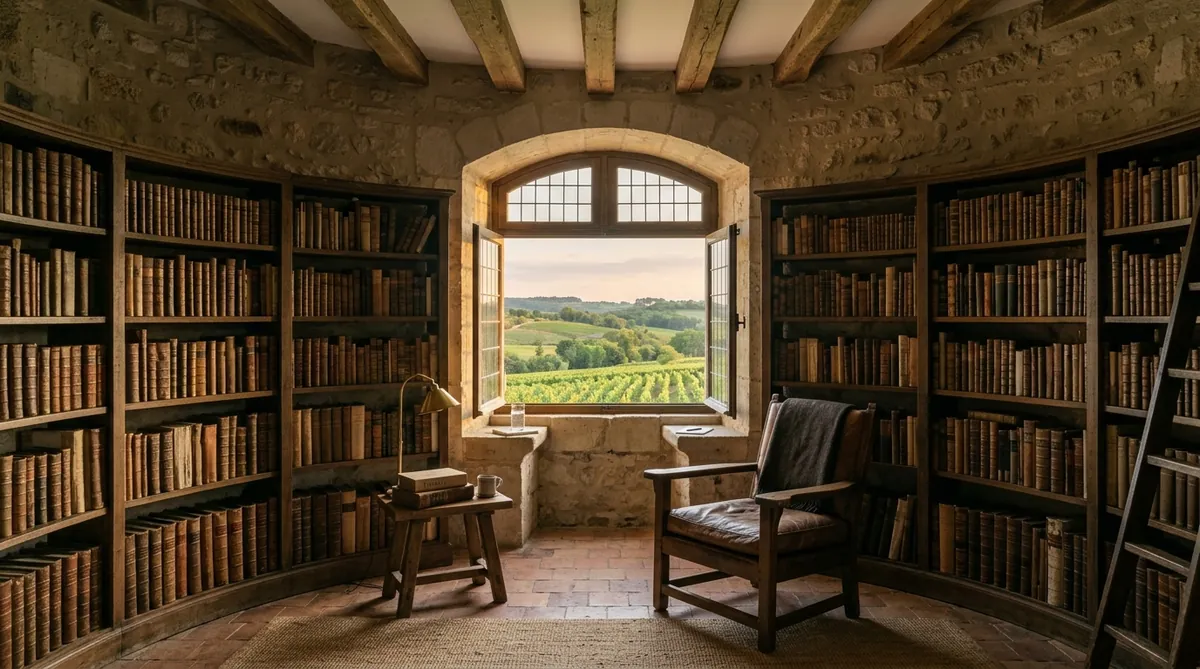
Montaigne’s library was deliberately circular, measuring sixteen paces across.
In a circular room, there are no sharp corners where visual tension or mental rigidity can accumulate.
From his wooden desk, he could cast his gaze across rolling vineyards and wide French skies.
When peripheral vision expands to take in panoramic horizons, the nervous system naturally disarms its survival panic.
2. The Maxims on the Rafters
Whenever Montaigne raised his tired eyes from his writing desk, he looked directly up at the ceiling.
Carved into forty-six massive oak rafters were fifty-seven Greek and Latin quotations from Seneca, Epictetus, and Ecclesiastes.
Sentences reminding him of human ignorance, the fragility of fame, and the folly of fretting over trivial matters.
He created a visual landscape that actively interrupted loops of anxious rumination.
3. The Room Behind the Shop
Montaigne never advocated for abandoning loved ones or becoming a bitter hermit.
Instead, he insisted that we must lend ourselves to others, but give ourselves only to ourselves.
The merchant must serve customers in the front shop, but must keep a private back room where no commerce enters.
“The greatest thing in the world,” Montaigne wrote, “is to know how to belong to oneself.”
Building Your Own Modern Tower of Solitude
You do not need an ancient French castle or a circular tower to live with Montaigne’s wisdom.
You only need to erect an intentional boundary around a small portion of your day.
Designate a single armchair, a quiet porch step, or a park bench as your personal haven of stillness.
Declare that space completely free of screens, notifications, and social performances.
Spend fifteen unhurried minutes there each morning, holding a warm cup of tea and watching the clouds pass.
Lend your energy generously to the world, but never surrender the deed to your private inner chamber.
Frequently Contemplated Questions
Where is Montaigne’s original tower located today?
Montaigne’s historic tower remains standing at Château de Montaigne in Saint-Michel-de-Montaigne, near Bordeaux, France.
Visitors can still climb the narrow stone stairs to see his circular library, original fireplace, and the ancient Greek maxims carved into the wooden rafters.
What did Montaigne mean by the term ‘arrière-boutique’?
The arrière-boutique literally translates from French as the “back-shop.”
It represents an untouchable inner retreat where you owe nothing to the world, allowing you to converse peacefully with your own essence.
How can I practice Montaigne’s solitude in a noisy home?
Solitude is fundamentally an internal posture of quiet non-attachment rather than absolute physical isolation.
You can establish your tower by waking twenty minutes before the household stirs, taking a solo walk without headphones, or taking three conscious breaths during moments of chaos.