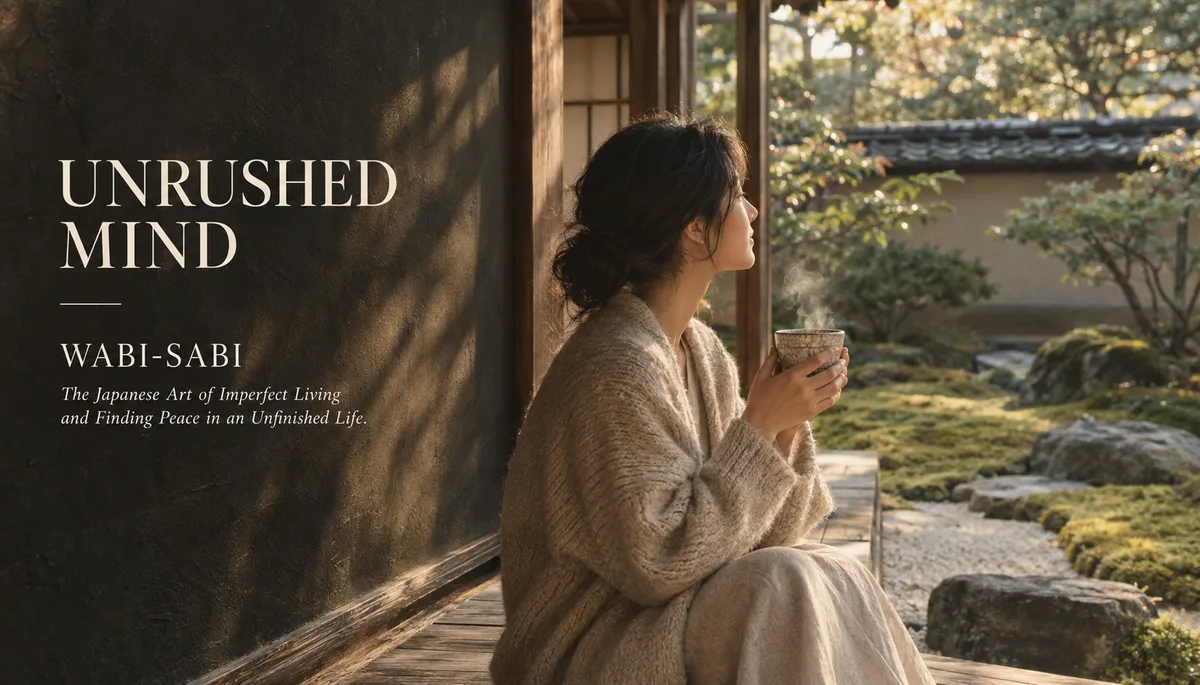
There is a particular kind of quiet exhaustion that does not come from working too many hours or sleeping too few. It comes from the relentless, invisible strain of trying to keep life polished. You feel it when you look around your living room in the late afternoon. The light is soft and golden, but […]
There is a particular kind of quiet exhaustion that does not come from working too many hours or sleeping too few. It comes from the relentless, invisible strain of trying to keep life polished.
You feel it when you look around your living room in the late afternoon. The light is soft and golden, but instead of savoring the warmth, your eyes instantly dart toward the small scratches on the wooden coffee table, the dog-eared corner of a paperback book left open on the sofa, or the thin layer of dust gathering along the windowsill. You feel it in your work, where a project that is already ninety percent complete sits stagnant on your desk because the final ten percent does not yet match the immaculate, shimmering vision in your head. And you feel it most painfully when you look into the bathroom mirror under harsh overhead lights—noticing the faint lines forming around your eyes, the quiet fatigue settling into the corners of your mouth, and wondering when your existence became something that required continuous management, concealment, and repair.
In a modern culture dominated by digital curation, high-gloss finishes, and algorithms that reward flawless symmetry, we have been quietly conditioned to believe that life is a product waiting to be perfected. We treat our bodies as machinery to be upgraded, our homes as showrooms to be sanitized, and our personal journeys as linear trajectories that must never stumble, falter, or fray. Whenever reality inevitably collides with these impossible ideals—when plans unravel, when relationships carry friction, when porcelain cracks, or when our own energy wanes—we do not simply feel disappointed. We feel a gnawing sense of personal shame, as if imperfection were an ethical failure.
Take a slow breath and let your shoulders drop away from your ears.
There are no straight lines in nature. The ocean shore does not follow a mathematical grid. The ancient oak tree does not grow in perfect bilateral symmetry; it twists, knots, and leans toward the sun, carrying scars from past winters that only deepen its dignity. The pressure to live a pristine, finished life is an artificial cage.
Long before the industrial world convinced us to worship frictionless surfaces and disposable novelty, Japanese culture gave birth to a gentle, earth-bound philosophy that offers the ultimate sanctuary medicine for our overworked souls: Wabi-Sabi (侘寂). It is the ancient art of finding reverence in the flawed, the weathered, and the unfinished—not as a consolation prize, but as the deepest, most authentic expression of life itself.
1. What Is Wabi-Sabi? The Ancient Art of Finding Reverence in the Flawed and Fleeting
Wabi-sabi is an ancient Japanese aesthetic and philosophical worldview rooted in Zen Buddhism that finds profound beauty and quiet contentment in the imperfect, impermanent, and incomplete. It teaches that true elegance arises not from flawless symmetry, but from modesty, organic weathering, and natural simplicity.
To understand wabi-sabi is to enter a way of seeing that defies Western categorical thinking. In Japan, the phrase is rarely dissected in analytical discourse; like the quiet smell of petrichor after rain or the subtle cooling of evening air, it is felt intuitively in the marrow of the bone rather than explained through formal definitions. Yet by tracing its two constituent words, we can uncover a compassionate mirror for our modern struggles.
`
┌──────────────────────────────────────────────┐
│ WABI-SABI (侘寂) │
│ The Sanctuary of Imperfect Living │
└──────────────────────┬───────────────────────┘
│
┌─────────────────────────┴─────────────────────────┐
▼ ▼
┌───────────────────────┐ ┌───────────────────────┐
│ WABI (侘) │ │ SABI (寂) │
│ Inner Simplicity │ │ The Rust of Time │
├───────────────────────┤ ├───────────────────────┤
│ • Voluntary modesty │ │ • Natural patina │
│ • Solitary contentment│ │ • Transience (Mujo) │
│ • Freedom from excess │ │ • Honoring weathering │
│ • Rustic authenticity │ │ • Dignity of aging │
└───────────────────────┘ └───────────────────────┘
`
The word Wabi (侘) originally carried connotations of desolation, poverty, and loneliness—the bitter solitude of a hermit living in a remote mountain hut cut off from the luxuries of the imperial court. Over centuries, however, through the profound influence of Zen philosophy and tea masters, the concept underwent a quiet spiritual metamorphosis. Wabi came to represent voluntary simplicity—the conscious choice to live with less, to find richness in poverty of circumstance, and to take delight in the unadorned, the rustic, and the humble. It is the peace of knowing you do not need grandeur to possess dignity, and that a quiet cup of water taken in stillness holds greater wealth than a banquet served in anxiety.
The word Sabi (寂), by contrast, speaks to the inescapable passage of time. Etymologically linked to the patina that forms on ancient bronze and the natural graying of unvarnished cedar, sabi is the beauty of weathering. It is the quiet grace that only years, use, and exposure to the elements can bestow. A brand-new lacquer bowl has shine, but it lacks sabi; only when the lacquer softens, when the edges reveal the dark grain of the wood beneath, and when the hands of three generations have held it, does it acquire soul. Sabi reminds us that wear and tear is not damage; it is the physical imprint of a life genuinely lived.
In his seminal treatise Wabi-Sabi for Artists, Designers, Poets & Philosophers, theorist Leonard Koren distilled the core teachings of this philosophy into three unshakeable fundamental truths of nature:
- Nothing lasts: Everything in the cosmos is in a state of ceaseless flux—arriving, lingering briefly, and dissolving. The Roman Stoics called this memento mori; the Zen masters call it mujo (impermanence).
- Nothing is finished: Creation is never closed. Every house, every forest, every relationship, and every human heart is a continuous, unfolding draft that will never reach an absolute, static state of completion.
- Nothing is perfect: Perfection is an abstract mathematical concept invented by human anxiety to control a messy universe. In the physical, organic world, perfection does not exist, and attempting to enforce it only creates brittle sterility.
When we weave these two concepts together, wabi-sabi emerges not as a decorating trend or a minimalist design manual, but as an existential sanctuary. It gives us permission to stop fighting the natural laws of decay, aging, and change, inviting us instead to make peace with the unfinished nature of our days.
2. The Cultural Malady: How Toxic Perfectionism Is Fracturing the Modern Soul
Why does the concept of wabi-sabi feel like such a soothing balm to the modern spirit? Because we are living through what psychological researchers call an epidemic of perfectionism.
In decades past, people compared their lives to the neighbors down the lane or the families in their local community. Today, our nervous systems are subjected to an unceasing, globalized torrent of curated perfection. Every time we unlock our phones, we are bombarded by architectural marvels devoid of clutter, morning routines executed with algorithmic discipline, pristine skin smoothed by digital filters, and career trajectories that appear unbroken by doubt or failure. Without realizing it, our subconscious mind absorbs the toxic premise that an acceptable life must look effortless, polished, and perpetually ascendant.
`
┌─────────────────────────────────────────────────────────────────────────────┐
│ THE PROGRESSION OF TOXIC PERFECTIONISM │
└─────────────────────────────────────────────────────────────────────────────┘
[Cultural Pressure] “Everything must be flawless, efficient, and seamless.”
│
▼
[Internalized Belief] “If my life has cracks or unfinished edges, I am unworthy.”
│
▼
[Behavioral Trap] Relentless overwork, aesthetic anxiety, concealing vulnerability.
│
▼
[Somatic Collapse] Chronic exhaustion, analysis paralysis, emotional alienation.
`
This dynamic creates a profound psychological condition that therapists term Toxic Perfectionism. Unlike healthy striving—which is intrinsically motivated, celebrates gradual progress, and remains compassionate when mistakes occur—toxic perfectionism is driven entirely by fear. It is a heavy psychological armor donned to ward off criticism, shame, and abandonment. The perfectionist believes: “If I look perfect, work perfectly, and manage my household perfectly, I can avoid the painful sting of being judged.”
Yet this armor comes at an unbearable somatic and emotional cost:
- The Agony of the Unfinished Task: When perfection is the only acceptable outcome, beginning or completing a project becomes terrifying. We fall into severe procrastination or what psychologists call productivity dysmorphia, unable to see the genuine worth of what we have created because our attention remains fixated exclusively on what is still missing.
- Aesthetic Anxiety and Domestic Tension: The home—which ought to serve as a restful harbor—becomes another theater of vigilance. We snap at our partners over an unwashed mug, feel acute guilt over a messy kitchen counter, and exhaust our finite evening energy scrubbing surfaces instead of resting our depleted minds.
- The Denial of Aging and Grief: By worshiping youth, smoothness, and novelty, modern culture turns natural biological aging into a source of dread. We spend billions attempting to erase every wrinkle, dye every strand of silver hair, and replace durable objects the moment they show the slightest sign of wear, severing our connection to the grounding rhythm of the seasons.
- Relational Fragility: Perfectionism makes intimacy nearly impossible. When we refuse to accept flaws in ourselves, we inevitably project that intolerance onto the people we love. We become hypercritical of our partners’ habits, impatient with our children’s messy explorations, and terrified of revealing our own authentic messiness, reinforcing deep relational loneliness.
When we run this race indefinitely, our biology eventually breaks down. As we explore in our work on the window of tolerance and chronic survival mode, the nervous system cannot survive under the constant threat of perceived deficiency. It yearns for a philosophy that honors reality rather than punishing it.
3. The Philosophy of the Tea Bowl: Sen no Rikyu, Chabana, and Kintsugi
To trace how wabi-sabi moved from an abstract aesthetic intuition into an enduring way of life, we must turn to sixteenth-century Japan and the legendary tea master Sen no Rikyu (1522–1591).
During Rikyu’s era, the Japanese ruling class—the samurai warlords and wealthy merchants—practiced chanoyu (the Japanese tea ceremony) as an ostentatious display of political power and material dominance. They competed fiercely to acquire imported Chinese porcelain tea utensils known as karamono. These Chinese bowls were marvels of technical mastery: perfectly symmetrical, coated in immaculate jade-green celadon glazes, and polished to a mirror-like shine. To host a tea gathering was to prove how much immaculate wealth one commanded.
`
┌───────────────────────────────────┬───────────────────────────────────┐
│ THE KARAMONO MINDSET │ THE WABI-CHA MINDSET │
│ (Imperial Splendor / China) │ (Sen no Rikyu / Japanese Zen) │
├───────────────────────────────────┼───────────────────────────────────┤
│ • Pristine, porcelain symmetry │ • Rustic, hand-shaped earthenware │
│ • Flawless, mirror-smooth glaze │ • Asymmetrical, coarse textures │
│ • Display of wealth and power │ • Intimate sanctuary of humility │
│ • Expensive, imported luxury │ • Local, humble, found materials │
│ • Static, timeless preservation │ • Celebrates the marks of time │
└───────────────────────────────────┴───────────────────────────────────┘
`
Rikyu recognized that this obsession with ostentatious perfection was suffocating the true spiritual essence of tea, which was meant to be an encounter of pure presence, humility, and ataraxia—an untroubled mind. In a radical cultural rebellion, Rikyu dismantled the traditional tea room. He shrank the gathering space down to a modest two-tatami hut made of rough mud walls, unpeeled cedar pillars, and a low entrance (nijiriguchi) that forced even the most feared samurai warlords to remove their swords and crawl inside on their hands and knees, establishing complete equality before nature.
Most revolutionary of all, Rikyu abandoned the pristine Chinese porcelain. In their place, he collaborated with a Kyoto tile-maker named Chojiro to create Raku ware: coarse, hand-molded earthenware bowls fired at low temperatures. These bowls were intentionally asymmetrical. They bore the subtle indentation of the potter’s fingers, rough unglazed patches, and unpredictable dark scorch marks from the kiln coals. When held in both hands on a chilly morning, a Raku bowl did not feel cold and aloof like porcelain; its thick, textured clay retained heat, welcoming the drinker’s touch with an earthy, grounding warmth.
The Parable of the Fallen Leaves
A classic Zen story illustrates Rikyu’s profound understanding of wabi-sabi. Rikyu asked his young son and student to clean the garden path leading to the tea hut. The son swept the moss path meticulously. Seeing that a few twigs remained, he swept it a second time, and then a third time, working for hours until not a single pine needle, twig, or withered leaf remained anywhere on the ground. The path was spotless, pristine, and mathematically sterile.
He called his father to inspect the work. Rikyu looked at the immaculate garden, shook his head gently, and walked over to a maple tree whose leaves were turning crimson in the autumn chill. Reaching up, the master shook the branch lightly. A handful of golden and red leaves drifted down through the crisp air, scattering naturally across the damp green moss and the stone lanterns.
“There,” Rikyu said quietly. “Now the garden has life.”
Rikyu understood that mechanical cleanliness lacks spirit. True beauty requires the presence of nature’s unchoreographed, fleeting touch. It asks us not to sanitize the world, but to allow the world to be itself.
Chabana: Flowers as They Grow in the Field
This same spirit gave rise to Chabana (茶花), the minimalist floral arrangement practiced in the tea ceremony. Unlike Western floral bouquets that demand dozens of identical, fully bloomed roses bound together in rigid geometric arrangements, Chabana follows a single, disarmingly simple guideline: Arrange flowers as they are in the field.
A tea master might select a single wild grass bending in the wind, or a solitary camellia bud that is half-closed, placed inside a weathered bamboo tube. They often choose a bud rather than a flower in full, glorious bloom. Why? Because a flower in full bloom has nowhere to go but decay; its story is finished. A bud, carrying a small imperfection or a dewdrop on its stem, invites the viewer’s imagination to participate in the unfolding mystery of life. It honors potential, restraint, and the quiet dignity of the ordinary.
Kintsugi: The Golden Scars of Resilience
Closely intertwined with wabi-sabi is the centuries-old art of Kintsugi (金継ぎ), or “golden joinery.” When a cherished ceramic bowl or vase breaks, conventional Western thinking suggests two options: throw it in the trash, or glue it back together using invisible adhesive so that no one can tell it was ever fractured.
Kintsugi rejects both paths. The artisan gathers the shattered shards and painstakingly joins them together using natural Japanese urushi lacquer mixed with genuine powdered gold, silver, or platinum. Rather than disguising the break, the golden seams illuminate it with radiant reverence. The fracture becomes the focal point of the object’s beauty.
`
┌─────────────────────────────────────────────────────────────────────────────┐
│ THE WISDOM OF KINTSUGI │
├─────────────────────────────────────────────────────────────────────────────┤
│ Conventional Approach: Breakage = Ruin, Defect, Value Lost │
│ Kintsugi Philosophy: Fracture = History, Resilience, Value Deepened │
│ │
│ “The crack is not where the object failed; it is where its true story │
│ began. By illuminating the fracture in gold, we honor the trials that │
│ shaped its existence rather than pretending they never happened.” │
└─────────────────────────────────────────────────────────────────────────────┘
`
The metaphorical medicine for the human heart is unmistakable. How many of us spend our lives exhausted because we are frantically trying to hide our golden scars? We hide our past failures, our divorces, our bouts with depression, our periods of financial struggle, or the grief that softened our hearts, terrified that if others saw where we were broken, they would deem us defective.
Wabi-sabi whispers the counter-cultural truth: Your cracks are not evidence of your failure. They are the record of your endurance. When you honor the places where life broke you and brought you to your knees, you transform raw suffering into deep empathy, compassion, and unshakeable inner wisdom. You cease to be a fragile porcelain doll; you become a golden-seamed vessel capable of holding the sorrow and beauty of the world without breaking.
4. Master Diagnostic Table: The 4 Mindsets of Life’s Imperfection
To recognize where you currently stand in relation to perfection, control, and grace, examine the four distinct ways human beings navigate an imperfect reality:
| Dimension | The Toxic Perfectionist Controller | The Cynical Careless Resigner | The Aesthetic Wabi-Sabi Consumer | The Grounded Wabi-Sabi Sanctuary Mind |
|---|---|---|---|---|
| View of Flaws & Mistakes | Sees flaws as personal catastrophes and proof of unworthiness; frantically conceals, corrects, and overcompensates. | Uses imperfection as an excuse for neglect, sloppy habits, and apathy; claims “nothing matters anyway.” | Fetishizes flaws only if they look chic, expensive, or curated for social media; rejects genuine, messy life. | Reveres flaws as the natural footprint of time and human effort; treats mistakes with tender, reflective curiosity. |
| Relationship with Belongings | Replaces items the moment they chip or show wear; obsesses over frictionless surfaces and brand-new shine. | Surrounds themselves with broken clutter; treats belongings without reverence or thoughtful stewardship. | Buys mass-produced faux-distressed furniture at high prices; seeks the appearance of age without the history. | Cares deeply for a few durable, honest objects; treasures the honest patina and memories etched into the wood. |
| Stance on Aging & the Body | Wages an exhausting war against time with cosmetic interventions; panics over every line and loss of stamina. | Abandons bodily health and somatic care, confusing neglect with self-acceptance; lives disconnected from vitality. | Views aging through romanticized nostalgia from afar, but secretly dreads personal physical decline. | Meets the changing body with profound gratitude; honors wrinkles as the honest roadmap of joy, sorrow, and life. |
| Reaction to Unfinished Work | Paralyzed by anxiety; cannot rest or sleep while tasks remain incomplete; constantly burns out. | Leaves projects abandoned at the first sign of difficulty; chronic avoidance disguised as freedom. | Only displays completed projects that fit an immaculate personal brand; hides the messy, grinding drafts. | Works with devoted craftsmanship while accepting that life is a perpetual draft; rests peacefully amid unfinishedness. |
| Dominant Somatic State | High muscle tension (jaw clenched, shallow breath, hypervigilant eyes scanning for errors). | Heavy, lethargic numbness; collapsed posture; emotional detachment and flat affect. | Restless visual scanning; constantly evaluating how things “look” rather than how they feel inside. | Dropped shoulders, open chest, rhythmic diaphragmatic breathing, grounded somatic ease. |
| Deepest Inner Longing | To be invulnerable to criticism, safe from rejection, and in absolute control of the universe. | To avoid the pain of disappointment by never caring enough to try or invest deeply. | To be perceived as tasteful, enlightened, and sophisticated by external onlookers. | To belong authentically to the natural world and find enduring peace within life’s fleeting, unfinished reality. |
5. The Sanctuary Imperfection Protocol: 4 Daily Practices to Settle into an Unfinished Life
Embracing wabi-sabi is not about throwing out your belongings or moving to a mountain hermitage in Nagano. It is an internal orientation that can be cultivated anywhere—in a small city apartment, in a demanding corporate career, or in the noisy middle of raising a family.
Here is a four-step somatic and psychological protocol to integrate the wisdom of wabi-sabi into your daily life without turning it into another exhausting self-improvement chore:
`
┌─────────────────────────────────────────────────────────────────────────────┐
│ THE SANCTUARY IMPERFECTION PROTOCOL (4 STEPS) │
└─────────────────────────────────────────────────────────────────────────────┘
[1. Honoring the Crack] Catch the urge to fix or conceal; speak gentle validation.
│
▼
[2. Savoring the Patina] Find the living history in worn objects and your aging body.
│
▼
[3. Cultivating Ma] Clear space for silence and stillness; stop overfilling life.
│
▼
[4. Peaceful Unfinishedness] Leave the task gently at sundown; surrender to natural limits.
`
Step 1: Honoring the Crack (Catching the Urge to Conceal)
The next time something in your day does not go according to plan—a cake sinks in the middle, a presentation has a typo, you arrive ten minutes late due to traffic, or your child spills tea on the tablecloth—notice your immediate somatic reaction.
For most of us, the nervous system instantly triggers a surge of adrenaline, tightening the chest and activating a critical inner voice: “How could you let this happen? You ruined it!”
Instead of scrambling to conceal the flaw or lashing out in irritation, take a conscious, three-second breath. Place a warm hand over your sternum, let your belly soften, and name the reality out loud:
“This is a crack. It is unexpected, it is imperfect, and it is completely welcome here. Life is not ruined because it deviated from the blueprint.”
By refusing to meet an everyday imperfection with panic, you rewire your amygdala’s fear response. You teach your nervous system that an error is not an emergency, restoring what psychologists call somatic safety and emotional sovereignty.
Step 2: Savoring the Patina of Time (The Gratitude of Wear)
Once a week, choose one object in your home that has been marked by time and spend two uninterrupted minutes observing it with contemplative eyes.
It might be a wooden cutting board scored with hundreds of knife marks from meals prepared for people you love. It might be a wool sweater with slightly frayed cuffs that has kept you warm through five winters. It might be the worn spine of a beloved novel, or a ceramic mug whose glaze has developed fine network lines (crazing) from years of holding hot coffee.
Notice the texture. Feel the cool or warm surfaces under your fingertips. Recognize that if these objects were still encased in plastic packaging on a store shelf, they would have no story, no soul, and no memory.
Then, turn that same gentle lens toward yourself. Look at your hands—the small scars from childhood, the veins that show the faithful pumping of your blood, the texture of your skin. Rather than viewing your body as an aesthetic asset that is depreciating in value, recognize it as a sacred, living vessel that has carried you through every storm, every heartbreak, and every sunrise you have ever witnessed. Meet it with profound, tearful gratitude.
Step 3: Cultivating Ma (The Art of Generous Negative Space)
In Japanese aesthetics, Ma (間) refers to the negative space—the pregnant pause between musical notes, the empty corner in a room, the white space on a scroll of calligraphy that allows the brushstrokes to breathe.
Modern life suffers from a catastrophic lack of Ma. We pack our schedules with back-to-back commitments, fill every quiet moment in the elevator by scrolling our screens, and clutter our homes with bargain purchases until our visual fields are overloaded. This sensory congestion keeps our minds in a perpetual state of sensory overload.
Wabi-sabi invites us to reintroduce Ma with deliberate tenderness:
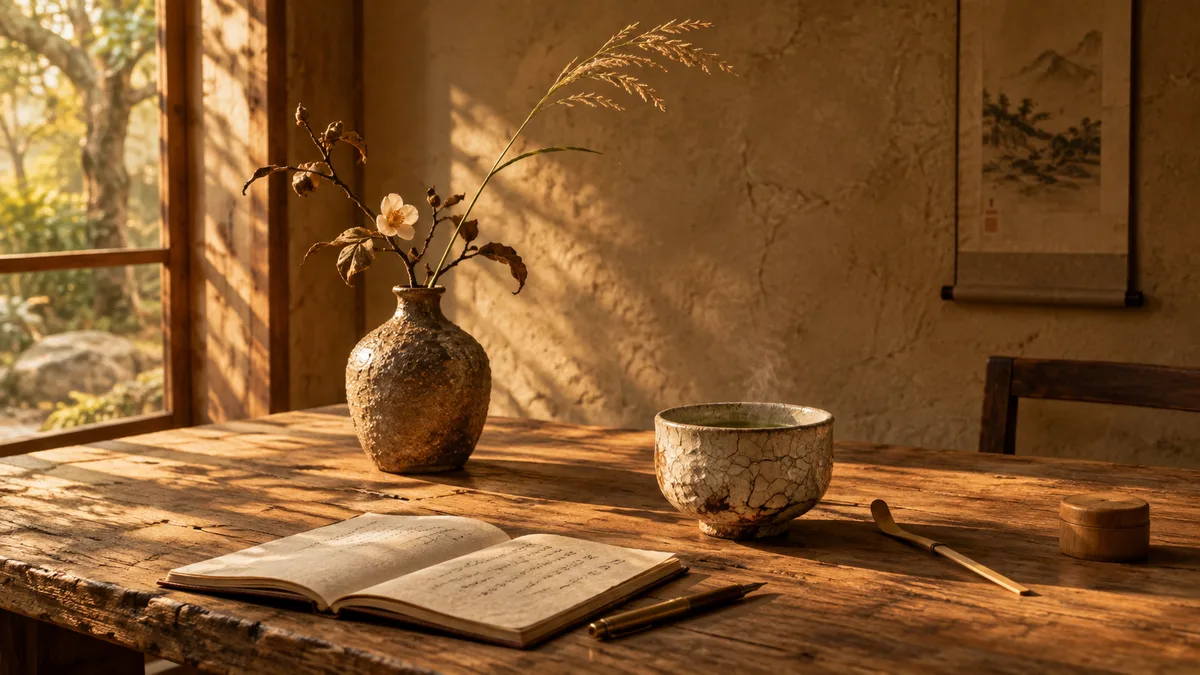
- Spatial Ma: Leave one wall in your room completely blank. Clear one tabletop so that nothing rests on its surface except the natural grain of the wood and the sunlight falling across it. Give your eyes an unhurried resting place.
- Temporal Ma: Build ten-minute “pockets of nothingness” into your day. When you finish a work meeting, do not immediately open your inbox. Sit by an open window. Drink a glass of water without a phone in your hand. Let the thoughts settle like silt at the bottom of a quiet pond.
- Conversational Ma: Practice holding space by pausing for two seconds before responding to someone. Resist the urge to fill every silence with clever words.
Step 4: Practicing Peaceful Unfinishedness (The Evening Surrender)
One of the most destructive habits of the modern achiever is the inability to close down the day while things remain undone. We stay up past midnight answering “just one more email,” folding “just one more load of laundry,” or obsessively tweaking a slide deck because our nervous system cannot tolerate going to sleep with loose threads.
Yet here is the liberating truth of wabi-sabi: You will die with an unfinished to-do list.
Every great thinker, artist, builder, and philosopher in human history left this earth with books unread, letters unanswered, and projects half-conceived. To demand that you finish everything before you allow yourself to rest is to demand that life cease being life.
At sundown, establish a deliberate ritual of surrender:
- Close your computer or put down your tools.
- Look at the items remaining on your list and speak to them with affection: “You are important, but you belong to tomorrow. Today has had enough labor. The world will keep turning while I rest.”
- Surrender your burden to the dark. Step into the healing embrace of deep restorative rest, knowing that an unfinished day is not a failed day; it is simply a human day.
6. Frequently Asked Questions About Wabi-Sabi and Imperfect Living
Does wabi-sabi mean resigning oneself to sloppiness, messiness, or low standards?
Not at all. This is the most common misunderstanding of wabi-sabi in the West. Wabi-sabi is never an excuse for carelessness, apathy, or neglect.
In traditional Japanese crafts—whether pottery, joinery, or the tea ceremony—the artisan practices extraordinary discipline, devotion, and technical precision. The difference lies in the spirit of expectation. The wabi-sabi artisan pours their whole heart into the craft, but once the bowl is placed into the kiln, they surrender the outcome to the fire. They do not force the clay to be what it is not.
Sloppiness is the absence of care; wabi-sabi is deep, reverent care coupled with the humility to accept what cannot be controlled.
How can I practice wabi-sabi in a competitive workplace that demands flawless metrics?
You do not need to abandon professional competence to live the spirit of wabi-sabi. In fact, wabi-sabi often makes you significantly more effective at work because it eliminates the crippling friction of the arrival fallacy and analysis paralysis.
In a professional setting, apply wabi-sabi by focusing your energy on functional excellence rather than cosmetic perfectionism. Deliver thorough, thoughtful work, but recognize the point of diminishing returns—the point where spending another five hours polishing formatting adds zero real value and only burns out your nervous system. Internally, hold your professional role lightly: recognize that job titles, quarterly metrics, and corporate accolades are fleeting phenomena (mujo) that do not define your intrinsic human worth.
What is the relationship between Japanese Wabi-Sabi and Western Stoicism?
Wabi-sabi and ancient Greco-Roman Stoicism are profound philosophical cousins born on opposite sides of the globe. Both philosophies recognize that human suffering arises when we stubbornly demand that the universe conform to our fragile personal desires.
Stoicism approaches this through rational inquiry and the dichotomy of control, urging us to distinguish between what is up to us and what is not, and to cultivate Amor Fati—the love of fate. Wabi-sabi arrives at the exact same conclusion through intuitive, poetic aesthetics: by attuning our senses to the seasonal decay of autumn leaves, the chipping of old stone, and the transience of life, we naturally soften our grip on reality and surrender to the unfolding flow of existence.
Do I need to buy expensive Japanese ceramics or redesign my home to practice wabi-sabi?
To spend thousands of dollars buying minimalist designer furniture to create a “wabi-sabi aesthetic” is a tragic commercial contradiction. The moment wabi-sabi becomes a luxury commodity to be purchased, its soul evaporates.
The true essence of wabi is refined simplicity—taking joy in what is already present. You can practice wabi-sabi today with the plainest ceramic mug from your kitchen, an old wool blanket passed down from your grandmother, or a single wildflower picked from the sidewalk on your evening walk. Wabi-sabi is not about acquiring special objects; it is about cultivating a compassionate, unhurried eye that can recognize the sacred dignity hiding inside the ordinary.
The Quiet Grace of Leaving Things Undone
You were never meant to be a polished marble statue standing cold, untouchable, and immortal inside a museum gallery.
You are a human being made of warm blood, soft tissue, and fleeting breath. You are meant to weather. You are meant to be shaped by the griefs you have survived, the laughter that has etched crow’s feet beside your eyes, the journeys that have scuffed the leather of your boots, and the quiet mistakes that have humbled your youthful arrogance and taught you how to love.
Stop holding your breath waiting for the day when your life will finally be completely sorted, your inbox will be empty forever, your body will be impervious to time, and all your uncertainties will be permanently resolved. That day does not exist, and if it did, it would be as barren as a sterile laboratory.
Look down at your hands today. Look around the room you inhabit. Notice the chipped cup, the uneven light, the project half-done, the tired body resting gently in its chair.
See the beauty that is already here, resting quietly beneath the surface of things. Breathe into the space where the cracks meet. And let yourself be held by the timeless, unfinished grace of being alive.
A Reflective Note on Mindful Living and Emotional Wellbeing This essay is offered as a philosophical reflection and contemplative lens for personal inquiry, grounded in the enduring traditions of Japanese aesthetics and Zen philosophy. It is not intended as clinical psychological treatment or diagnostic advice. If you are experiencing overwhelming anxiety, debilitating perfectionism, or chronic depression, please consider seeking the compassionate support of a licensed therapist or mental health professional. Healing is not a linear sprint toward perfection; it is a gentle, unfolding return to your innate wholeness.