






There is an invisible poison in modern life, and its name is perpetual sound. From the blare of morning traffic to the relentless chiming of notifications, our sensory systems are submerged in an unbroken sea of noise. You feel it as a tight band across your temples, an inexplicable dread when your phone vibrates, and […]
There is an invisible poison in modern life, and its name is perpetual sound.
From the blare of morning traffic to the relentless chiming of notifications, our sensory systems are submerged in an unbroken sea of noise.
You feel it as a tight band across your temples, an inexplicable dread when your phone vibrates, and a deep cognitive exhaustion that sleep cannot heal.
In a culture that equates constant connectivity with importance, silence has become the rarest and most urgent form of medicine.
Quick Sanctuary Takeaway: Silent monastery retreats provide profound relief from digital sensory overload by removing performative speech and acoustic pollution. Neuroscience shows that sustained silence quiets the amygdala’s fight-or-flight reflex, stimulates hippocampal neurogenesis, and restores the autonomic nervous system to deep, regenerative balance.
The Invisible Hemorrhage of Sensory Overload
Most modern exhaustion is not physical; it is sensory gating failure caused by chronic overstimulation.
Your brain possesses an ancient neurological filter designed to discard irrelevant auditory and visual data.
In our hyper-connected reality, that filter is bombarded by tens of thousands of digital inputs every single day.
The human organism was never biologically engineered to endure this continuous, fragmented deluge of alerts and social demands.
When you cross the threshold of a historic monastery, the immediate shock is not what you find, but what is suddenly absent.
There are no screens demanding emotional reactions, no background hum of machinery, and no ambient traffic grinding against your nerves.

What Happens When the World Goes Mute
Across monastic traditions—from Benedictine cloisters to Zen mountain temples—silence is honored as Silentium Magnum, the Great Silence.
It is not an empty punishment, but an intentional sanctuary where words cease so true perception can awaken.
Modern neuroscience confirms what ancient contemplatives knew through experience: stillness initiates rapid physiological repair.
When external noise vanishes, baseline cortisol levels drop significantly, and the sympathetic nervous system finally surrenders its guard.
A landmark study published in Brain, Structure and Function revealed that sustained silence stimulates neurogenesis in the hippocampus, the neural center for memory and emotional regulation.
In silence, your mind is not idling; it is actively repairing the fractures created by modern velocity.
Furthermore, without the obligation to speak, the ego’s exhausting habit of defending, projecting, and performing simply dissolves.
The Architecture of Stillness: A Modern Diagnostic
Monasteries were carefully engineered across centuries as living architecture for nervous system restoration.
| Modern Noise Source | Invisible Somatic Cost | Monastic Sanctuary Antidote | The Restorative Shift |
|---|---|---|---|
| Micro-Alerts & Pings | Chronic sympathetic arousal; elevated baseline adrenaline. | The Device Sabbath: Phones locked away upon arrival. | “My attention is a sacred sanctuary, not a public commodity.” |
| Performative Small Talk | Social masking exhaustion; chronic tension in jaw and throat. | Noble Silence: Dining, walking, and dwelling without words. | “I do not owe the world a performance to justify my existence.” |
| Urban Acoustic Hum | Auditory cortex fatigue; inability to reach deep rest. | Stone Cloister Masonry: Heavy walls absorbing vibration. | “True quiet is not an empty void; it is the presence of clarity.” |
| Artificial Urgency | Dopamine depletion; fractured attention spans. | Liturgy of the Hours: Unhurried rhythms tied to natural light. | “Life unfolds in unhurried seasons, not frantic sprints.” |
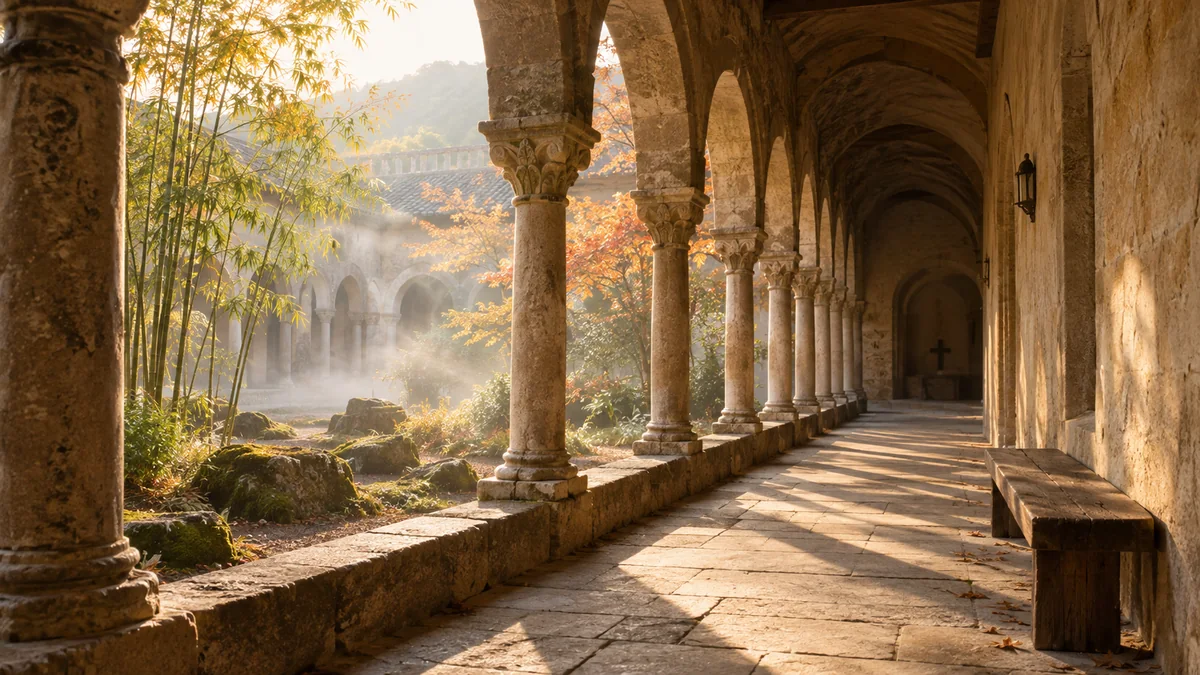
The Secular Monastery Protocol: 4 Steps to Deep Silence
You do not need to take monastic vows to drink from the restorative well of silence.
Whether visiting a heritage abbey or creating a silent retreat at home, this 4-step framework reclaims your mental sovereignty.
1. Enter the Digital Cell
Real sensory decompression begins with a total severance from screens.
Turn off your phone, place it inside a drawer, and set an explicit away message.
Expect phantom vibrations in your pockets during the first twelve hours; this is the somatic withdrawal from dopamine overstimulation.
2. Commit to Noble Speechlessness
Dedicate a minimum of 48 unbroken hours to non-verbal living.
Eat your meals without speaking, walk along garden paths without taking photos, and allow eye contact to be soft and unhurried.
When you stop explaining yourself to others, your nervous system realizes it is finally safe to rest.
3. Align with Natural Circadian Cycles
Monastic communities structure their existence around sunlight rather than artificial deadlines.
Rise with the dawn, walk in outdoor stillness, and welcome dim evening light without fluorescent bulbs.
This simple biological attunement resets your circadian clock and deepens slow-wave restorative sleep.
4. Allow the Emotional Thaw
When external distractions vanish, deferred grief, anxiety, and restlessness often float to the surface.
Do not panic or reach for a book to numb the sensation.
Sit gently with whatever arises, knowing that emotional clarity only emerges after the initial sediment settles.
Carrying the Cloister in Your Chest
The ultimate goal of a silent retreat is not to escape the world forever, but to change how you inhabit it.
You discover that silence is not merely a geographic location; it is an interior posture of grounded sovereignty.
When you return to the roaring city, you can close your eyes, take three slow breaths, and re-enter that peaceful stone cloister within your own soul.
Frequently Asked Questions