There is a quiet weariness that modern life carves into the nervous system. It is not merely physical fatigue, but the exhaustion of living in a world that never stops humming, pinging, and demanding attention. Every day, your senses are bombarded by sirens, screens, and pressure to perform. In this constant sensory overdrive, the mind […]
There is a quiet weariness that modern life carves into the nervous system.
It is not merely physical fatigue, but the exhaustion of living in a world that never stops humming, pinging, and demanding attention.
Every day, your senses are bombarded by sirens, screens, and pressure to perform.
In this constant sensory overdrive, the mind fragments, always anticipating the next obligation.
You yearn for an empty space—a sanctuary where nothing is demanded of you, and where the air feels ancient and unhurried.
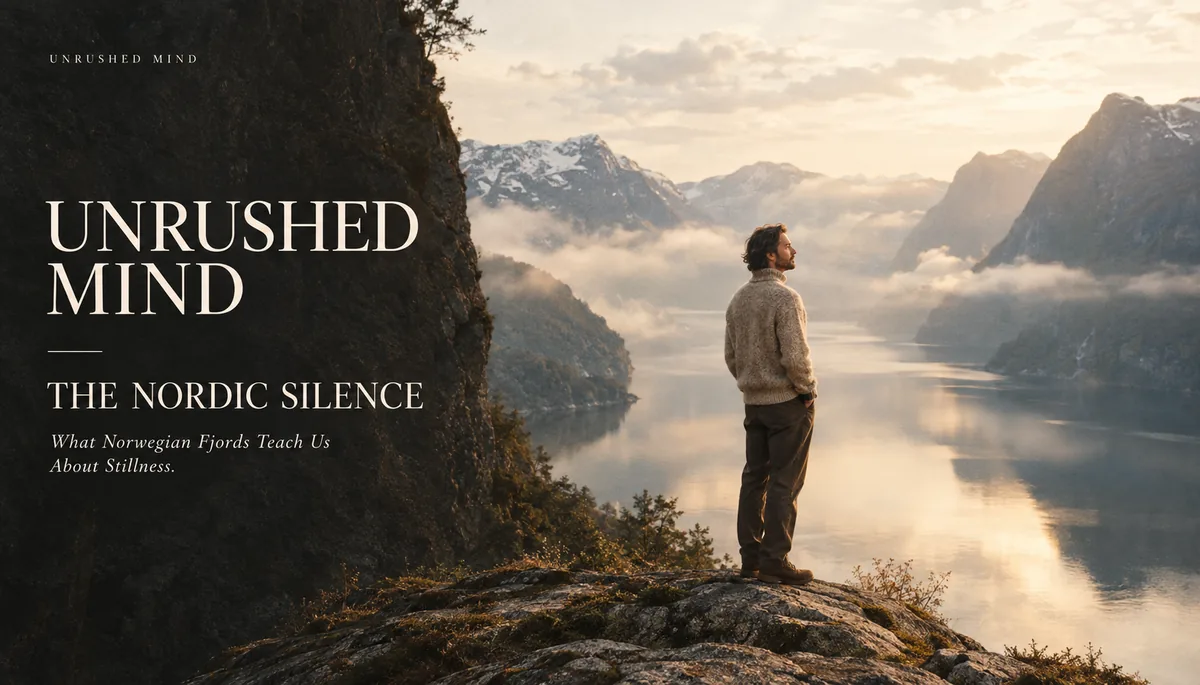
This is where the solitary Norwegian fjords offer a profound medicine: the gift of sacred stillness.
Quick Sanctuary Takeaway: Nordic silence in the solitary fjords provides an acoustic sanctuary that gently de-escalates an overstimulated nervous system. Rooted in the philosophy of Friluftsliv, slow immersion in these glacial valleys reveals that true peace comes not from consuming more, but from cultivating stillness and living with less.
The Geometry of Solitude: Why the Fjords Create an Acoustic Sanctuary
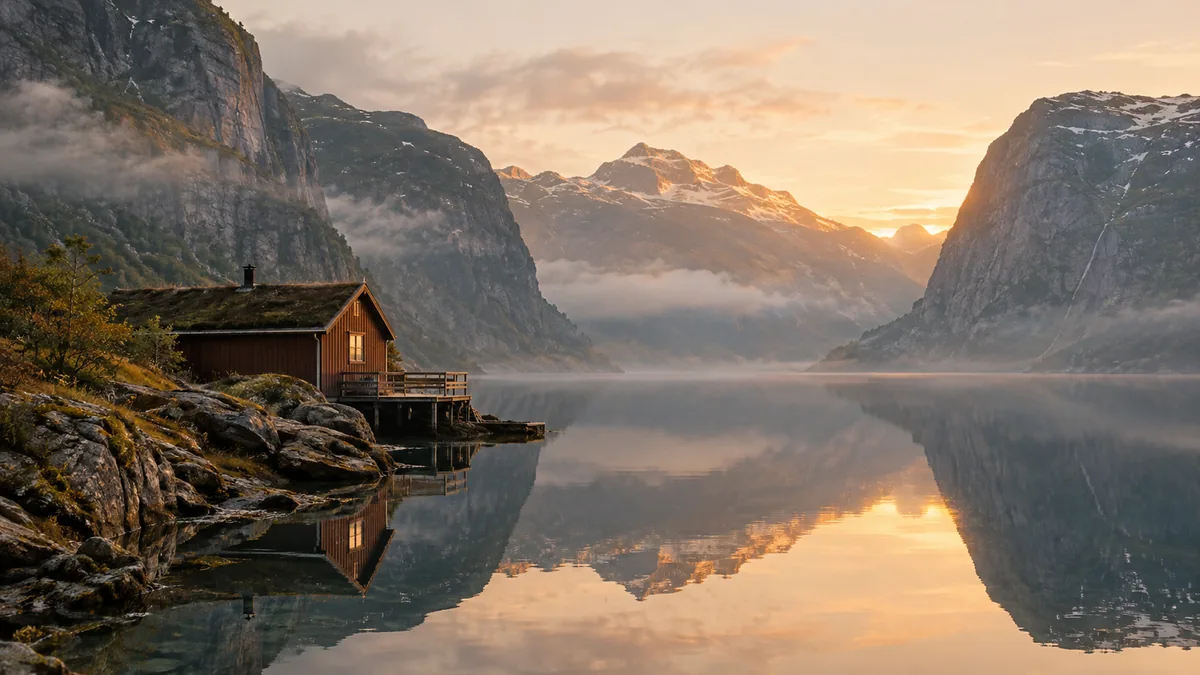
Standing beside a Norwegian fjord like Nærøyfjord, the absolute weight of silence takes your breath away.
Carved by ancient glaciers, these narrow waterways are flanked by sheer granite cliffs rising thousands of feet.
These colossal walls act as natural acoustic shields, absorbing reverberations and blocking mechanical noise.
Here, ambient noise drops below twenty decibels—a threshold virtually extinct in modern cities.
The only sounds remaining are elemental: glacial meltwater cascading down rock faces, rustling mountain birch, and mirror-still water.
In this profound quiet, your nervous system finally lowers its invisible armor.
Your survival brain stops scanning for alerts, synchronizing with the slow cadence of the landscape.
This is not empty void; it is a living presence that invites your soul to rest.

Friluftsliv: The Nordic Art of Finding Wealth in Having Less
In Norway, connection to nature is captured in the cultural concept of Friluftsliv—literally “free air life.”
Coined by Henrik Ibsen, Friluftsliv is not about conquering peaks or rushing through crowded itineraries.
Instead, it is a spiritual commitment to being unhurriedly at home in the natural world.
When staying in a solitary fjord hamlet or a timber cabin (rorbu), artificial complexities fall away.
Daily life shrinks to essentials: brewing coffee, watching mist lift from water, and walking along quiet shores.
You notice how much emotional energy was once squandered on manufactured urgency.
The fjords remind you that abundance is not accumulation; it is the spaciousness of an uncluttered mind.
| Modern Sensory Drain | Somatic Cost | Nordic Philosophical Shift | Restorative Practice |
|---|---|---|---|
| Digital Noise | Elevated cortisol; mental fatigue. | Acoustic Sanctuary: Silence as medicine. | Acoustic fasting for 30 minutes each morning. |
| Rushed Tourism | Performance exhaustion; burnout. | Friluftsliv: Being present exceeds seeing all. | Sitting beside one viewpoint for two hours. |
| Material Clutter | Sensory overwhelm; decision fatigue. | Living with Less: Peace in simplicity. | Removing non-essential objects from sight. |
| Fragmented Attention | Inner restlessness; shallow breath. | Sacred Stillness: Calm reflects nature. | Gazing at still water without checking a screen. |
The Slow Travel Protocol: 4 Ways to Anchor Nordic Stillness in Daily Life
You do not need to move to a Scandinavian mountain to benefit from the wisdom of the fjords.
The essence of slow travel is carrying the stillness of the landscape back into your daily rhythms.
Here are four gentle practices to help you anchor Nordic stillness wherever you live.
1. Practice Daily Acoustic Fasting
Dedicate the first thirty minutes of your morning to total silence.
Resist turning on podcasts, news, or background music while making tea.
Allow your auditory senses to awaken gently to ambient sounds: a boiling kettle, birds outside, or your own breath.
This creates a calm buffer before external demands begin.
2. Take Audio-Free Friluftsliv Walks
Walk in nature at least twice a week without headphones or digital devices.
Notice the subtle textures beneath your shoes and the crisp air touching your skin.
Reconnecting with physical sensations pulls awareness out of anxious mental loops.
3. Perform a Radical Inventory Audit
Examine the spaces you inhabit daily—your desk, your bedroom, your workspace.
Ask yourself: “Does this object contribute to my peace, or does it demand my subconscious attention?”
Remove three non-essential items from your immediate sightline to create visual negative space.
Your mind can only relax when your surroundings cease clamoring for attention.
4. Anchor the Mirror-Water Reflection
When unexpected urgency rattles your peace, pause for three steady breaths.
Visualize the deep, unmoving surface of a solitary fjord reflecting the sky.
Remind yourself: “Circumstances may ripple the surface, but my depths remain undisturbed.”
This simple somatic anchor allows you to respond with calm clarity rather than frantic haste.
Những Băn Khoăn Thường Gặp