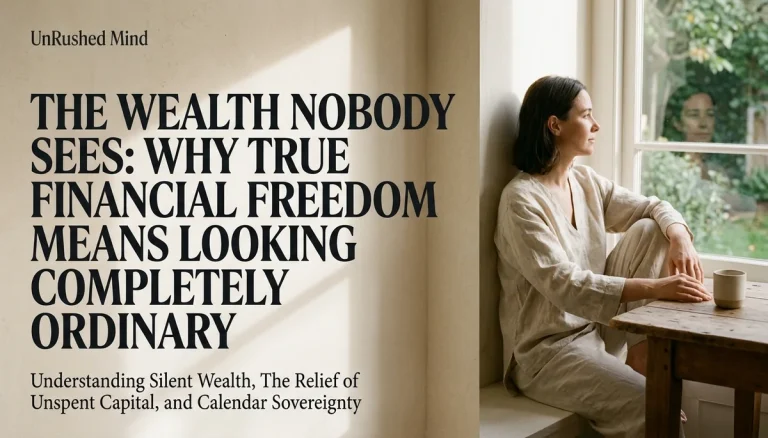
There is a quiet, disorienting panic that often arrives in the wake of a promotion or a substantial raise. You finally cross the financial threshold you spent years striving toward, yet your bank account remains strangely barren as the month draws to a close. Your working hours grow longer, the executive pressures multiply, and an […]
There is a quiet, disorienting panic that often arrives in the wake of a promotion or a substantial raise.
You finally cross the financial threshold you spent years striving toward, yet your bank account remains strangely barren as the month draws to a close.
Your working hours grow longer, the executive pressures multiply, and an unsettling truth begins to surface: earning more has not made you feel wealthy.
Instead, you find yourself tethered to a demanding desk simply to service an upgraded lifestyle you rarely have the time or energy to savor.
This silent, gilded prison is the hallmark of lifestyle creep, powered by the relentless psychological machinery of the hedonic treadmill.
Breaking free from these golden handcuffs does not demand joyless austerity, but rather an intentional return to what truly matters: Peace Capital.
Quick Sanctuary Takeaway: Lifestyle creep occurs when discretionary spending unconsciously expands to absorb rising income, driven by hedonic adaptation. Rather than providing security, unchecked lifestyle inflation locks high earners into “golden handcuffs”—a trap where swollen overhead eliminates personal sovereignty, forcing endless work to sustain an exhausting baseline.
The Hedonic Treadmill: How Luxuries Silently Become Mandatory Necessities
To understand why a higher salary often feels like a trap, we must examine our innate adaptation machinery.
Psychologists call this the hedonic treadmill: our tendency to quickly normalize positive upgrades back to a neutral baseline.
At first, each lifestyle upgrade feels like a well-deserved reward for your relentless sacrifices.
You trade public transit for private rides, upgrade your apartment, and dine out without checking the total.
Yet within a handful of weeks, the initial thrill evaporates into ordinary routine.
Your nervous system recalibrates around the new standard, quietly recategorizing optional delights into mandatory requirements for daily comfort.
What began as an occasional luxury soon calcifies into an immovable, recurring overhead.
Because spending rises in lockstep with earnings, your margin for pause or experimentation vanishes entirely.
You find yourself unable to take a sabbatical, pivot to meaningful slow work, or leave a hostile workplace.

The Anatomy of Golden Handcuffs: Status Fatigue vs. Peace Capital
The most dangerous cost of unchecked lifestyle inflation is not the depleted savings account, but the loss of sovereignty.
When your recurring commitments expand to swallow your peak earning power, you have locked the golden handcuffs around your wrists.
Your possessions cease to serve your joy; instead, you become an indentured servant to the mortgage, the lease, and the curated wardrobe.
The perpetual effort to project effortless success breeds a quiet condition known as status fatigue.
This dynamic mirrors the deeper psychology of status anxiety, where outward success becomes an endless comparison treadmill.
True financial well-being, however, is completely invisible to the outside world.
It is measured by Peace Capital—the sovereign, unhurried gap between what you earn and what you genuinely require to thrive.
A professional with modest earnings who lives contentedly below their means commands enormous autonomy and the power to say ‘No.’
Conversely, a top earner whose overhead consumes every dollar lives on the knife’s edge of chronic dread and trapped time.
| Life Dimension | The Lifestyle Creep Trap | The Slow Wealth Sanctuary |
|---|---|---|
| Income Allocation | Expands to match raises; zero margin for pause. | Capped at an intentional baseline; surplus buys back time. |
| Workplace Agency | Chained to demanding roles; terrified of declining burnout. | Unshakable independence; absolute freedom to walk away. |
| Possessions | Acquired to signal status and numb work-induced fatigue. | Curated with care; prioritizing stillness over display. |
| Nervous System | Chronic vigilance masked by luxury comforts and conveniences. | Deep, grounded tranquility rooted in unburdened sufficiency. |

Reclaiming Sovereignty: 4 Grounded Shifts to Break the Cycle
Escaping the golden handcuffs requires untangling the confusion between high consumption and genuine well-being.
Here are four intentional practices to dismantle the trap and reclaim your financial peace:
1. Cap Your Lifestyle Ceiling
Decide consciously upon a comfortable standard of living and declare it complete.
When bonuses or raises arrive, bank the vast majority into buying back future freedom rather than inflating present overhead.
2. Audit Compensatory Spending
Observe how often high-ticket purchases occur immediately after exhausting workweeks.
Many luxury splurges are merely attempts to soothe an overworked nervous system.
When you permit yourself genuine rest, the impulse to purchase synthetic comfort dissolves naturally.
3. Measure Price in Life Energy
Before taking on a recurring commitment, translate its cost into the hours of life required to earn it.
Ask yourself honestly whether a larger vehicle is worth forty hours of corporate tension every single month.
When priced in irreplaceable heartbeats, most status symbols lose their shine instantly.
4. Cultivate Invisible Wealth
Shift your admiration away from visible displays toward the quiet luxury of an unhurried existence.
Real prosperity is an unburdened calendar, slow mornings, and the sovereignty to chart your own course.
This philosophy reflects the art of quiet wealth—an unadvertised peace that protects your inner sanctuary.
Frequently Asked Questions