Have you ever faced a sudden failure or painful mistake that made your entire world feel like it was collapsing? Perhaps a difficult confrontation erupted, an important project fell apart, or you said something you instantly regretted. In those raw moments, the mind rarely offers gentle comfort. Instead, a ferocious inner voice rises to attack […]
Have you ever faced a sudden failure or painful mistake that made your entire world feel like it was collapsing?
Perhaps a difficult confrontation erupted, an important project fell apart, or you said something you instantly regretted.
In those raw moments, the mind rarely offers gentle comfort.
Instead, a ferocious inner voice rises to attack you while you are already down.
It whispers that you are fundamentally broken, that everyone else manages life with ease, and that you alone are flawed.
We subject ourselves to cruel internal criticism that we would never dream of directing at a hurting friend.
Yet punishing yourself has never healed a single wound.
True resilience does not emerge from savage self-criticism; it blossoms when you learn to become your own safest refuge.
The Biology of Self-Blame: Why the Inner Critic Paralyzes Us
When personal failure strikes, our nervous system instinctively hungers for safety.
Yet when we respond with harsh judgment, our brain misinterprets our own thoughts as an acute biological threat.
Clinical neurobiology confirms that harsh self-criticism triggers the body’s fight-or-flight response.
Your amygdala sounds the alarm, flooding your bloodstream with cortisol and adrenaline.
Because the attacker and the victim reside within the same skull, there is nowhere to flee.
Your chest constricts, your shoulders tense, and cognitive clarity dissolves into panic.
This internal warfare drains vital energy, leaving you trapped in shame.
To unlock your nervous system from this freeze, you do not need harsher discipline.
You need a somatic signal of safety.

The Three Sacred Steps of Dr. Kristin Neff’s Practice
Pioneering psychologist Dr. Kristin Neff discovered that self-compassion consists of three interconnected, scientifically proven pillars.
The self-compassion break is a simple three-minute ritual designed to de-escalate emotional turmoil wherever you are.
Whenever acute distress threatens your peace, step into a quiet space and move through these three stages.
1. Mindfulness: Naming the Ache Without Drama
The first step is simply noticing what is happening without fleeing or exaggerating the pain.
Instead of spiraling into catastrophic thoughts, focus on the raw physical sensation of your sorrow.
Take a slow breath and say silently with honesty: “This is a moment of suffering.”
You can also use words authentic to your heart, such as “This hurts,” or “I am carrying heavy stress right now.”
Naming your emotional reality engages the prefrontal cortex, quieting the alarm in your amygdala.
2. Common Humanity: Dissolving the Illusion of Isolation
When we fail, shame tricks us into believing that we are the only defective person alive.
This perceived isolation magnifies our suffering tenfold.
The second step shatters this illusion by reminding your spirit: “Suffering is a shared human experience.”
Whisper to yourself: “Imperfection and difficulty are woven into every human life; I am not alone in this struggle.”
Recognizing that struggle connects all humanity transforms inadequacy into universal belonging.
3. Self-Kindness: Activating Oxytocin Through Soothing Touch
The final step is actively offering yourself the tender warmth you would give to a beloved friend.
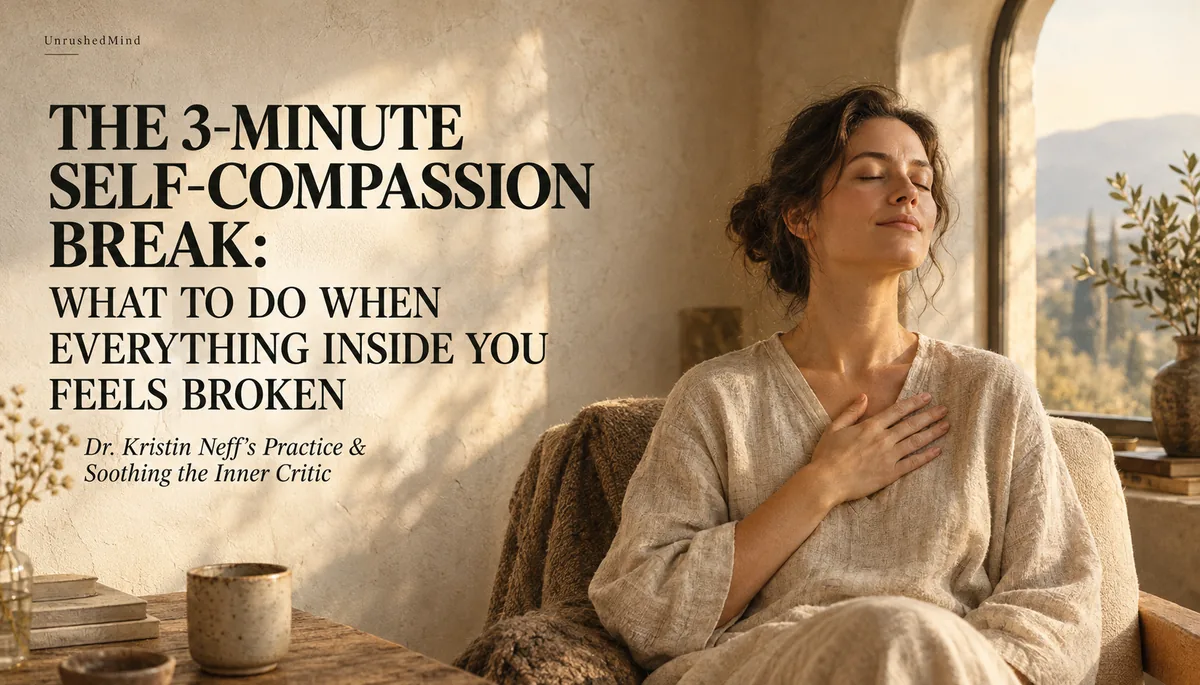
Place one or both palms gently over your chest, feeling the reassuring warmth of your hands and your rhythmic breathing.
Physical touch releases oxytocin, lowering your heart rate and easing somatic cortisol.
As you feel this gentle warmth, speak inward: “May I be kind to myself in this moment. May I give myself the compassion I truly need.”
Allow this soothing touch to wrap around your heart like a warm blanket on a cold night.
| The Inner Critic | Emotional Over-Identification | The 3-Minute Self-Compassion Break |
|---|---|---|
| Cruel Self-Punishment | Attacking oneself with shame, harsh blame, and guilt. | Embracing the hurting self with patience and gentle reassurance. |
| Phantom Isolation | Believing you alone are hopelessly broken or unworthy. | Remembering that suffering and mistakes are universal human experiences. |
| Somatic Contraction | Freezing the nervous system in defensive paralysis. | Calming the vagus nerve and releasing soothing oxytocin through touch. |

How to Weave the Practice into Your Daily Routine
You do not need an hour of silent meditation to reclaim your inner peace.
Whenever an unsettling email arrives, a conversation stings, or tears well in your eyes, take three unhurried minutes.
Step into a quiet room, sit in your parked car, or simply close your eyes at your desk.
Inhale slowly, feel your feet planted firmly upon the floor, and honor your distress with patience.
You will discover that you do not have to be flawless to deserve your own unconditional love.
Frequently Asked Questions About the Self-Compassion Break