We live in a world that has declared an aggressive war on shadows. From dawn until night, our eyes are flooded with harsh blue light and restless digital clarity. Every question is met with an algorithmic answer, leaving little room for quiet contemplation. Yet beneath this relentless illumination, many of us feel an unspoken, hollow […]
We live in a world that has declared an aggressive war on shadows.
From dawn until night, our eyes are flooded with harsh blue light and restless digital clarity.
Every question is met with an algorithmic answer, leaving little room for quiet contemplation.
Yet beneath this relentless illumination, many of us feel an unspoken, hollow fatigue.
When everything is thoroughly exposed, the human spirit is quietly robbed of wonder.
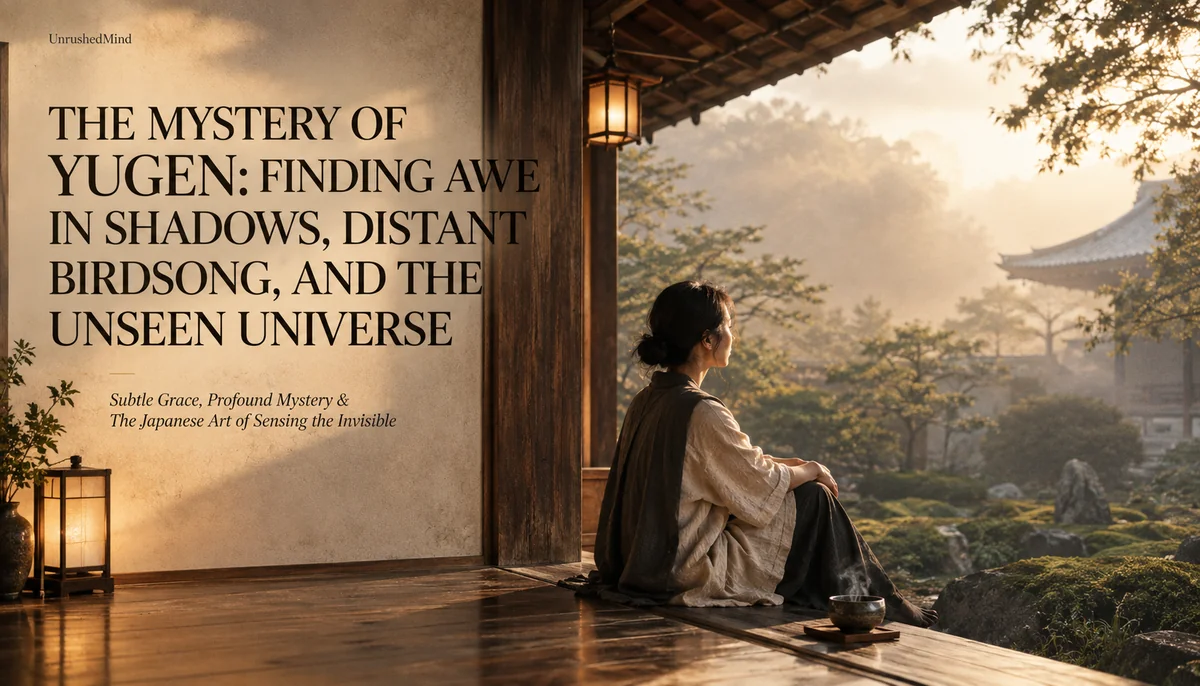
The Japanese concept of yūgen (幽玄) refers to a profound, mysterious sense of the beauty of the universe that cannot be fully expressed in words or perceived directly by the senses. Rather than superficial clarity, yūgen evokes subtle grace through suggestion, veiled shadows, and the quiet awe of the unseen.
Centuries ago, classical Japanese masters recognized that life’s deepest truths do not demand bright spotlights.
Instead, they reveal themselves only when we soften our gaze and honor what remains concealed.
The Overlit Modern Mind: Why Total Clarity Starves the Soul
Our culture equates total visibility with wisdom and progress.
We want every mystery explained, every feeling categorized, and every future outcome guaranteed.
Yet when our senses are bombarded with excessive visual data, our neural pathways enter chronic hyperarousal.
When nothing is left to the imagination, the brain retreats into flat emotional numbness.
Awe requires an encounter with vastness that our rational minds cannot immediately master.
When you strip away mystery, you do not gain peace; you simply inherit mental exhaustion.
We forget that our souls were born to marvel at the unknown, not merely manage feeds and spreadsheets.
In Praise of Shadows: What Japanese Masters Knew About the Invisible
In traditional Japanese architecture, rooms were never built to banish the evening gloom.
Instead, artisans celebrated shadows as an indispensable canvas for living beauty.
Writing in his classic 1933 essay In Praise of Shadows, Jun’ichirō Tanizaki noted that gold lacquerware only glimmers when kept within dim, tea-tinted rooms.
Placed under harsh fluorescent bulbs, its delicate soul evaporates into cheap artificial gloss.
True beauty resides not in the object itself, but in the subtle interplay of shadow and light.
The 14th-century Noh master Zeami Motokiyo described yūgen through poetic vignettes that defy literal analysis.
He spoke of watching a wild goose vanish behind rain clouds, or following a ship sailing behind a distant island.
In those fleeting moments, the mind touches something infinitely greater than what physical eyes behold.
The bird has disappeared, yet the vast sky remains charged with its lingering flight.

The Architecture of Perception: Overexposure vs. The Subtle Grace of Yūgen
To understand how modern life dulls our awareness, we must examine the contrast between forced exposure and contemplative restraint.
The table below contrasts our hurried impulses with the restorative aesthetic of yūgen:
| The Overlit Modern World | The Spiritual Fatigue of Exposure | The Subtle Grace of Yūgen |
|---|---|---|
| High-definition screens, harsh ceiling bulbs, and constant alerts | Chronic sensory overload and diminished capacity for quiet awe | Amber lantern light, paper screens, and deep, restful shadows |
| The urge to photograph, explain, and monetize every passing moment | The death of intimacy; turning your private sanctuary into a public showroom | Holding sacred experiences quietly in your heart without publishing them |
| Demanding immediate answers and absolute certainty in all matters | Persistent anxiety when facing life’s inevitable ambiguities | Finding profound peace in what remains unsaid, half-glimpsed, and mysterious |
Notice that yūgen does not ask us to fear the dark.
Rather, it gently reminds us that what is partially veiled possesses a healing depth that bright lights can never manufacture.
Four Daily Practices to Reclaim the Sanctuary of Mystery
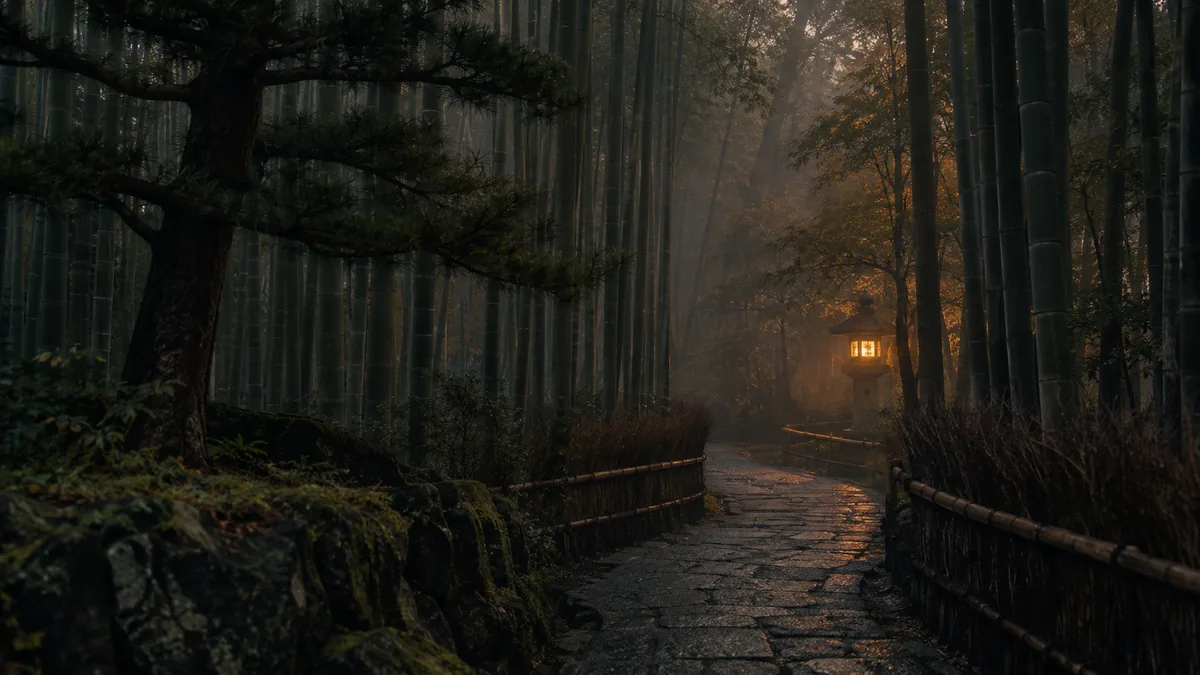
You do not need to move to a Kyoto temple to invite the grace of yūgen into your daily rhythm.
You only need to soften your insistence on full exposure and make peace with the unseen.
1. Dim Your Evening Horizon
An hour before bedtime, turn off overhead lighting.
Rely on a single warm candle or a low-wattage floor lamp, allowing restful shadows to gather in the room.
2. Listen for the Distant Echo
When stepping outside, close your eyes for thirty seconds.
Listen deliberately for the furthest sound you can detect—a distant train horn or wind through pine boughs.
3. Keep One Sacred Moment to Yourself
When you witness a breathtaking sunset or share a tender conversation, resist taking a photo.
Carry that moment quietly inside your chest like an untamed jewel.
4. Gaze at the Cloud-Covered Moon
The poet Yoshida Kenkō wrote that we should not revere the moon only in a cloudless sky.
A moon veiled by autumn mist evokes a far deeper longing than a glaring, fully revealed orb.
Grounding Sanctuary Note: You Are Allowed to Remain a Mystery
Society constantly demands that you explain yourself, build an online persona, and justify your worth.
Yet your soul was never meant to be fully transparent or commercially consumed.
You are entitled to your private depths, your quiet silences, and your uncataloged dreams.
When the world feels blindingly bright, step back into the cool sanctuary of the shadows.
There, in the quiet space between what is seen and what is felt, true peace awaits you.
Frequently Asked Questions