It is eleven at night, and your body aches with heavy exhaustion. Yet the moment your head touches the pillow, your pulse quickens and your mind races. You find yourself trapped in that painful modern paradox: thoroughly exhausted, yet chemically wired. We often blame demanding careers for our inability to rest. Yet the true disruptor […]
It is eleven at night, and your body aches with heavy exhaustion.
Yet the moment your head touches the pillow, your pulse quickens and your mind races.
You find yourself trapped in that painful modern paradox: thoroughly exhausted, yet chemically wired.
We often blame demanding careers for our inability to rest.
Yet the true disruptor is often hanging silently from our ceilings.
For thousands of generations, sunset signaled biological sanctuary.
Today, our rooms are flooded with 5000K LEDs that convince ancient cells that noon never departed.
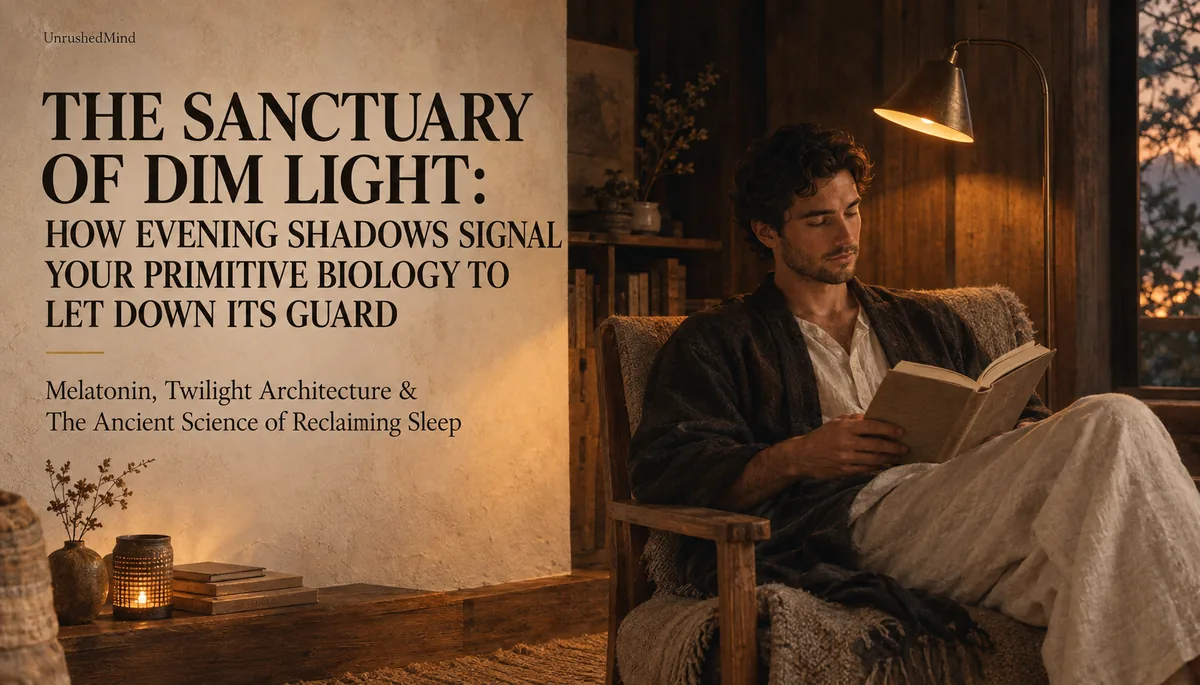
Dimming evening lights below ten lux signals primitive photoreceptors in the human retina that twilight has arrived.
This darkness triggers the pineal gland to synthesize melatonin, cooling core temperature and down-regulating the sympathetic nervous system from vigilance into deep restorative sleep.
The Biological Deception: The Overlit Modern Dusk
Your primitive biology does not understand modern working hours.
It understands only two primal states: the alertness of the hunt, and the safe darkness of shelter.
When you switch on bright overhead bulbs after dusk, you create a profound biological deception.
The body registers this downward glare as high noon on an open plain.
In response, your adrenal glands secrete cortisol, keeping survival antennae raised.
You feel tired because cellular energy is spent, but your brain refuses to sleep under an artificial midday sky.
True rest cannot be forced through willpower.
It must be invited through the ancient language of shadows.
The Ancient Retina: Why ipRGCs Cannot Distinguish LEDs from Midday Sun
Deep inside your eyes sits a specialized network of cells: intrinsically photosensitive retinal ganglion cells, or ipRGCs.
Unlike rods and cones, ipRGCs do not process visual shapes or letters.
Instead, they function as biological irradiance meters, detecting blue wavelengths between 460 and 480 nanometers.
These cells connect directly to the master circadian clock in your hypothalamus.
When cool artificial light strikes these receptors at night, the master clock halts melatonin production.
The pineal gland ceases synthesis, keeping core body temperature elevated.
By keeping homes brightly lit until midnight, we blindfold our body’s internal chronometer.
We deny our biology the twilight transition it needs to gently lay down its armor.
The Two Evenings: A Comparative Look at Circadian Alignment
| Dimension | The Overlit Modern Evening | The Sanctuary of Dim Light |
|---|---|---|
| Lighting Environment | Overhead 5000K LEDs (100–300 Lux). | Low-lux amber lamps, candlelight (< 10 Lux). |
| Endocrine State | Melatonin blocked, sustained cortisol. | Melatonin surge, core cooling. |
| Nervous System Tone | Vigilance, shallow breathing (“tired but wired”). | Vagal activation, parasympathetic calm. |
Twilight Architecture: 4 Gentle Micro-Shifts to Welcome Shadows
Reclaiming your evening rest does not require living in total isolation.
It simply requires creating an intentional architecture of twilight within your home.
1. The Floor-Level Horizon Shift
Notice where the sun sits at dusk: it hovers low against the horizon before disappearing.
Our ancestors never encountered harsh illumination pouring from above after dark.
At eight in the evening, turn off overhead ceiling fixtures.
Switch to table lamps or low lights placed near the floorboards to protect the sensitive lower retina.
2. Bathe Your Sanctuary in Warm Amber (2200K–2700K)
Light is biological information.
Replace cool white bulbs in your evening spaces with warm amber fixtures rated at 2200K to 2700K.
Warm amber hues mimic glowing embers that sheltered humans for millennia.
To your ancient biology, amber light carries an unmistakable reassurance: the day is done, and it is safe to sleep.
3. The Digital Horizon Curfew
The glow of a handheld screen delivers high-intensity photons directly into your circadian core.
Give yourself the gift of a digital horizon thirty minutes before bed.
Place your phone across the room and let a physical book or quiet reflection close your day.
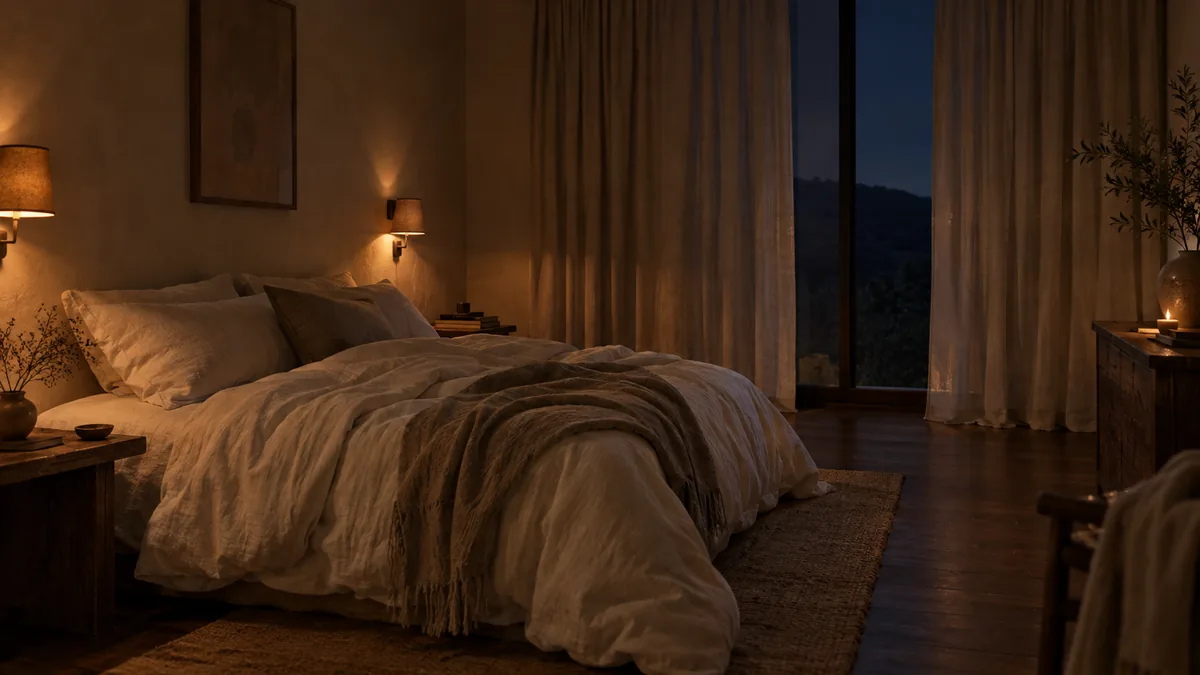
4. Welcoming the Velvet of the Room
Modern culture often views stillness as unproductive.
Yet darkness is the fertile soil where biological repair takes root.
As you prepare for sleep, draw your curtains and allow your eyes to adapt to soft shadows.
In the gentle velvet of an unhurried room, your nervous system finally realizes it has nothing left to guard against.
Listening to the Body: A Grounding Sanctuary Note
Honoring circadian darkness is a foundational biological rhythm, but it is not a clinical cure.
If you struggle with chronic insomnia, treat yourself with compassionate care.
Seek guidance from a qualified physician or sleep specialist to evaluate underlying hormonal health.
Creating a sanctuary of dim light is not a rigid chore, but a gentle daily offering of peace to your body.
Frequently Asked Questions