





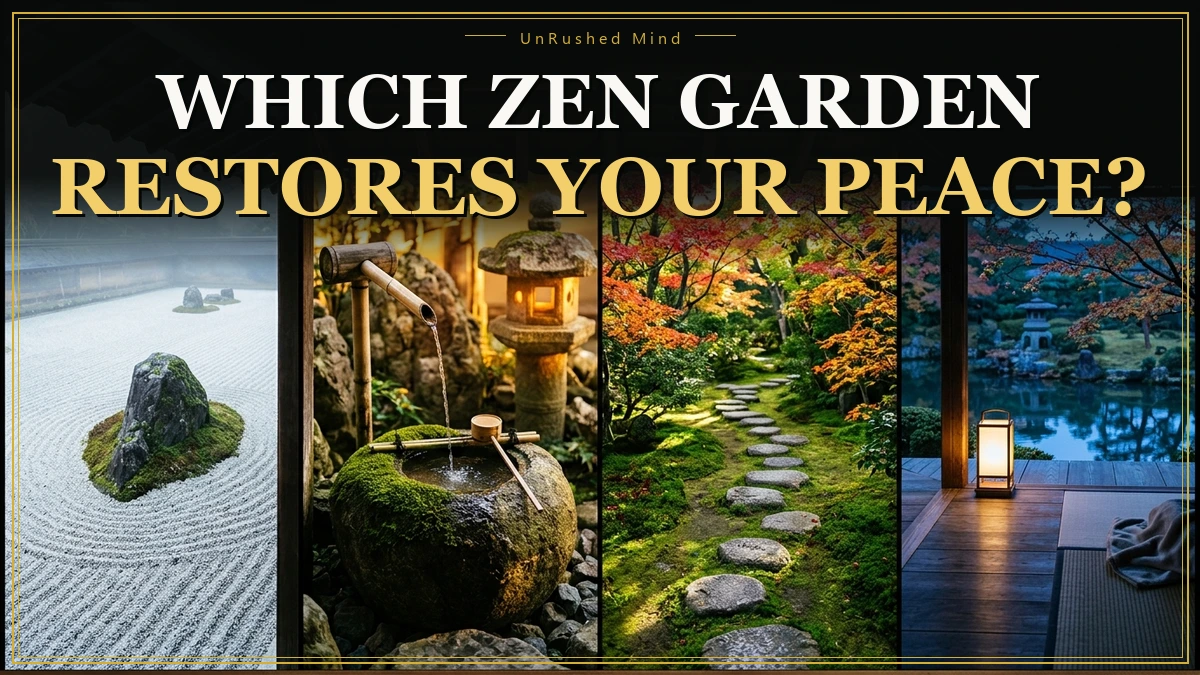
Select 1 of 4 tranquil Kyoto Zen garden corners—from raked Karesansui gravel to a twilight cedar Engawa—to uncover what your overstimulated mind needs most right now.
Step away from the urgency of the clock: Take one slow, grounding breath. If you could step into one of these four quiet Kyoto Zen garden corners right now, where would your eyes and body choose to rest?
Choose one of the four contemplative Japanese spaces in the interactive tool below to decode your current mental load and receive your personalized spatial and psychological restoration ritual.
This self-assessment is designed for educational and personal reflection purposes regarding mental restoration, burnout symptoms, and stress levels. It does not replace professional clinical diagnosis, psychiatric care, or licensed medical therapy.
The Environmental Neuroscience of Contemplative Japanese Spaces
In environmental psychology and neuro-architecture, the landscapes we are drawn to reflect the specific cognitive deficit our brain is attempting to heal. According to Stephen and Rachel Kaplan’s Attention Restoration Theory (ART), modern urban and digital environments exhaust our directed voluntary attention, leaving the prefrontal cortex irritable and fatigued.
Classical Kyoto temple gardens were engineered over centuries as neuro-restorative instruments. Through the deliberate orchestration of negative space (Ma), organic weathered textures (Wabi-Sabi), acoustic water intervals (Tsukubai), and sheltered viewing verandas (Engawa), these spaces engage effortless ‘soft fascination’—quieting amygdala reactivity and restoring inner equilibrium.
Architectural Profile Decodings & Restoration Guidance
Every intuitive choice or score threshold mirrors an underlying autonomic state. Below are the comprehensive psychological and neurobiological decodings for each result profile:
🪨 [Corner No. 1]: Karesansui Dry Rock Garden — Cognitive Crowding & The Need for Sacred Space (Ma)
✦ Autonomic State: Your immediate attraction to the austere stillness of raked white gravel and a solitary mossy stone reveals a clear cognitive signal: Your mind is suffering from Information Crowding and is starving for Ma (間)—Sacred Negative Space.Every margin of your calendar and mental bandwidth has been filled with inputs, opinions, and obligations. Even your moments of leisure have become crowded with background media and mental checklists.Neuroimaging studies at Kyoto University show that viewing Karesansui dry landscape gardens calms the visual cortex by removing chaotic clutter, allowing the brain’s Default Mode Network to settle into spacious, unhurried clarity.
✦ Gentle Micro-action: 1. Clear One Physical Surface: Completely clear your desk or bedside table today, leaving only one meaningful object and open space.2. Unscheduled Margin: Protect a 30-minute block between your workday and evening where zero inputs (no podcasts, no news, no chores) are allowed.3. Visual Stillness: Spend 5 minutes gazing at open sky or uncluttered space to let your overstimulated optic nerve rest.
🌿 Read Mindful Guide: The Japanese Art of Ma & Creating Room to Breathe ➔
🎍 [Corner No. 2]: The Bamboo Tsukubai Basin — Hurry Sickness & The Need for Rhythmic Pacing
✦ Autonomic State: Being drawn to the clear trickle of a bamboo Tsukubai water basin reflects an urgent message from your nervous system: You have been trapped in Chronos Urgency (Hurry Sickness)—moving through your days as if life were an emergency to be finished.In traditional Kyoto tea gardens, guests crouch slightly at the Tsukubai stone basin to rinse their hands and mouth before entering the tea room. It is a physical threshold designed to slow the heartbeat and wash away the dust of worldly haste.Your psyche is asking to step off the conveyor belt of artificial deadlines and return to a natural, drop-by-drop cadence.
✦ Gentle Micro-action: 1. The Single-Speed Ritual: Choose one daily activity—walking to get water, washing your hands, or brewing tea—and perform it at half your normal speed.2. Auditory Water Reset: Listen to natural running water or gentle rain for 10 minutes to entrain your heart rate variability (HRV).3. Release Artificial Urgency: When you feel your chest tighten with haste today, ask yourself: ‘Is anything actually on fire right now?’
🌿 Read Your Solution: Unhooking Your Nervous System from Hurry Sickness ➔
🌿 [Corner No. 3]: Velvet Moss Stepping Path — Perfectionist Strain & The Healing Grace of Wabi-Sabi
✦ Autonomic State: Your instinctive pull toward velvety green moss carpeting weathered stepping stones beneath autumn maples reveals a tender inner burden: You have been carrying Perfectionist Self-Criticism and need the forgiving grace of Wabi-Sabi (侘寂).You hold yourself to relentless standards, often feeling that you are falling behind or that your efforts are never quite polished enough. This rigid internal pressure tightens your body and steals your joy.Moss cannot be forced to grow on a schedule; it thrives only in quiet shade, moisture, and patience, softening the sharp edges of stone. Your spirit is craving permission to be unfinished, organic, and gently imperfect.
✦ Gentle Micro-action: 1. Embrace the Unfinished: Leave one minor task imperfectly done today and consciously practice speaking to yourself with warmth instead of critique.2. Fractal Nature Immersion: Walk slowly beneath living trees for 20 minutes; natural botanical fractals reduce sympathetic stress by up to 60%.3. Drop the Timeline: Remind yourself that slow, subterranean growth is still sacred growth.
🌿 Read Mindful Guide: Wabi-Sabi & Finding Peace in an Unfinished Life ➔
🏮 [Corner No. 4]: Twilight Cedar Engawa Veranda — Social Depletion & Sheltered Contemplation
✦ Autonomic State: Choosing the warm lantern-lit cedar Engawa veranda overlooking a still twilight pond signals a profound psychological need: You are experiencing Social & Relational Overexposure and require a sheltered boundary of solitude.In Japanese architecture, the Engawa is a liminal wooden porch—neither fully locked indoors nor completely exposed to the outside world. It is a safe vantage point where you can observe the beauty of life without being demanded to participate in its noise.Your nervous system does not want isolation; it simply wants a peaceful threshold where nobody needs anything from you for a little while.
✦ Gentle Micro-action: 1. The Twilight Threshold: Sit near a window or porch for 15 minutes at dusk with a warm drink, watching the light change without checking your phone.2. Quiet Social Recovery: Give yourself permission to decline non-essential social gatherings this weekend to recharge your internal battery.3. Soft Lantern Lighting: Turn off harsh overhead ceiling lights after 20:00 and use a single low, warm lamp to signal safety to your nervous system.
🌿 Read Mindful Guide: Kyoto in Stillness & Ancient Zen Temple Wisdom ➔
📚 Academic Sources & Clinical Citations: Attention Restoration Theory (Prof. Stephen & Rachel Kaplan, University of Michigan), Visual Neuroscience of Karesansui Zen Gardens (Dr. Gert van Tonder & Dr. Michael Lyons, Kyoto University), and Physiological Effects of Shinrin-Yoku Landscapes (Dr. Yoshifumi Miyazaki, Chiba University).
🌿 Mindful Reflection Notice: This self-assessment is designed solely for educational, self-inquiry, and personal reflection purposes. It does not constitute medical, psychiatric, or clinical psychological advice, diagnosis, or treatment. If you are experiencing acute emotional distress, severe burnout, or chronic physical symptoms, please consult a qualified healthcare professional.