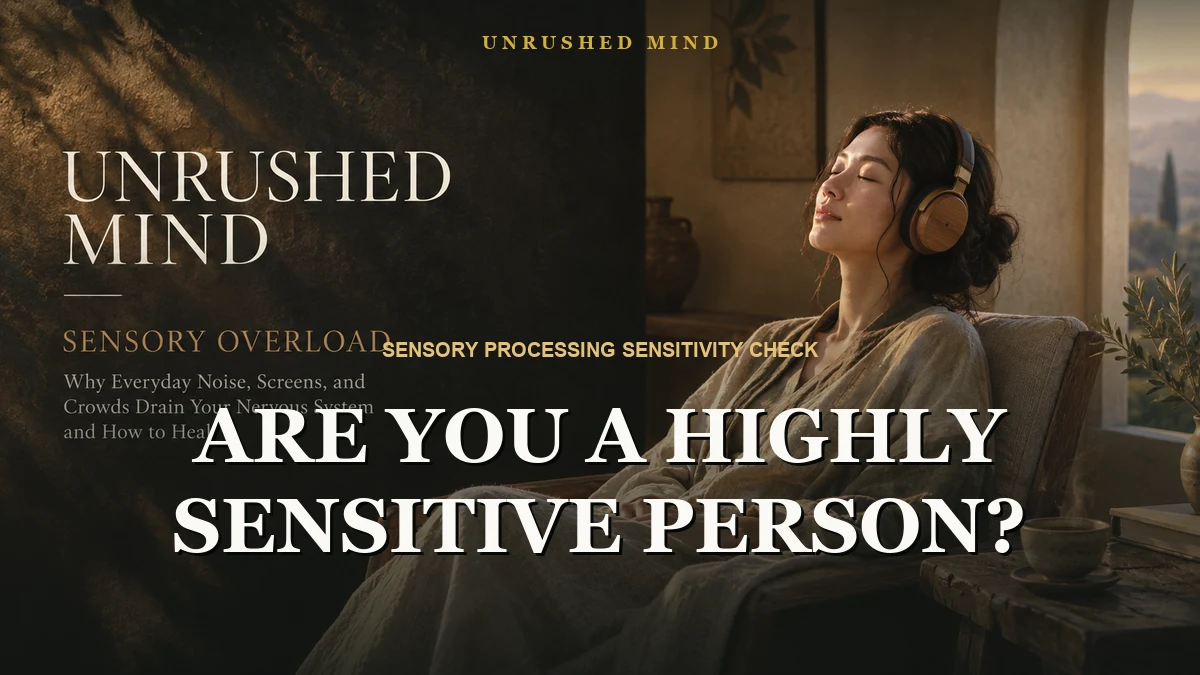
Do crowded rooms, loud noises, or subtle shifts in mood overwhelm you? Take this 10-question reflection to discover your innate sensory processing depth.
For much of modern history, individuals who feel deeply, notice subtle environmental shifts, and exhaust quickly in chaotic spaces have been told they are “too fragile,” “overly dramatic,” or “thin-skinned.” Yet neuroimaging and evolutionary biology prove that this trait is not a psychological defect—it is an innate biological survival strategy known as Sensory Processing Sensitivity (SPS).
Take this gentle 10-question reflective assessment, inspired by the pioneering clinical research of Dr. Elaine Aron, to uncover your sensory processing profile and learn how to honor your nervous system’s profound depth.
This self-assessment is designed for educational and personal reflection purposes regarding mental restoration, burnout symptoms, and stress levels. It does not replace professional clinical diagnosis, psychiatric care, or licensed medical therapy.
The Neurobiology of Sensitivity: What Sensory Processing Sensitivity Truly Is
Identified by psychologists Dr. Elaine N. Aron and Dr. Arthur Aron in 1997, Sensory Processing Sensitivity (SPS) is an innate behavioral trait found in approximately 15% to 20% of human populations and across over 100 non-human species. It does not represent a disorder or pathological condition; rather, it reflects a central nervous system designed to process sensory, emotional, and contextual information with greater neurological depth.
Functional MRI (fMRI) studies led by Dr. Bianca Acevedo reveal that when highly sensitive individuals observe subtle human faces or environmental cues, they demonstrate significantly greater activation in the insular cortex (the brain’s seat of interoceptive awareness and emotional integration) and the mirror neuron system. You literally register other people’s micro-expressions, pain, and joy with visceral somatic resonance.
The DOES Framework: The Four Pillars of the HSP Experience
Dr. Elaine Aron formalizes the authentic HSP trait through the foundational acronym DOES:
- Depth of Processing (D): Highly sensitive people do not simply perceive stimuli; their brains engage in prolonged cognitive analysis, drawing intricate associations between present experiences, historical memories, and future consequences.
- Overstimulation (O): Because the sensory intake filter is more permeable, intense environments—bright lights, persistent hums, conflicting emotional demands—fill the cognitive buffer rapidly, triggering autonomic overload.
- Emotional Reactivity & Empathy (E): Sensitive individuals experience higher positive and negative affect. A sublime string concerto can bring tears of transcendence; witnessing cruelty can cause physical ache.
- Sensing the Subtle (S): An exquisite eye for details that others overlook: the faint odor of rain before it falls, the subtle tension in a spouse’s jawline, or the subtle beauty of morning light upon aged linen.
Sensory Processing Sensitivity vs. Sensory Overload Comparison
| Dimension | Standard Sensory Processing | Highly Sensitive Person (HSP) | Sensory Saturation / Overload |
|---|---|---|---|
| Environmental Filtering | Filters out background hums & flicker effortlessly | Notices subtle background inputs continuously | Sensory inputs feel painful, chaotic, and intrusive |
| Social Energy Curve | Gradual, predictable fatigue after gatherings | Deep connection enjoyed; requires quiet post-gathering | Sudden emotional withdrawal and autonomic freeze |
| Empathic Resonance | Cognitive empathy (understands others’ feelings) | Somatic empathy (feels others’ emotional tone in the body) | Emotional flooding & loss of personal boundaries |
| Restoration Requirement | Casual relaxation, entertainment, or light social rest | Deliberate low-stimulation solitude in dim lighting | Complete sensory deprivation and somatic grounding |
Building Protective Boundaries for the Permeable Mind
Living as a sensitive individual in an aggressive, high-decibel culture requires deliberate defensive architecture. Sensitivity is only exhausting when it lacks structure:
- The Sensory Buffer Zone: Never rush from high-stimulation spaces directly into high-focus work. Schedule 15-minute sensory airlocks—moments of quiet stillness, warm tea, or closed eyes to allow the insula to downshift.
- Physical Protective Tools: High-fidelity earplugs, soft natural linen clothing, and warm 2700K low-lux home illumination communicate safety directly to your amygdala.
- The Grace of Saying No: Declining invitations is not selfish; it is biological stewardship. Honoring your limit preserves the depth and compassion you offer to the few things that matter.
Academic Sources & Clinical Citations
- Aron, E. N., & Aron, A. (1997). Sensory-processing sensitivity and its relation to introversion and emotionality. Journal of Personality and Social Psychology, 73(2), 345–368.
- Acevedo, B. P., et al. (2014). The highly sensitive brain: an fMRI study of sensory processing sensitivity and response to others’ emotions. Brain and Behavior, 4(4), 580–594.
- Jagiellowicz, J., et al. (2011). The trait of sensory processing sensitivity and neural responses to changes in visual scenes. Social Cognitive and Affective Neuroscience, 6(1), 38–47.
Mindful Reflection Notice
This reflective exploration is created for self-inquiry and educational purposes. It is an original work inspired by scientific frameworks in Sensory Processing Sensitivity and environmental psychology, and is not a clinical psychiatric diagnosis. If you are experiencing debilitating anxiety or sensory distress, please consult a qualified healthcare or mental health professional.
Architectural Profile Decodings & Restoration Guidance
Every intuitive choice or score threshold mirrors an underlying autonomic state. Below are the comprehensive psychological and neurobiological decodings for each result profile:
🌿 The Grounded Sensor — Resilient Sensory Insulation
✦ Autonomic State: Your nervous system possesses robust biological filters. You experience emotional empathy and notice sensory beauty, but your internal equilibrium is shielded by natural resilience against environmental overstimulation. You thrive in vibrant social spaces without accumulating heavy cognitive debt.
✦ Gentle Micro-action: Preserve your healthy autonomic boundaries while cultivating patience for friends, partners, or colleagues whose sensory systems process the world with greater permeability.
🌸 The High-Empathy Sensor — Classic Highly Sensitive Person (HSP)
✦ Autonomic State: Your nervous system reflects the innate biological trait of Sensory Processing Sensitivity (SPS), shared by approximately 20% of the population. You perceive subtleties, emotional micro-expressions, and aesthetic nuances that others overlook. However, when environments become chaotic or demands become relentless, your system reaches sensory saturation quickly.
✦ Gentle Micro-action: Your sensitivity is an evolutionary gift of depth and intuition, not a flaw to overcome. Protect your bandwidth by mastering protective boundaries and scheduling non-negotiable daily quiet intervals.
🌿 Read Your Guide: The Grace of Saying No — Protective Boundaries ➔
🌊 The Porous Sensor — Deep Environmental & Emotional Porosity
✦ Autonomic State: You walk through the world with an exceptionally fine, permeable nervous system. You feel everything with visceral intensity — absorbing the unexpressed grief of strangers, vibrating with the pulse of loud rooms, and experiencing art with transcendent awe. Without sacred boundaries, this gift quickly transforms into chronic sensory exhaustion and hypervigilant fatigue.
✦ Gentle Micro-action: You must treat your nervous system as a delicate biological instrument. Build a daily low-stimulation sanctuary: dim amber 2700K lighting, noise-softening rituals, warm baths, and permission to unplug from the world without guilt.
🌿 Read Deep Dive: High-Functioning Anxiety & Masked Sensory Exhaustion ➔
📚 Academic & Clinical Foundation: Inspired by Sensory Processing Sensitivity research (Aron & Aron, 1997; Jagiellowicz et al., 2011)
🌿 Mindful Reflection Notice: This self-assessment is designed solely for educational, self-inquiry, and personal reflection purposes. It does not constitute medical, psychiatric, or clinical psychological advice, diagnosis, or treatment. If you are experiencing acute emotional distress, severe burnout, or chronic physical symptoms, please consult a qualified healthcare professional.