The 30-Second Stillness (Quick Answer): Morning sunlight exposure directly calibrates your circadian neurochemistry through specialized retinal sensors called ipRGCs wired directly to the master circadian clock (SCN). Just ten minutes of natural outdoor photons suppresses residual morning melatonin, sparks a clean Cortisol Awakening Response for natural alertness, and synchronizes an internal 14-to-16-hour biological timer that […]
The 30-Second Stillness (Quick Answer): Morning sunlight exposure directly calibrates your circadian neurochemistry through specialized retinal sensors called ipRGCs wired directly to the master circadian clock (SCN). Just ten minutes of natural outdoor photons suppresses residual morning melatonin, sparks a clean Cortisol Awakening Response for natural alertness, and synchronizes an internal 14-to-16-hour biological timer that releases natural melatonin for effortless, deep night rest.
You awaken to the harsh blare of an alarm, feeling as though an invisible weight is pressing your skull into the mattress.
You stumble through a dim hallway, flip on harsh LED bulbs in the kitchen, and immediately pour a scalding cup of dark coffee to force your nervous system awake.
For an hour, the caffeine offers a jittery illusion of energy.
Yet by two in the afternoon, a suffocating fog blankets your prefrontal cortex, leaving you sluggish, irritable, and reaching for an afternoon pastry or a second espresso.
When midnight finally arrives, an even crueler irony unfolds.
You collapse beneath your bed covers exhausted to your bones, yet the moment your eyes close, your thoughts begin to sprint.
Your heart pounds quietly against the sheets, your brain refuses to shut down, and you wonder: why is your body both hopelessly tired and painfully wired?
Tonight’s Sleep Begins with This Morning’s Photons
We tend to treat sleep as a distinct state that begins only when our head touches the pillow at night.
We invest in expensive weighted blankets, download white noise applications, and swallow synthetic melatonin gummies in the dark.
Yet neurobiology reveals that sleep quality is not determined at ten in the evening.
It is chemically engineered within the first sixty minutes after you wake up.
Deep within your retina lies a specialized population of non-visual light sensors known as intrinsically photosensitive retinal ganglion cells (ipRGCs).
These ancient neurons do not register faces, colors, or visual art.
Instead, their solitary biological duty is to measure the density and spectral angle of ambient photons and transmit an unyielding electrical signal directly to your suprachiasmatic nucleus (SCN)—the master circadian pacemaker in the hypothalamus.
When you spend your morning indoors behind double-paned glass under typical incandescent or LED bulbs, your eyes receive a meager 300 to 500 lux.
To the primal architecture of your brain, 500 lux is functionally indistinguishable from twilight.
Your master clock remains frozen in a sluggish biological dusk, trapped in an ambiguous hormonal no-man’s-land.
Sleep is not an isolated nightly event; it is an endocrine cascade ignited at dawn. The photons you absorb in your first hour awake dictate the exact timing of the natural melatonin surge that puts you to sleep sixteen hours later.
`
[ THE CIRCADIAN LIGHT-DARK CYCLE ]
Direct Morning Photons (10,000+ Lux)
│
▼
Retinal ipRGCs Signal the Master SCN Clock
│
┌─────────────┴─────────────┐
▼ ▼
Halts Residual Melatonin Ignites Morning Cortisol Pulse
(Clears Grogginess) (Clean, Focused Alertness)
│ │
└─────────────┬─────────────┘
│
▼
14-to-16-Hour Biological Timer Starts
│
▼
Dusk & Low-Light Contrast
│
▼
Pineal Melatonin Surge for Deep Rest
`
Artificial Lighting vs. The Circadian Sun Alignment
Stepping outside for just ten minutes immerses your eyes in 10,000 to over 50,000 lux of full-spectrum blue and near-infrared photons, even under thick cloud cover.
This photonic wave triggers a profound biochemical shift across your entire endocrine system.
| Dimension | The Artificial Indoor Trap | The Circadian Sun Alignment |
|---|---|---|
| Morning Light Volume | 300–500 lux (artificial bulbs indoors) | 10,000–50,000+ lux (full outdoor spectrum) |
| Melatonin Elimination | Sluggish; grogginess lingers for hours | Swift, complete halt; immediate mental clarity |
| Morning Energy Pulse | Induced artificially by high doses of caffeine | Natural Cortisol Awakening Response (CAR) |
| Afternoon Energy | Sharp crash at 2:00 PM as adenosine rebounds | Smooth, resilient ultradian energy stability |
| Nighttime Transition | Delayed melatonin onset; restlessness and tossing | Rapid sleep onset; deep restorative delta waves |
| Nervous System State | Chronic sympathetic tension and sleep debt | Grounded autonomic balance and somatic calm |

3 Restorative Practices to Reset Your Circadian Pacemaker
To restore your nervous system and reclaim restorative sleep, you do not need complicated biohacking equipment.
You only need to realign your daily habits with the natural rhythm of planetary light.
1. Step Outside for the 10-Minute Naked-Eye Morning Gaze
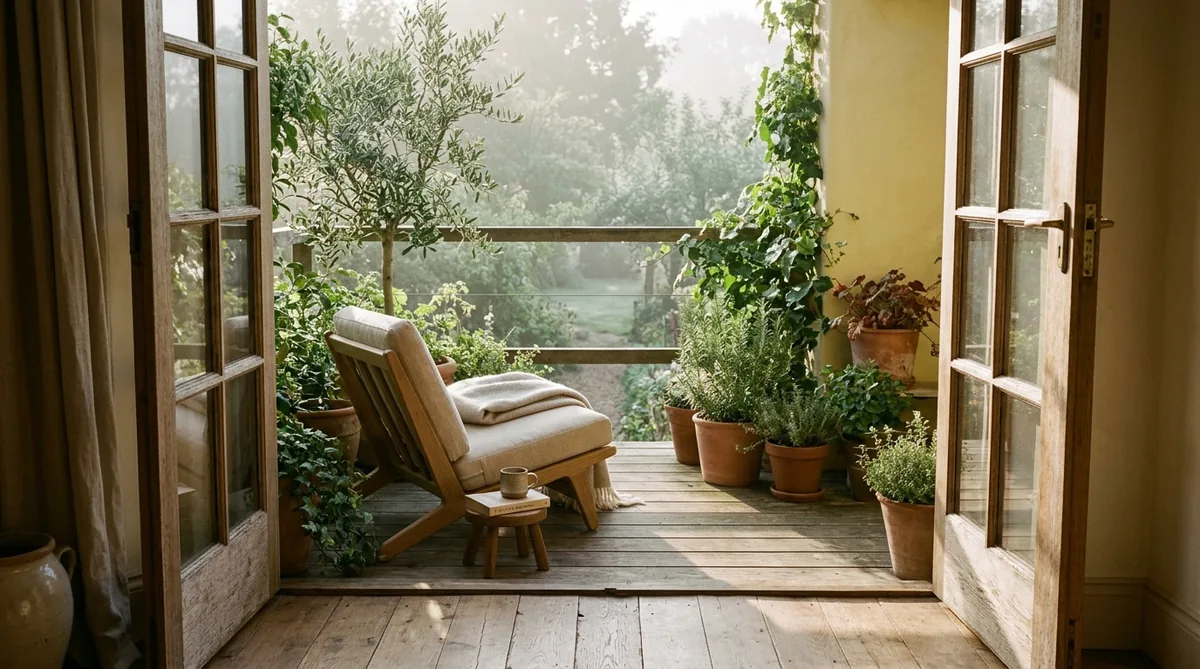
Within thirty to sixty minutes of waking, step outside onto an open balcony, porch, garden, or quiet sidewalk.
- ✦ Direct Photons Over Window Glass: Modern window glass filters out up to 50% of the short-wavelength blue photons required to stimulate ipRGCs. Always step into unfiltered outdoor air.
- ✦ Diffuse Horizon Gaze: Do not stare into the solar disk. Simply gaze gently in the general direction of the dawn sky with naked eyes, leaving sunglasses in your pocket.
- ✦ Duration by Weather: On a bright clear morning, 5 to 10 minutes is sufficient; under thick overcast skies, linger for 15 to 20 minutes to receive the equivalent lux volume.
2. Practice the 90-Minute Caffeine Delay
When you wake, your brain still holds residual pockets of adenosine—the chemical compound that produces sleep pressure.
- ✦ The Receptor Trap: Pouring caffeine into your system the moment you leave bed blocks adenosine receptors without clearing the molecule. When caffeine metabolizes by midday, accumulated adenosine floods receptors simultaneously, triggering a sharp crash.
- ✦ Natural Cortisol Pulse: Wait 90 to 120 minutes before your first coffee or tea. Allow direct sunrise photons and gentle movement to spark your natural Cortisol Awakening Response (CAR), clearing adenosine naturally.
3. Embrace the Low-Lux Twilight Horizon
Your master clock requires biological contrast to recognize the progression of day into restorative night.
- ✦ Sunset Photons: In late afternoon, step outside for 5 minutes to view the setting sun as light softens into warm amber and red frequencies, signaling that daytime photon flux has ended.
- ✦ Indoor Light Hygiene: As night falls, dim overhead LED fixtures and transition to low-placed lamps with warm amber 2700K bulbs.
- ✦ Melatonin Release: Authentic biological contrast opens the endocrine pathway for your pineal gland to release a clean flood of endogenous melatonin.
🌿 The Gentle Takeaway: Aligning with Planetary Light
✦ At Dawn: Absorb 10 minutes of direct outdoor sunrise photons to calibrate your master clock.
✦ At Midday: Delay caffeine by 90 minutes to let natural cortisol clear residual sleep pressure.
✦ At Dusk: Welcome the twilight horizon and soften indoor lighting to trigger deep night melatonin.
Mindful Reflection Notice
A Gentle Restorative Sleep Notice: This essay is written for educational contemplation and circadian lifestyle balance. Natural light exposure is a gentle biological foundation for restorative rest. If you suffer from chronic insomnia, clinical sleep apnea, or severe affective disorders, please consult a qualified healthcare practitioner or certified sleep specialist to receive personalized clinical guidance.
Frequently Asked Questions (AEO & Search Intent)
Does viewing sunlight through a closed window provide the same benefits?
No. Standard window glass and automobile windshields filter out substantial portions of the blue and ultraviolet light spectrum needed to stimulate retinal ipRGCs. Additionally, glass reduces the overall lux volume reaching the eyes. Stepping outside onto a porch, balcony, or open area is essential for proper circadian calibration.
Will morning light therapy work on cloudy, foggy, or rainy days?
Yes. Even on heavily overcast mornings, ambient outdoor light typically measures between 5,000 and 15,000 lux—far brighter than the 300 to 500 lux produced by typical indoor lighting. On cloudy mornings, simply extend your outdoor exposure time from ten minutes to fifteen or twenty minutes to absorb the required photonic dose.
How many hours after morning light exposure does natural melatonin release?
In a healthy circadian rhythm, direct morning light exposure initiates a biological countdown timer of approximately fourteen to sixteen hours. If you step outside into sunrise photons at 7:00 AM, your brain’s pineal gland will naturally begin secreting melatonin between 9:00 PM and 11:00 PM, creating effortless sleepiness without synthetic supplements.