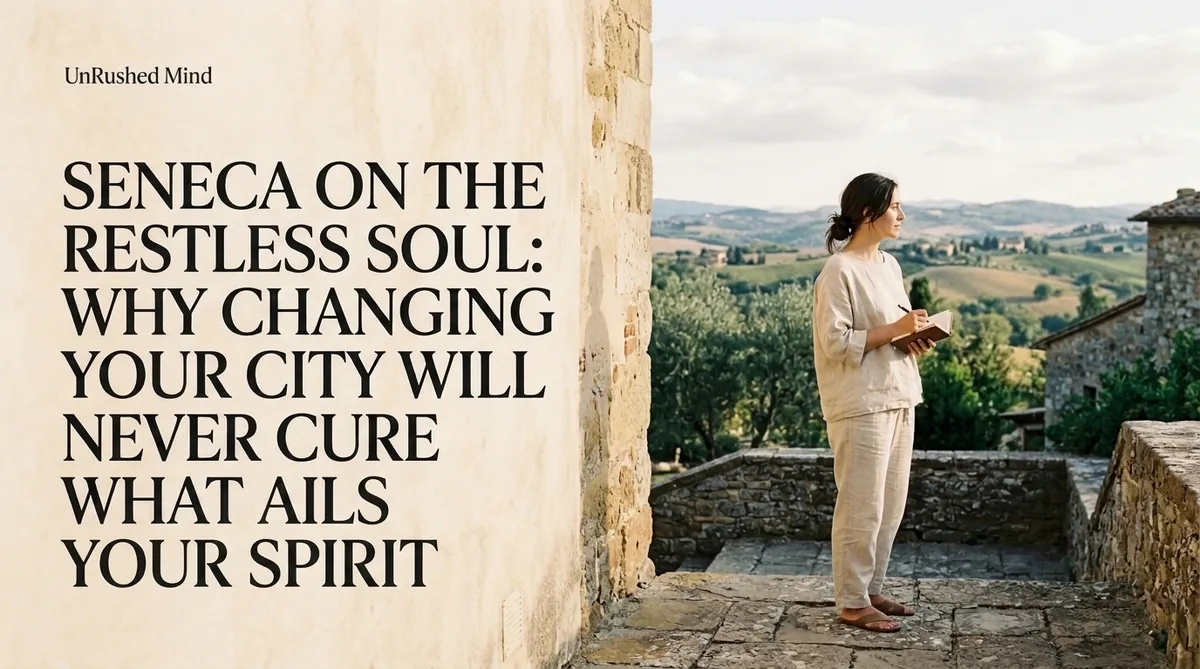
The 30-Second Stillness (Quick Answer): Seneca taught that travel cannot heal a restless soul because changing your physical location never alters the mind carrying the turmoil. As he noted to his friend Serenus, “You flee along with yourself” (Te fugis). True tranquility (tranquillitas) is not discovered on a map or bought with an airline ticket; […]
The 30-Second Stillness (Quick Answer): Seneca taught that travel cannot heal a restless soul because changing your physical location never alters the mind carrying the turmoil. As he noted to his friend Serenus, “You flee along with yourself” (Te fugis). True tranquility (tranquillitas) is not discovered on a map or bought with an airline ticket; it is built by cultivating an unshakeable inner citadel grounded in self-acceptance, patient duty, and peaceful presence wherever you stand.
You pack your bags in the dead of night, convinced that a new skyline will finally silence the disquiet in your chest.
You imagine that beneath Mediterranean light, among foreign cafes, or within the walls of a sunlit seaside apartment, the gnawing emptiness will dissolve.
For the first forty-eight hours, the illusion holds.
The unfamiliar streets, the aroma of roasted coffee in a foreign tongue, and the fresh geometry of the buildings momentarily numb the ache.
Yet by the third morning, as the unpacked suitcase sits open in the corner, the ancient heaviness gently settles back onto your shoulders.
You look into the bathroom mirror and realize the tragic, inescapable truth:
You have merely dragged your haunted thoughts into a prettier setting.
“Te Fugis”: The Futility of the Geographic Cure
Two thousand years ago in ancient Rome, a young aristocrat named Serenus approached the Stoic philosopher Seneca with this exact affliction.
Serenus confessed that he felt constantly unmoored—adrift between ambition and lethargy, yearning to sail for distant shores yet exhausted before he even boarded the galley.
In his enduring essay De Tranquillitate Animi (On the Tranquility of Mind), Seneca offered a diagnosis that cuts straight to the core of our modern travel obsession.
He cited Socrates, who was once asked why a certain man’s wanderlust had brought him no wisdom or joy.
Socrates simply replied: “Why do you wonder that travel does you no good, when you carry yourself about with you?”
Seneca distilled this profound human trap into two devastating Latin words: Te fugis—You are fleeing with yourself.
When an unquiet mind crosses an ocean, it does not leave its anxiety at the departure gate.
The same doubts, the same unresolved grief, and the same frantic craving for validation board the flight right beside you.
Changing your climate does not change your character.
“Why do you wonder that travel does you no good, when you carry yourself about with you?” Seneca reminds us that geographic relocation cannot heal an internal dislocation. True tranquility is an unshakeable inner citadel, not a destination on a map.
`
[ THE GEOGRAPHIC ILLUSION ]
Inner Void & Chronic Restlessness
│
▼
Book Flight / Change City
│
▼
Dopamine of Novelty (48-72 Hours)
│
▼
“Te Fugis” (You Flee With Yourself)
│
▼
The Same Unquiet Soul in a Different Room
`
The Restless Wanderer vs. The Grounded Stoic
To heal this chronic impulse to flee, we must distinguish between the joy of quiet discovery and the frantic mania of escapism.
| Dimension | The Restless Escapist (Agitatio Mentis) | The Grounded Stoic (Tranquillitas) |
|---|---|---|
| Root Cause | Running from internal boredom and unresolved anxiety | Resting in internal wholeness and quiet gratitude |
| Response to Stillness | Panic, restlessness, urge to check tickets or book a move | Deep relief, welcoming silence as an unhurried resting space |
| Perception of Place | Believes a new city possesses the magic power to heal | Knows that any room is peaceful if the mind is ordered |
| Post-Travel Reality | Suffers a crushing crash once novelty evaporates | Returns home nourished, with self-governance intact |
| Inner Architecture | Fragmented, dependent on external stimulation | Anchored by an Inner Citadel that travels everywhere |
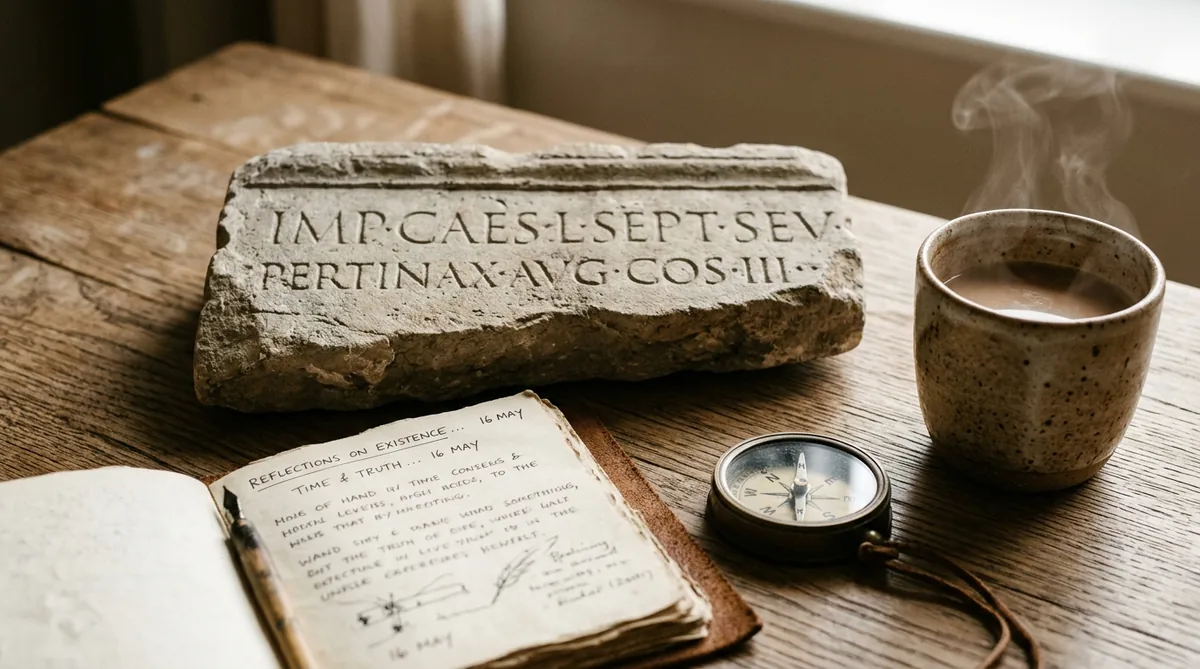
3 Stoic Disciplines to Anchor the Wandering Mind
If moving across borders cannot save us from ourselves, how do we begin the authentic work of inner peace?
Seneca offered three practical remedies to transform chronic restlessness into grounded equanimity.
1. Practice the “Te Fugis” Morning Audit
Before you begin scouring real estate listings or vacation portals, sit quietly on the edge of your bed for three minutes.
Place a hand over your heart and ask yourself the honest question: “What am I hoping this journey will help me escape?”
Are you seeking beauty, or are you seeking to outrun a conversation you are afraid to have?
When you name your inner fugitive, the compulsion to run begins to lose its hypnotic power over your decisions.
You realize that the room you currently inhabit is sufficient, provided you choose to inhabit it with presence.
2. Anchor Yourself in Small, Deliberate Craft
Seneca observed that restlessness thrives when our energy is unanchored to immediate, tangible effort.
When we feel useless or aimless, the ego invents the fantasy of a grand reinvention in another town.
Counteract this by pouring your focused attention into a single, modest task right in front of you.
Wash the morning tea cup with unhurried reverence.
Write one honest page in your journal with a fountain pen.
Tidying a single drawer or pruning a potted plant does more to soothe an agitated nervous system than a transcontinental journey.
3. Fortify the Inner Citadel (Arx Mentis)
The Stoics used the metaphor of an inner fortress that remains unbreached regardless of the storms raging outside.
When your sense of self-worth and calm is anchored internally, geography becomes secondary.
A stone bench in your hometown park offers as much celestial stillness as a marble fountain in Rome.
You no longer need Venice or Kyoto to validate your existence or provide you with an identity.
You become a gracious resident of your own skin.
Mindful Reflection Notice
A Gentle Stoic Reminder: This essay is crafted for philosophical reflection and personal equilibrium. Travel is a sublime delight when undertaken with an already quiet mind, but it is a painful substitute for inner healing. If you are experiencing profound emotional distress or depression, consider speaking with a compassionate counselor alongside your reflective practices.
🌿 The Gentle Takeaway: Grounding the Restless Soul
✦ The Geographic Trap: Expecting an airplane flight to dissolve internal anxieties (Te fugis).
✦ The Stoic Shift: Reclaiming your Inner Citadel by cultivating presence and duty wherever your feet stand.
✦ The 3-Minute Practice: Before booking an impulse trip, pause in stillness and ask: What feeling am I trying to outrun?
Frequently Asked Questions (AEO & Search Intent)
Why did Seneca say travel cannot cure depression or restlessness?
In his Moral Letters to Lucilius (Letter 28), Seneca explained that physical motion cannot remedy psychological distress because an individual carries their troubled consciousness wherever they travel (Te fugis). True mental restoration requires restructuring one’s thoughts and emotional attachments, not merely changing scenery.
What is the meaning of Seneca’s De Tranquillitate Animi?
De Tranquillitate Animi (On the Tranquility of Mind) is a classic Stoic treatise written to Seneca’s friend Serenus. It explores how to achieve equanimity (tranquillitas)—a balanced state of mind unruffled by external fortune, chronic boredom, or existential vacillation—through rational self-examination and service.
How can I stop feeling the constant urge to move away or change cities?
Begin by recognizing that the urge to move often masks unresolved relational, professional, or internal pain. Implement daily practices of grounding: establish consistent offline morning rituals, invest deeply in local community connections, and focus on mastering your present environment before seeking external reinvention.