





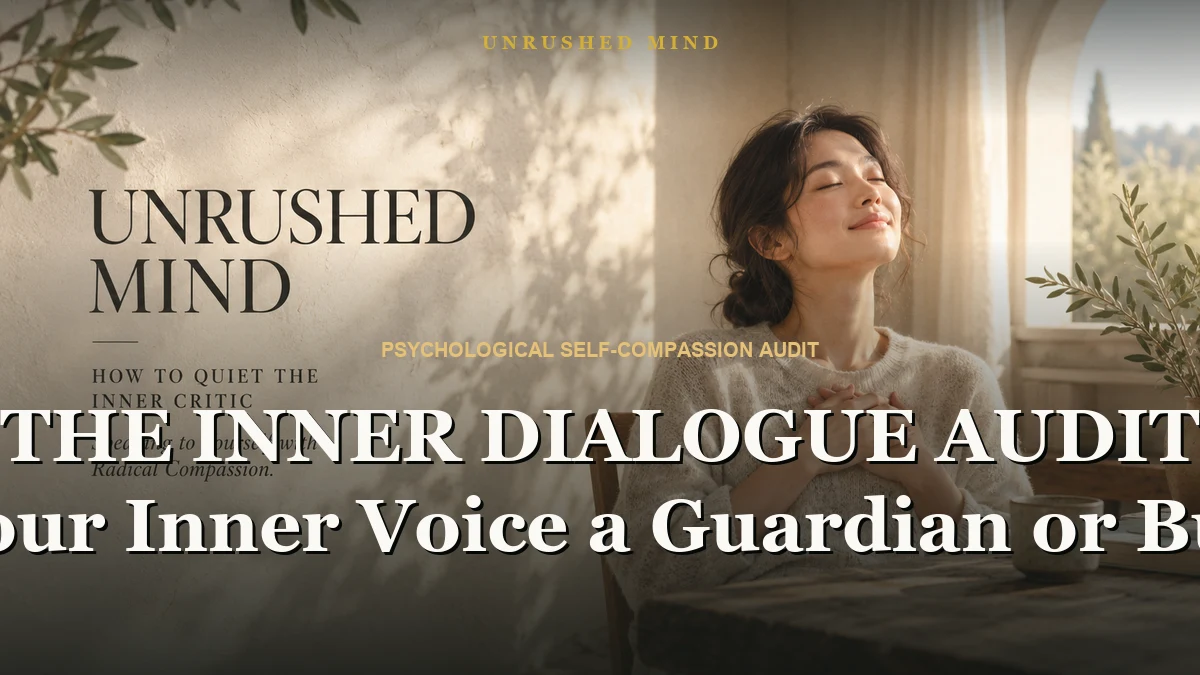
Audit the tone of your internal voice with this 7-question psychological assessment based on Kristin Neff's Self-Compassion Scale and IFS.
We speak to ourselves more than to any other human being on earth. When you stumble, make an error, or feel depleted, what tone does your inner voice adopt? Discover the dominant pattern of your internal monologue.
This self-assessment is designed for educational and personal reflection purposes regarding mental restoration, burnout symptoms, and stress levels. It does not replace professional clinical diagnosis, psychiatric care, or licensed medical therapy.
✦ Theoretical Framework: Self-Compassion & Cognitive Reattribution
In empirical research by Dr. Kristin Neff (2003; 2011), self-compassion consists of three core components: Self-Kindness vs. Self-Judgment, Common Humanity vs. Isolation, and Mindfulness vs. Over-Identification.
Contrary to the popular myth that self-criticism drives high performance, psychological data proves that self-judgment triggers cortisol release and increases procrastination. Cultivating an encouraging inner guardian builds resilient, sustainable excellence.
Clinical Assessment Notice: This educational self-reflection is designed to support self-compassion and inner voice awareness. It is not a clinical psychological diagnosis or a psychiatric assessment.
The 3 Inner Voice Profiles
🕊️ 0–20 Points: The Compassionate Guardian
✦ Inner State: Grounded self-warmth, emotional patience, and unconditional personal acceptance.
✦ Cognitive Mechanism: Healthy self-compassion allowing errors to be processed as natural learning without shame.
✦ Gentle Micro-action: Continue offering yourself the same wise, generous presence you share with dear friends.
⚖️ 21–45 Points: The Anxious Manager
✦ Inner State: Self-worth tied conditionally to daily productivity, fueled by anticipatory anxiety.
✦ Cognitive Mechanism: The inner voice acts as a vigilant manager believing that pressure is required to maintain safety.
✦ Gentle Micro-action: Name the anxious manager when it speaks, thanking it for trying to help while choosing a calmer response.
⚔️ 46–70 Points: The Critical Auditor
✦ Inner State: Punitive internal monologue, attacks on character, and heavy emotional exhaustion from self-judgment.
✦ Cognitive Mechanism: Internalized shame loops triggering chronic physiological stress and defensive retreat.
✦ Gentle Micro-action: Use the friendship mirror: ask yourself if you would ever say this to a friend, and release harsh self-blame.