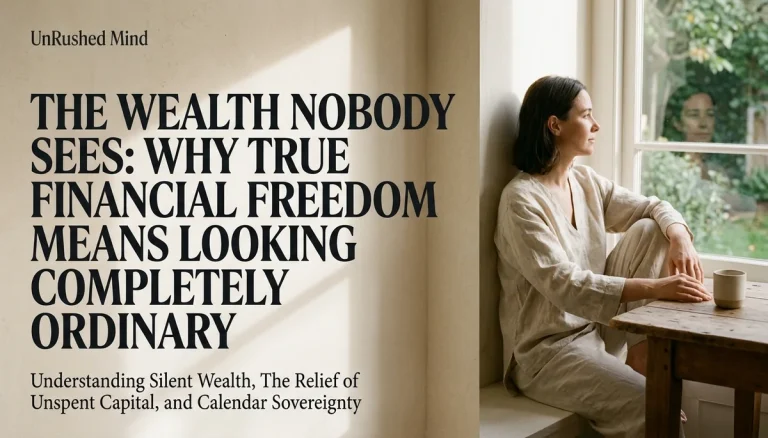
Few modern experiences carry the quiet, suffocating dread of opening a digital calendar only to find it carpeted in relentless, back-to-back colored blocks. When every thirty-minute increment of your daylight hours is pre-allocated to meetings, syncs, and obligations, a subtle somatic exhaustion settles deep into your bones. You may be earning an enviable income and […]
Few modern experiences carry the quiet, suffocating dread of opening a digital calendar only to find it carpeted in relentless, back-to-back colored blocks.
When every thirty-minute increment of your daylight hours is pre-allocated to meetings, syncs, and obligations, a subtle somatic exhaustion settles deep into your bones.
You may be earning an enviable income and collecting impressive professional accolades, yet beneath the surface lies an undeniable truth: you do not actually own your life.
Somewhere along the trajectory of modern industrial ambition, society performed a tragic sleight of hand by equating constant availability with human significance.
Invisible wealth is the profound state of time sovereignty where an individual retains full autonomy over their daily hours. Rather than displaying material prestige, it measures prosperity by open calendar space, unhurried mornings, and freedom from forced obligations.
The Great Inversion: How Busyness Became a Counterfeit Trophy
A century ago, sociologist Thorstein Veblen observed that the ruling classes displayed their fortune through conspicuous leisure—the visible privilege of not having to labor.
In our hyper-connected economy, that dynamic has completely inverted into what researchers now call performative exhaustion.
To confess that you have a free Tuesday afternoon is often met with suspicion, as if unoccupied time were an embarrassing admission of obsolescence.
We have normalized sighing into our morning coffee and muttering about how “crazy busy” things are, treating our sleep deprivation and crowded schedules like military medals.
Yet this badge of honor is a counterfeit currency designed to distract us from a devastating reality: time poverty is the hallmark of modern servitude, no matter how plush the corporate cubicle or lucrative the consulting fee.
When your days are sliced into frantic micro-segments, your nervous system remains trapped in a persistent sympathetic state, constantly bracing for the next notification chime or scheduled encounter.

The Anatomy of an Empty Calendar: White Space as Sacred Ground
In book design and typography, margins are never considered wasted paper; they are the generous, quiet space that makes the printed words legible.
Without margins, text becomes an unreadable, claustrophobic block of ink that exhausts the human eye.
Your calendar functions precisely the same way: white space is not empty void, but the fertile breathing room where genuine consciousness occurs.
Financial author Morgan Housel captured this timeless principle when noting that the highest dividend money can ever pay is the ability to wake up every morning and say, “I can do whatever I want today.”
Material possessions—luxury automobiles, designer apparel, and beachfront villas—possess an inherent paradox: they demand maintenance, attention, and perpetual earnings to sustain.
Conversely, a morning devoid of appointments costs nothing to maintain, yet offers an exquisite inner peace that billions in venture capital cannot purchase.
When you cultivate the mind of enough, you begin to understand that true affluence is measured not by what you accumulate, but by what you have the liberty to refuse.
The Diagnostic Mirror: Auditing Your Time Sovereignty
To step off the carousel of performative busyness, we must first honestly examine the psychological patterns that keep our schedules dangerously congested.
Review the diagnostic framework below to discern where your relationship with time currently resides:
| Dimension | The Overbooked Status Chaser | The Anxious Accumulator | The Guilt-Ridden Daydreamer | The Quiet Wealth Practitioner |
|---|---|---|---|---|
| Calendar Reality | Wall-to-wall meetings; triple-booked days as proof of personal indispensability. | Voluntarily trades free evenings and weekends for additional income increments. | Has sporadic free hours but instantly fills them with urgent chores or screen consumption. | Protected white space; entire mornings or full days deliberately left blank. |
| Psychological Cost | Chronic sympathetic overdrive; fractured relationships; zero capacity for contemplation. | Impressive financial ledger accompanied by profound emotional fatigue and emptiness. | Chronic guilt and shame for “being unproductive” whenever stillness appears. | Parasympathetic ease; creative clarity; deep emotional groundedness and vitality. |
| Relationship to ‘No’ | Incapable of declining; says yes out of fear of missing status opportunities. | Accepts every client demand due to deep-seated scarcity fears about the future. | Agonizes over boundaries; delivers elaborate apologies whenever forced to decline. | Practices gentle, sovereign boundaries; declines gracefully without defensive justifications. |
| Core Definition of Wealth | Public visibility, prominent job titles, and relentless frenetic motion. | The numerical balance of the investment portfolio, regardless of physical exhaustion. | A distant retirement mirage after decades of surviving the current grind. | Absolute daily autonomy: owning one’s morning, mind, and hours without asking permission. |

The Empty Calendar Sanctuary Protocol: 4 Steps to Reclaiming Your Hours
Reclaiming your time from the predatory expectations of modern culture is not an overnight event; it is a systematic reclaiming of personal territory.
The four-step protocol below offers a concrete pathway to transition from chronic calendar congestion to quiet, sovereign wealth:
1. The Status Uncoupling
Begin by consciously dismantling the unconscious link between a crowded agenda and your fundamental human value.
Remind yourself daily: a full calendar is not proof of importance; it is often merely evidence of poor boundaries and reactive living.
2. The Sacred White Space Fence
Designate at least one non-negotiable half-day each week—such as Thursday afternoon or Monday morning—as protected sovereign space.
Mark this block as “Unavailable” across all scheduling links, and treat it with the same inviolable reverence you would accord an audience with royalty.
3. The Asynchronous Firewall
Eighty percent of scheduled calls could easily be resolved with a thoughtful written memo or an asynchronous voice note.
Embrace the grace of saying ‘no’ to reflexive calendar invites by responding: “To respect our mutual focus, let’s address this via email first.”
4. The Sovereign Morning Moat
Protect the first ninety minutes of your waking day from external inputs, digital communications, and scheduled commitments.
Spend this pristine window sipping warm tea, journaling in silence, or walking without a destination—anchoring your mind before the world makes its demands.
A Sanctuary Note on Time and Privilege: Time sovereignty does not require immediate financial retirement or complete detachment from society. It begins with micro-reclamations: ten minutes of unhurried morning tea, a polite refusal of a superfluous meeting, or an evening walk without headphones. True wealth is built one protected minute at a time.
Frequently Asked Questions About Quiet Wealth and Empty Calendars
What is the fundamental difference between quiet wealth and conventional wealth?
Conventional wealth focuses on external accumulation and conspicuous display—luxury cars, designer labels, and social prestige. Quiet wealth focuses on internal sovereignty and time affluence: the luxury of owning your hours, declining undesirable demands, and living without chronic hurry.
How can I begin creating an empty calendar if my job has mandatory obligations?
Start at the margins. Reclaim thirty minutes before opening your work email, block a non-negotiable one-hour focus window in the afternoon, and practice batching your meetings into specific days. Incremental autonomy accumulates into significant neurological relief.
Why does an unscheduled afternoon trigger anxiety for so many high achievers?
Modern culture conditions us to equate productivity with personal survival. When external tasks vanish, suppressed emotions and existential reflections surface, creating temporary phantom panic. Recognizing this reaction as cultural conditioning helps the nervous system settle into genuine rest.
How does time affluence accelerate recovery from chronic burnout?
Burnout is fundamentally a prolonged state of nervous system dysregulation caused by chronic demand exceeding somatic capacity. Unscheduled time removes acute sensory pressures, allowing the vagus nerve and parasympathetic system to restore baseline resilience.
The Ultimate Luxury: Living on Your Own Terms
At the twilight of life, no human looks back with gratitude upon the thousands of Zoom meetings they dutifully attended or the hundreds of calendar tiles they meticulously filled.
What we remember are the unscripted afternoons: an uninterrupted conversation over mint tea, an unhurried walk through autumn leaves, or two hours spent reading by a sunlit window without glancing at a watch.
Release the need to prove your worth through relentless exhaustion.
Wipe the slate clean, protect your margins with fierce tenderness, and discover the incomparable freedom of an empty calendar.