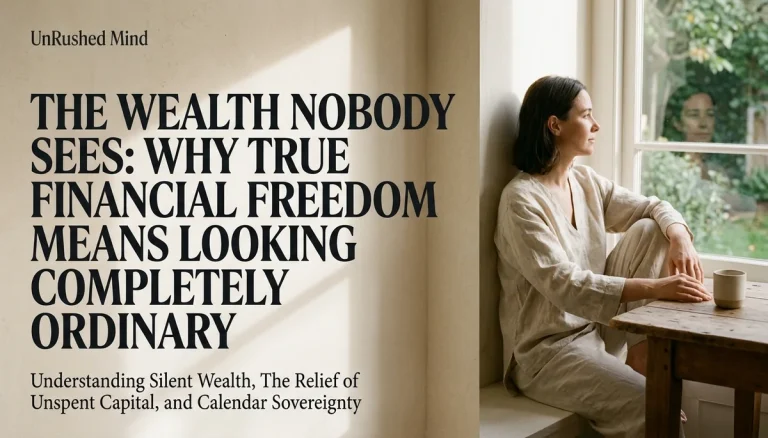
You wake up to the urgent chime of your alarm, your heart immediately accelerating before your feet even touch the floor. You swallow your morning coffee in brisk, distracted gulps while scrolling through three different messaging channels. You eat lunch in seven hurried minutes over a keyboard dusted with crumbs, eyes darting between spreadsheets and […]
You wake up to the urgent chime of your alarm, your heart immediately accelerating before your feet even touch the floor. You swallow your morning coffee in brisk, distracted gulps while scrolling through three different messaging channels. You eat lunch in seven hurried minutes over a keyboard dusted with crumbs, eyes darting between spreadsheets and calendar invites that cluster like storm clouds across your screen. On paper, your life represents an enviable picture of modern success: a dependable income, comfortable furniture, subscriptions to every conceivable convenience, and a pantry stocked with food from halfway across the world. Yet beneath the veneer of material abundance, a quiet, corrosive starvation gnaws at your spirit: you are utterly, desperately poor in time.
Every waking hour feels leased to an invisible landlord. The simple luxury of sitting on a bench for thirty minutes without a productive objective produces a sudden, irrational spike of panic—a sensation that someone, somewhere, is waiting for your response, or that the invisible machinery of the world is leaving you behind. We have built an extraordinary civilization capable of manufacturing speed, efficiency, and material wealth at an unprecedented scale, yet we have quietly engineered a society where almost everyone feels perpetually out of breath.
If you find yourself perpetually whispering “I just don’t have enough time” like a mournful secular prayer, you are not suffering from poor discipline, nor do you require another color-coded productivity application. You are navigating the quiet, widespread epidemic known as time poverty—a state of existence where external abundance masks an acute internal famine of presence, autonomy, and sovereign peace.
What Is Time Poverty? The Hidden Price of Modern Abundance
Time poverty is the chronic, suffocating sensation of having too many competing obligations and never enough discretionary hours to absorb them, regardless of financial security or social standing. It occurs when our waking hours are stripped of personal autonomy, reducing the human journey to an unending queue of logistical transactions, fragmented attention, and existential haste.
For centuries, human economic thinkers operated under a foundational assumption: as societies grew wealthier and technology automated manual labor, humanity would inherit vast oceans of leisure. In 1930, the economist John Maynard Keynes famously predicted that by the century’s end, technological progress would yield a fifteen-hour workweek, leaving our great-grandchildren wondering how to spend their abundant leisure hours without succumbing to boredom. Yet modern reality has enacted a cruel reversal. Instead of trading material productivity for temporal freedom, we have converted every efficiency gain into higher expectations of output, faster response times, and an insatiable appetite for hyper-availability.
Recent behavioral research led by Professor Ashley Whillans at Harvard Business School reveals that over eighty percent of working adults report feeling chronically “time poor”—a psychological state researchers formalize as time famine. Crucially, Whillans’ empirical findings demonstrate that time poverty diminishes personal happiness, elevates anxiety, and degrades physical health more severely than moderate financial hardship or even unemployment. When we are starved of time, our sympathetic nervous system remains locked in low-grade vigilance, our personal relationships whither into transactional logistics, and our capacity for moral imagination and contemplative awe quietly evaporates.
The tragedy of modern temporal scarcity lies in its deceptive disguise. In earlier historical eras, poverty was unmistakably physical: cold rooms, empty pantries, bare feet. Today, one can reside in an air-conditioned penthouse, dress in bespoke wool, and possess every luxury gadget while enduring the desperate, cornered psychology of an indentured servant whose hours are completely owned by external forces.
The Illusion of the Clock: Why Efficiency Tools Make Us Poorer in Time
Whenever modern professionals feel the constricting grip of temporal panic, our collective reflex is almost always technological: we download a new time-tracking tool, adopt the Pomodoro technique, batch our emails, or enroll in a workshop promising to “10x our daily output.” We operate under the stubborn delusion that if we can only organize our tasks with greater mathematical precision, we will finally cross the threshold into effortless ease.
Yet anyone who has mastered a productivity framework knows the bitter outcome: the promised ease never arrives. In economic theory, this phenomenon is captured by the Jevons Paradox, which states that increasing the efficiency with which a resource is used leads not to a reduction in its consumption, but to an exponential surge in overall demand. When steam engines became twice as efficient at burning coal, industrial Britain did not use half as much coal; it built ten times as many steam engines. The exact same dynamic governs the ecology of modern human attention.
When you learn how to process twenty emails in fifteen minutes instead of an hour, you do not gain forty-five minutes of quiet contemplation. Because you responded with lightning speed, you invite twenty-five immediate replies, while simultaneously signaling to your peers that your attention is an on-demand commodity. By streamlining your workflow, you simply increase the velocity at which new demands crash upon your shores. As we observed when examining hurry sickness and the illusion of urgency, speed creates an appetite for more speed, until the human vessel becomes incapable of sustained deceleration.
Furthermore, the modern corporate landscape has sanctified what the cultural theorist Derek Thompson terms “Workism”—the elevation of professional labor from an economic necessity into a sacred spiritual vessel from which individuals seek purpose, transcendence, and salvation. When work becomes religion, any unused hour feels like an act of spiritual neglect. Empty space on a digital calendar is no longer welcomed as an invitation to breathe; it is treated as a void that must be swiftly colonized before someone notices the vacancy.
This relentless drive to optimize every second triggers the exact physiological distress detailed in our guide to productivity dysmorphia and the curse of output anxiety. No matter how many projects you deliver or how many milestones you check off before midnight, the psychological threshold of “enough” continuously recedes like an impossible desert mirage.
The Tragedy of “Time Confetti”: How Micro-Distractions Shatter Deep Leisure
Perhaps the most insidious driver of contemporary temporal exhaustion is not merely the sheer volume of our workload, but the structural disintegration of our free hours. In her groundbreaking study of modern overwhelm, journalist Brigid Schulte coined a term that captures this neurological condition with haunting accuracy: “Time Confetti”.
Time confetti refers to the fragmentation of our non-work hours into tiny, scattered remnants—two minutes here, four minutes there, ninety seconds while waiting for the kettle to boil, three minutes between phone calls. On a spreadsheet, an individual might technically accumulate three or four hours of free time throughout the day. But because those hours are chopped into microscopic crumbs by smartphone vibrations, unread notifications, and reflexive screen-checking, the time loses its coherent restorative integrity.
The human brain cannot experience genuine relaxation in two-minute increments. Real leisure—what classical philosophers called otium—requires psychological continuity. It demands that the prefrontal cortex step down from its executive monitoring post, allowing the nervous system to settle into the parasympathetic restoration described in our exploration of the 7 types of rest and holistic recovery. When an individual attempts to read a novel or converse with their partner while glancing at a smartwatch every six minutes, the nervous system remains suspended in what neuroscientists call continuous partial attention.
Consider the daily reality of time confetti in an ordinary evening:
- You sit down on the sofa intending to decompress for an hour, but you pick up your phone to check the weather forecast.
- A red notification badge pulls you into your email inbox; you read a message from a colleague that requires no immediate action, yet its contents begin looping in your background thoughts.
- You put the phone down, but the emotional residue of the message lingers; you pick it up again to read an unrelated news alert.
- Forty-five minutes have passed. Your body has remained stationary, but your mind has undergone twelve micro-shifts in cognitive context.
At the end of such an evening, you do not feel rested; you feel strangely hollow and depleted, trapped in the bewildering paradox of having done “nothing” while feeling completely drained. This is the hallmark of time confetti: it consumes the clock without offering any of the rejuvenation that true stillness provides, leaving you as emotionally bankrupt as if you had worked overtime.
Seneca’s Warning: The Distorted Internal Exchange Rate
More than two thousand years before the invention of push notifications and calendar synchronization, the Roman Stoic philosopher Lucius Annaeus Seneca penned what remains the most piercing critique of temporal squandering ever written: his master essay De Brevitate Vitae (On the Shortness of Life). Writing to his friend Paulinus, Seneca made an observation that cuts directly to the core of our modern temporal neurosis:
“Men are frugal in guarding their personal property; but as soon as it comes to squandering time they are most wasteful of the one thing in which it is right to be stingy. No one will bring you back your years; no one will restore you to yourself. Life will go on as it began, without turning back or stopping its course.”
Seneca noticed that if a stranger attempted to seize a citizen’s house, villa, or coin purse, the owner would take up arms, summon the magistrates, and defend their physical estate with ferocious bravery. Yet when neighbors, acquaintances, and superiors demanded days, weeks, and months of that same citizen’s finite life for trivial trivialities, they surrendered their hours without the slightest resistance.
We suffer from a deeply distorted internal exchange rate. We treat money as scarce and valuable, but we treat our irreplaceable biological time as an infinite credit card that can be charged indefinitely. We will drive twenty minutes out of our way to save three dollars on groceries, but we will surrender an entire Saturday afternoon to an obligation we dread simply because we lack the emotional fortitude to establish healthy limits, as discussed in the grace of saying no without guilt.
Every time you say “yes” to a superficial social gathering, an unnecessary meeting, or an extra project that serves only someone else’s vanity, you are not paying with an abstract commodity called time. You are paying with the irreplaceable matter of your life. As Henry David Thoreau famously observed in his woodland sanctuary—a philosophy we examined in depth in the true cost of a thing and buying back your time—the real price of anything is the amount of life which is required to be exchanged for it, immediately or in the long run.
Master Diagnostic: The Spectrum of Temporal Experience
To untangle yourself from the grip of time poverty, you must first develop the capacity to recognize how temporal scarcity manifests across your internal landscape. This reflective diagnostic map outlines the progression from chronic temporal depletion to sovereign time affluence:
| Dimension | The Chronic Time-Pauper | The Fragmented Confetti Mind | The Time-Affluent Sanctuary Soul |
|---|---|---|---|
| Relationship to Calendar | Back-to-back blocks; zero buffer; views white space as an invitation for more tasks. | Technically open schedule, but constantly interrupted by incoming digital pings. | Generous structural slack; 30–40% of the day intentionally uncommitted and spacious. |
| Physiological State | Shallow breathing, clenched jaw, elevated baseline cortisol, persistent urgency. | Sensory agitation, dopamine fatigue, inability to sustain attention on one object. | Calm autonomic baseline, diaphragmatic breathing, grounded physical presence. |
| Experience of Leisure | Crippling guilt; feels “useless” or irresponsible whenever not actively producing. | Pseudo-leisure (doomscrolling while half-watching TV); restless and unfulfilled. | Unapologetic, deep restorative play; reading, walking, or resting without a clock. |
| Currency of Self-Worth | Total volume of completed items, external validation, visible performative hustle. | Speed of reaction, staying abreast of every digital discourse and update. | Sovereignty over the present moment; depth of relationships; peace of conscience. |
| Response to Friction | Explosive frustration at red lights, queues, or minor delays; intolerance of waiting. | Compulsively fills every 10-second pause by reaching into pockets for screens. | Welcomes delays as serendipitous moments of unexpected stillness and contemplation. |

From Temporal Poverty to Time Affluence: The Sanctuary Time Sovereignty Protocol
Reclaiming your life from time poverty does not require resigning from your career or retreating to a mountain cave. It requires a profound, deliberate recalibration of how you perceive, protect, and inhabit your hours. The following four-step protocol is designed to dismantle the architecture of temporal exhaustion from within:
1. The Confetti Consolidation: Rebuilding Continuous Time Blocks
The first imperative is to stop the hemorrhaging of your leisure hours into micro-fragments. Instead of checking your communication channels dozens of times throughout the day, institute strict structural batching. Confine digital correspondence to two dedicated windows—for instance, 11:00 AM and 4:30 PM. Turn off all non-human push notifications on every device you own.
When you sit down to relax in the evening, place your smartphone in another room entirely. If an urge arises to check an incoming notification, recognize it as a neurobiological phantom reflex rather than a genuine emergency. By consolidating the scattered crumbs of your evening into a single unbroken ninety-minute block, you allow your brain to enter the slow, restorative rhythm of deep presence, reconnecting with the restorative power of the digital sabbath and nervous system reset.
2. Protecting the Daily “Sovereign Hour”
In classical statecraft, a sovereign territory is land over which no foreign power holds jurisdiction. You must establish a corresponding Sovereign Hour within every twenty-four-hour cycle—sixty minutes of uncompromised, non-negotiable time that belongs entirely to your soul.
This hour cannot be an optimization routine. It is not an hour for reading productivity literature, tracking fitness metrics, or planning future career maneuvers. It is an hour dedicated purely to the beauty of existing without utility: taking an unhurried walk through the neighborhood as practiced in the quiet art of French flânerie, sitting with a cup of tea while watching dawn light sweep across your floor, or playing an acoustic instrument with no intention of performing for others. When you protect one sovereign hour daily, you anchor your identity in being rather than doing.
3. Applying the Seneca Exchange Rate Filter
Whenever you are presented with a new social invitation, an optional project, or an expensive material purchase that demands future maintenance hours, pause and run it through the Stoic filter: “How many hours of my finite earthly existence will this truly cost, and would I willingly trade my remaining breaths for it?”
When an acquaintance asks to “pick your brain” over an unfocused coffee, or a committee invites you to take on unpaid administrative burdens, remember that declining their request is not selfish; it is the ultimate stewardship of the life you have been granted. Master the elegant art of saying: “Thank you warmly for thinking of me, but my current commitments require my complete focus, so I must decline with grace.” No justification, no fabricated emergencies. Just the quiet authority of someone who honors the sanctity of their time.
4. Cultivating Structural Slack
In engineering, a bridge built without tolerance for movement collapses under sudden thermal stress. A supply chain operating at one hundred percent capacity breaks down when a single container ship runs aground. Yet modern professionals routinely design their lives with zero margin for error, cramming every day until the slightest traffic delay or minor misunderstanding shatters their composure, as we explored when analyzing the window of tolerance and emotional capacity.
To cultivate time affluence, you must intentionally build structural slack into your days. Schedule thirty-minute empty windows between appointments. Leave entire Sunday afternoons completely devoid of plans. Treat this uncommitted space not as empty time waiting to be filled, but as sacred breathing room—the acoustic chamber in which life’s true melodies can finally resonate.
The Ultimate Luxury: When Time Ceases to Be a Currency
The cultural myth of our era promises that if you accumulate enough material assets, you will eventually purchase your freedom. But look closely at the lives of those who have reached the pinnacle of financial accumulation: how many of them possess the freedom to spend a Tuesday morning reading poetry by an open window? How many of them can converse with their children without secretly eyeing their wristwatches? More often than not, greater financial wealth simply purchases a larger, more gilded prison, staffed by more demands and guarded by higher stakes.
True luxury has nothing to do with private aviation, luxury logos, or bespoke timepieces. True luxury is having an abundance of time. It is waking up without terror, lingering at the breakfast table, having the patience to listen deeply to a friend whose heart is breaking, and standing in silent wonder before the majesty of a sunset without feeling the urge to record it for an audience, tapping into the profound healing power of awe and the small self.
Time is not a currency to be traded away for symbols of status. Time is the canvas upon which your consciousness is painted. When you choose to slow down, when you learn to refuse the frantic choreography of the modern rat race as we examined in the myth of falling behind, you are not losing your competitive edge. You are stepping off the treadmill of temporal poverty and claiming the only inheritance that truly matters: the peaceful, luminous possession of your own mortal life.
Những Băn Khoăn Thường Gặp Về Time Poverty