There is a peculiar, quiet grief that accompanies living in a world that never stands still. You feel it on Sunday evenings as the golden light fades from your living room floor, or when looking at an old photograph of people you once spoke to every single day but have not heard from in years. […]
There is a peculiar, quiet grief that accompanies living in a world that never stands still. You feel it on Sunday evenings as the golden light fades from your living room floor, or when looking at an old photograph of people you once spoke to every single day but have not heard from in years. You feel it when a project you poured your heart into comes to an unceremonious conclusion, or when your body quietly reminds you that another birthday has passed.
Most of our modern exhaustion does not stem from physical labor. It stems from the invisible, relentless effort of trying to freeze time. We build psychological fortresses out of schedules, relationships, titles, and routines, quietly hoping that if we hold on tightly enough, things will stay as they are. We treat every ending as a personal betrayal and every unexpected shift as an existential threat. We cling with clenched white knuckles to people, youth, certainty, and past versions of ourselves—and then wonder why our arms and spirits are so profoundly tired.
To carry the illusion of permanence is to carry an unbearable weight. It is like trying to hold a handful of clear mountain stream water by squeezing your fingers into a fist; the harder you grasp, the faster it slips through the gaps, leaving you empty-handed and frustrated. Yet when you open your palm flat, the water rests there, peaceful and reflective.
Several autumns ago, seeking refuge from a season of sudden personal disruption and chronic mental restlessness, I boarded a dawn train to Kyoto. I did not go looking for grand revelations or exotic escapism. I went simply because I needed to sit somewhere that had witnessed a thousand years of grief, change, fire, and renewal—and had somehow remained deeply, unshakably at peace.
1. The Raked Gravel of Ryōan-ji: What a Zen Rock Garden Knows About Stillness
In Japanese Zen philosophy, impermanence—known as Mujō (無常), rooted in the ancient Sanskrit concept of Anicca—is not a tragic catastrophe to be mourned or resisted. It is the foundational architecture of reality itself. Everything that comes into form will eventually dissolve out of form. Nothing remains static, nothing is ever entirely finished, and nothing is ever permanently flawless.
At the 15th-century temple of Ryōan-ji in northwestern Kyoto, this truth is not taught through spoken sermons or heavy leather-bound texts. It is carved into fifteen stones resting quietly upon a sea of raked white gravel.
In Japanese Zen philosophy, impermanence (Mujō) is not a tragic truth to mourn, but the foundational reality of all existence. Ancient Kyoto Zen temples like Ryōan-ji embody this through their dry landscape gardens (Karesansui): fifteen stones resting in raked gravel that mirrors flowing water. When we realize that nothing in life is permanent, perfect, or complete (Wabi-Sabi), the desperate need to cling dissolves, leaving behind an unshakeable inner peace.
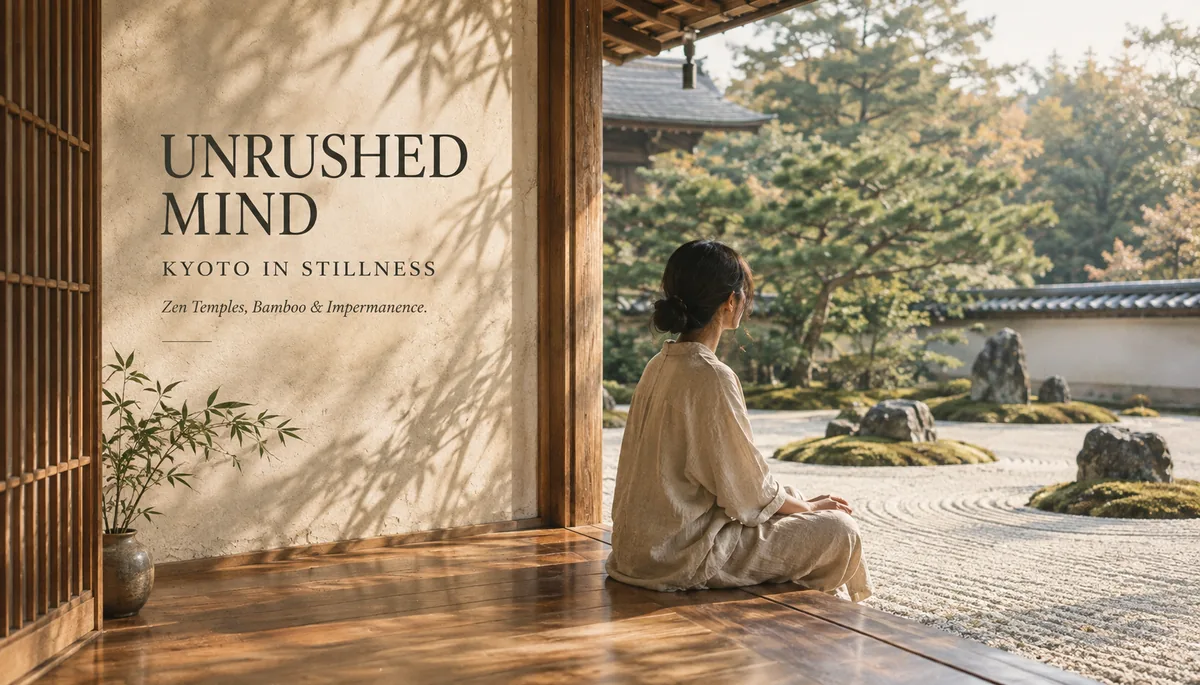
Sitting on the polished cedar veranda (engawa) of the temple hall on an overcast morning, the first thing that strikes you is the austere geometry. The garden measures barely twenty-five meters from east to west. There are no blooming flowers, no cascading water features, and no lush trees framing the courtyard. There is only gravel, raked daily into immaculate parallel ripples by the monks, and fifteen moss-ringed boulders arranged in five distinct clusters.
Yet there is an architectural secret built into Ryōan-ji: from whichever vantage point you sit upon the wooden porch, at least one of the fifteen stones is always hidden from sight behind another. You can shift your position, lean forward, or walk from one end of the veranda to the other, but you will only ever perceive fourteen stones at any single moment.
To the modern Western mind, trained on completeness and total transparency, this can feel subtly unsettling. We want to see all fifteen. We want the full picture, the complete guarantee, the closed loop. But the Zen masters who placed those boulders five centuries ago were offering a compassionate mirror: human life is inherently incomplete. We will never possess all the answers, control all the outcomes, or see the entire horizon at once. In learning to surrender what lies beyond our line of sight—an insight mirrored in the ancient Stoic wisdom of The Dichotomy of Control—we discover that peace does not require total knowledge. It requires only the quiet grace to sit comfortably with what is present.
Every morning, rain, falling pine needles, or the footprints of birds erase the crisp lines raked into the gravel. And every dawn, a monk calmly picks up the wooden rake and draws the ripples anew. He does not curse the autumn wind for disturbing yesterday’s work. He rakes not to preserve an eternal monument, but to practice the gentle rhythm of beginning again.
2. The Whispering Canes of Sagano: The Bamboo Grove’s Lesson on Yielding
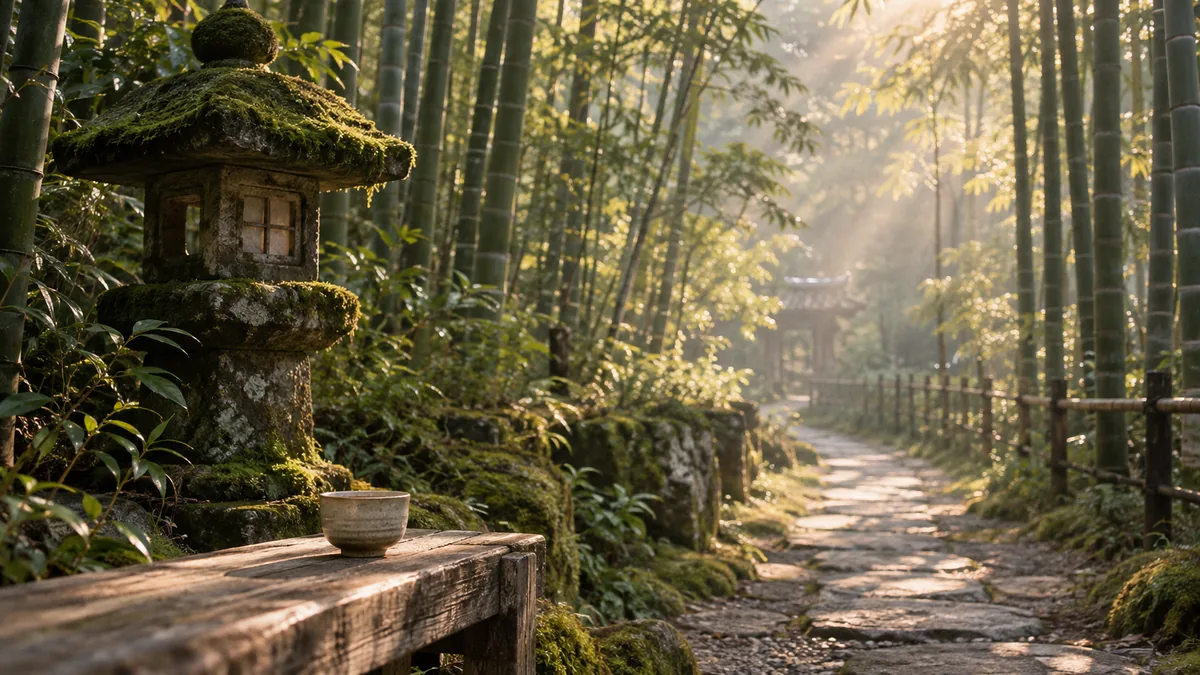
A few kilometers to the west lies the district of Arashiyama, where the Sagano bamboo forest rises toward the foothills of Mount Ogura. If you arrive just as the morning mist begins to lift, before the tour buses rumble into the narrow lanes, the grove possesses an atmosphere so serene it borders on the sacred.
Walking between the towering emerald stalks, your footsteps are cushioned by layers of fallen bamboo leaves. High above, the culms soar twenty meters toward the canopy, swaying gently against the pale morning sky. The sound they make when the wind moves through them is legendary in Japan—a resonant, hollow creaking followed by the rustling whisper of millions of delicate leaves, officially designated as one of the “100 Soundscapes of Japan.”
Standing in the stillness of that grove, an essential botanical truth becomes evident: bamboo is not a hardwood tree. It does not possess the massive, stubborn trunk of a mountain oak or an ancient elm. When typhoons sweep across the Kyoto basin during late summer, the giant oaks often snap under the sheer violence of the gale because their rigid wood refuses to bend. Their unyielding strength becomes their undoing.
Bamboo, by contrast, bends. When a fierce gust strikes the grove, the slender canes bow deeply toward the earth, arching in astonishing, sweeping curves. They groan, they sway, but they almost never snap. And the moment the wind relents, they spring upright once more, unblemished and whole.
Bamboo survives because it embodies two fundamental principles that we modern humans have largely forgotten:
- Emptiness at the Center (Shunyata): The inside of a bamboo cane is completely hollow. It does not waste energy filling its core with dense, heavy matter. Because it is hollow, it is lightweight, remarkably flexible, and free of internal tension.
- The Wisdom of Yielding (Ju): It does not waste its strength trying to fight the hurricane or assert its superiority over the wind. It yields instantly. It acknowledges the force of reality and accommodates it.
How much of our mental anguish comes from mistaking rigidity for strength? We imagine that being strong means holding our ground at all costs, defending our opinions to the death, and refusing to let our plans be diverted by unexpected circumstances. Yet, as we discovered when exploring the gentle art of setting boundaries in The Grace of Saying ‘No’, true strength is never aggressive or stubborn. True strength is yielding. It is the ability to say: “The storm is here today. I will bend with it. I will lower my head and let it pass through my hollow center, knowing that my roots are deep and I will rise again tomorrow.”
3. Mono no Aware: Finding Beauty in What Does Not Last
In Western aesthetics, beauty has historically been equated with eternity. We carve marble statues designed to outlast centuries; we preserve paintings under climate-controlled glass; we admire buildings that promise to stand forever. There is a deep-seated belief that for something to possess ultimate value, it must endure.
The traditional Japanese worldview inverted this premise entirely through the concept of Mono no Aware (物の哀れ)—literally translated as “the gentle pathos of things,” or a bittersweet sensitivity to the transience of life.
Under the lens of Mono no Aware, things are not precious despite their impermanence; they are precious because of it. A plastic cherry blossom branch never wilts, never loses its petals to the frost, and never changes color. Yet no poet writes verses about plastic blossoms, and no traveler weeps at the sight of them. They evoke nothing because they risk nothing. They cannot die, and therefore they are never truly alive.
Real cherry blossoms (Sakura) bloom for barely seven to ten days in early April. A sudden spring downpour can strip the branches bare in a single evening, carpeting the stone pathways in pale pink drifts. When Kyoto families spread their woven mats beneath the boughs, their joy is heightened by the unspoken awareness that next week, the branches will be bare. The beauty is inextricably bound to the goodbye.
When we apply this awareness to our own human existence, our relationship with time undergoes a profound transformation. We stop frantically measuring our progress against artificial milestones—a topic we examined deeply in The Myth of Falling Behind—and begin noticing the fragile beauty of ordinary seasons that will never return.
Consider the stark psychological difference between a mind conditioned to cling and a mind grounded in the quiet acceptance of impermanence:
| Life Dimension | The Clinging Mind (Chronic Fatigue) | The Zen Mind (Quiet Freedom) |
|---|---|---|
| Transitions & Change | Fights change; treats disruptions as personal failures or emergencies. | Honors life’s seasons; welcomes the new without clutching the old. |
| Loss & Endings | Clings with guilt; replays “what ifs”; stays trapped in nostalgia. | Practices Mono no Aware; honors memories with open, grateful palms. |
| Imperfection | Obsessed with flawless symmetry, social approval, and control. | Embraces Wabi-Sabi; sees weathered patina and cracks as sacred history. |
| The Present Moment | Mentally absent; constantly recording or preparing for the next task. | Lives in Ichigo Ichie—revering this exact moment because it will never recur. |
| Personal Worth | Tied to permanent trophies, net worth, and external validation. | Rests in the quiet truth that you are inherently whole without outer armor. |
When you sit quietly in the moss garden of Saihō-ji (the Moss Temple), where over one hundred varieties of velvety green moss carpet the earth beneath ancient maples, you realize that nature does not clean up its dead leaves in a panic. The fallen red leaf decays into the damp soil, nourishing the very moss that cradles it. What looked like a tragic ending was merely the beginning of another quiet form of life.
4. Kintsugi of the Soul: The Golden Beauty of Your Fractures
On a quiet backstreet near the Gion district, in a modest workshop smelling of pine resin and natural urushi lacquer, an elderly craftsman sits over a broken ceramic tea bowl (chawan). The bowl was accidentally dropped, its delicate stoneware fractured into three jagged fragments.
In many modern cultures, a broken object is deemed worthless—trash to be discarded and instantly replaced with a cheap, identical substitute from an online catalog. But in the Japanese tradition of Kintsugi (金継ぎ, literally “golden joinery”), the break is where the true story begins.
The artisan does not attempt to conceal the damage. He does not use clear epoxy to pretend the bowl was never dropped. Instead, he mixes Japanese tree sap lacquer with pure powdered gold or silver, carefully cementing the shards back together. Over weeks of delicate curing and polishing, the fracture lines become luminous, gleaming rivers of gold traversing the ceramic surface.
When the restored bowl is held in two hands, it is not merely repaired; it is infinitely more compelling than it was before it fell. The golden veins celebrate its survival. They tell the truth of what it endured.
This is the spiritual antidote to the chronic shame so many of us carry. We spend tremendous amounts of emotional energy trying to hide our scars, our failed ventures, our divorces, our bouts of burnout, or our past missteps—a heavy burden we learned to release when exploring self-compassion in Making Peace with Your Younger Selves. We imagine that to be worthy of love and respect, we must present an unblemished, impervious facade to the world.
Kintsugi whispers the opposite: your fractures are not your shame. They are your golden seams. The seasons when your heart was broken, when your plans collapsed, or when your health forced you into radical rest—as outlined in The 7 Types of Rest—were not wasted years. They were the crucible in which your superficial illusions were stripped away, making room for genuine empathy, depth, and humility.
5. Bringing Kyoto Home: Four Micro-Practices for Quiet Acceptance
You do not need to book a flight to Kansai or shave your head to enter a Zen monastery to weave this stillness into your daily existence. The wisdom of Kyoto is not geographical; it is an internal posture toward reality. Here are four practical, unhurried rituals you can begin practicing tomorrow morning in your own living room:
1. The Ritual of Ichigo Ichie (一期一会)
Coined by 16th-century tea master Sen no Rikyū, Ichigo Ichie translates poetically as: “One time, one meeting.” It reminds us that every single gathering, every conversation, and even every solitary cup of morning tea is an unrepeatable occurrence in the history of the universe. Even if you sit at the same kitchen table with the same person tomorrow, the weather will be different, your cells will have aged, and the world will have turned. Tomorrow’s tea is a different tea. When drinking your first cup tomorrow, put down your smartphone. Drink the tea as if it were the only cup you will ever be granted.
2. The Morning Raked Garden of the Mind
Before checking your notifications or letting the urgent demands of the day flood your senses, grant yourself three minutes of silent sitting upon a chair or cushion. Imagine your mind as the raked courtyard of Ryōan-ji. Thoughts will enter—worries about money, reminders of emails, fragments of memories. Do not try to strangle them or force them out. Simply watch them pass across the gravel like fallen pine needles, and gently return your attention to the rhythm of your breath.
3. The Bamboo Stance (The Yielding Breath)
When unexpected disruptions occur—a canceled flight, a lost contract, an angry email, a sudden domestic crisis—notice your instinctive reaction to tighten your jaw and fight the event. In that exact moment, take one deep, diaphragmatic breath and inwardly whisper: “I bend like the bamboo. I do not break. The wind is real, but so is my flexibility.” Acknowledge the storm without letting it shatter your internal peace.
4. Kinhin: Walking Without an Agenda
In Zen temples, seated meditation (Zazen) is alternated with walking meditation (Kinhin). Unlike your daily commute, where your feet are merely vehicles rushing you toward a deadline, Kinhin is walking purely for the sake of walking. Step outside for ten minutes with empty hands. Feel the contact of your soles against the pavement; notice the subtle temperature of the air against your skin. Walk at the speed of your own soul, just as the flâneur discovers wonder on the boulevards of Europe in The Art of Flânerie.
Quiet Inquiries on Zen Stillness and Letting Go