




Consider the last time your feet moved without a predefined destination. For most of us, walking has long ceased to be an act of discovery. It has been reduced to an errand of transportation—a mechanical, hurried passage between where you are and where you are expected to be. You slip on your shoes, press noise-canceling […]
Consider the last time your feet moved without a predefined destination.
For most of us, walking has long ceased to be an act of discovery. It has been reduced to an errand of transportation—a mechanical, hurried passage between where you are and where you are expected to be. You slip on your shoes, press noise-canceling earbuds into your ears, glance at the blue pulsing dot on your digital map, and set off with the brisk, defensive momentum of someone walking through an airport terminal. Even on Sunday mornings, when there are no deadlines looming, an invisible metronome ticks in the back of your skull. You measure your path in kilometers, in pace per minute, in rings closed on a wearable fitness tracker.
You may be moving through an ancient park, past centuries-old limestone façades, or beneath the quiet canopy of sycamore trees, but you are not really there. Your body is navigating the pavement, but your mind is already three emails ahead, drafting replies to hypothetical arguments, or replaying the anxieties of yesterday. The world slides past your peripheral vision as an unexamined blur: the scent of warm roasted coffee drifting from a basement roastery, the delicate curvature of a wrought-iron balcony, the sudden play of amber light across an ordinary puddle.
Then, at a quiet crosswalk or while waiting for a traffic light to turn, a strange feeling catches in your chest. You look down at your restless feet and realize a quiet ache: It has been months, perhaps years, since you walked simply for the sacred joy of being alive.
You Are Not Inefficient; You Are Starving for Awe
If you have ever felt a sudden urge to turn down an unfamiliar alley, to abandon your itinerary, or to wander aimlessly until dusk without checking the clock, your instinct was not an impulse of laziness. It was a cry for help from an exhausted nervous system.
Modern culture has weaponized efficiency to such an extent that even our leisure has been colonized by productivity. We are told to take walks “for cardio,” to walk “to clear our heads so we can work better,” or to listen to educational podcasts while walking so that “no time is wasted.” We have turned an ancient, poetic human ritual into an optimization problem.
“When every step you take must serve an outcome, your feet may travel hundreds of miles, but your soul remains trapped in the exact same frantic room.”
To wander without an agenda is not a dereliction of duty. It is an act of quiet rebellion against a world that demands a transaction from every passing second. What you are craving is not another wellness hack or an extra thirty minutes of sleep; you are starving for unhurried observation. You are longing for the lost art of the flâneur.
The Soul of the Flâneur: An Antidote to the Clock
In nineteenth-century Paris, amid the rising din of industrialization, factory whistles, and newly paved boulevards, a new cultural figure stepped into the light: the flâneur. Immortalized by poet Charles Baudelaire and later illuminated by philosopher Walter Benjamin, the flâneur was someone who walked the city streets with neither urgency nor destination, treating the urban landscape as a boundless, living sanctuary of contemplation.
The flâneur was neither a tourist rushing between monuments nor an idle loiterer with nothing to do. Baudelaire described him as a “passionate spectator”—someone who could plunge into the heart of the multitude and remain entirely centered in his own quiet soul. To practice flânerie was to look at life with wide, patient eyes, observing the human comedy, the subtle architectural textures, the quiet encounters, and the shifting moods of the sky with the reverence one usually reserves for high art.
Where the modern commuter sees the street as an obstacle course to be conquered, the flâneur sees it as an unfolding poem. When you strip away the demand to arrive, walking ceases to be work. It becomes an act of effortless listening.
4 Dimensions of Mindful Wandering
1. Surrendering the Fetish of the Finish Line
The moment you decide where you are going, your brain creates an invisible tension. Any detour feels like a mistake; any delay feels like an irritation. But when you embark on an aimless walk, you cannot take a wrong turn. You cannot be late. You cannot fail. The street that seems dark and dead-end might hold an old bookstore window; the quiet courtyard you stumbled into might offer a stone bench bathed in golden evening light. By discarding the finish line, you instantly dismantle the anxiety that rules your waking hours.
2. The Science of Soft Fascination
Psychologists Rachel and Stephen Kaplan, pioneers of Attention Restoration Theory, made an essential distinction between two types of human attention:
- Directed Attention: The intense, exhausting mental energy you use when typing at a screen, analyzing spreadsheets, or monitoring notifications. It requires active inhibition of distractions, and when sustained for too long without pause, it leads directly to cognitive burnout and irritability.
- Soft Fascination: The effortless, reflective attention triggered by gentle, aesthetically rich environments—the rustle of breeze through chestnut leaves, the flickering shadows on cobblestones, the soft chatter of people sharing tea under a canvas awning.
During an unhurried walk, your directed attention is finally permitted to go offline. Your prefrontal cortex cools down, your parasympathetic nervous system engages, and your brain naturally restores its capacity for creative thought and emotional balance.
3. Recovering the Emotion of Awe
When you rush through life, your perceptual world contracts to the width of your palm. You obsess over minor social slights, looming bills, and small professional friction. But when you step outside and allow your eyes to wander across architectural arches, weathered stone facades, and the vast canvas of the sky, your sense of perspective expands.
Psychologists call this the awe response: the profound realization that you are a small, quiet part of a magnificent, interconnected universe. Awe dissolves self-absorption. It makes your heavy burdens feel surprisingly light.
4. Becoming an Anonymous Inhabitant
In our hyperconnected digital existence, we are constantly performers. We curate our profiles, manage our reputations, and feel the constant scrutiny of metrics. An unhurried walk through a neighborhood offers the supreme luxury of anonymity. Among strangers who do not know your job title, your follower count, or your secret insecurities, you are simply another human being breathing the cool air, observing life, unencumbered and free.
The Commute vs. The Art of Flânerie
To help you distinguish between walking as a physical task and walking as a contemplative practice, consider how radically your inner landscape changes when you alter your intention:
| Dimension | The Destination-Driven Walk | The Mindful Flânerie Walk | The Inner Shift |
|---|---|---|---|
| Primary Objective | To arrive at Point B as quickly as possible; to close calorie rings or log steps. | No destination; the presence of your footsteps is the sole purpose. | From the pressure of Doing to the relief of Being. |
| Visual Focus | Pavement, map screen, obstacles, oncoming pedestrians to evade. | Upper balconies, play of sunlight, textures of tree bark, small human rituals. | From cognitive tunnel vision to soft, expansive fascination. |
| Physical Posture | Tense shoulders, forward-leaning neck, tight chest, shallow breathing. | Dropped shoulders, upright spine, wide peripheral vision, natural deep breath. | Soothing the sympathetic overdrive into deep somatic ease. |
| Emotional Aftermath | Physical exhaustion paired with an unsettled, hurried mental velocity. | A quiet sense of groundedness, gentle wonder, and renewed perspective. | Reclaiming your rightful place as an unhurried witness of life. |
3 Simple Rituals to Practice Flânerie Anywhere
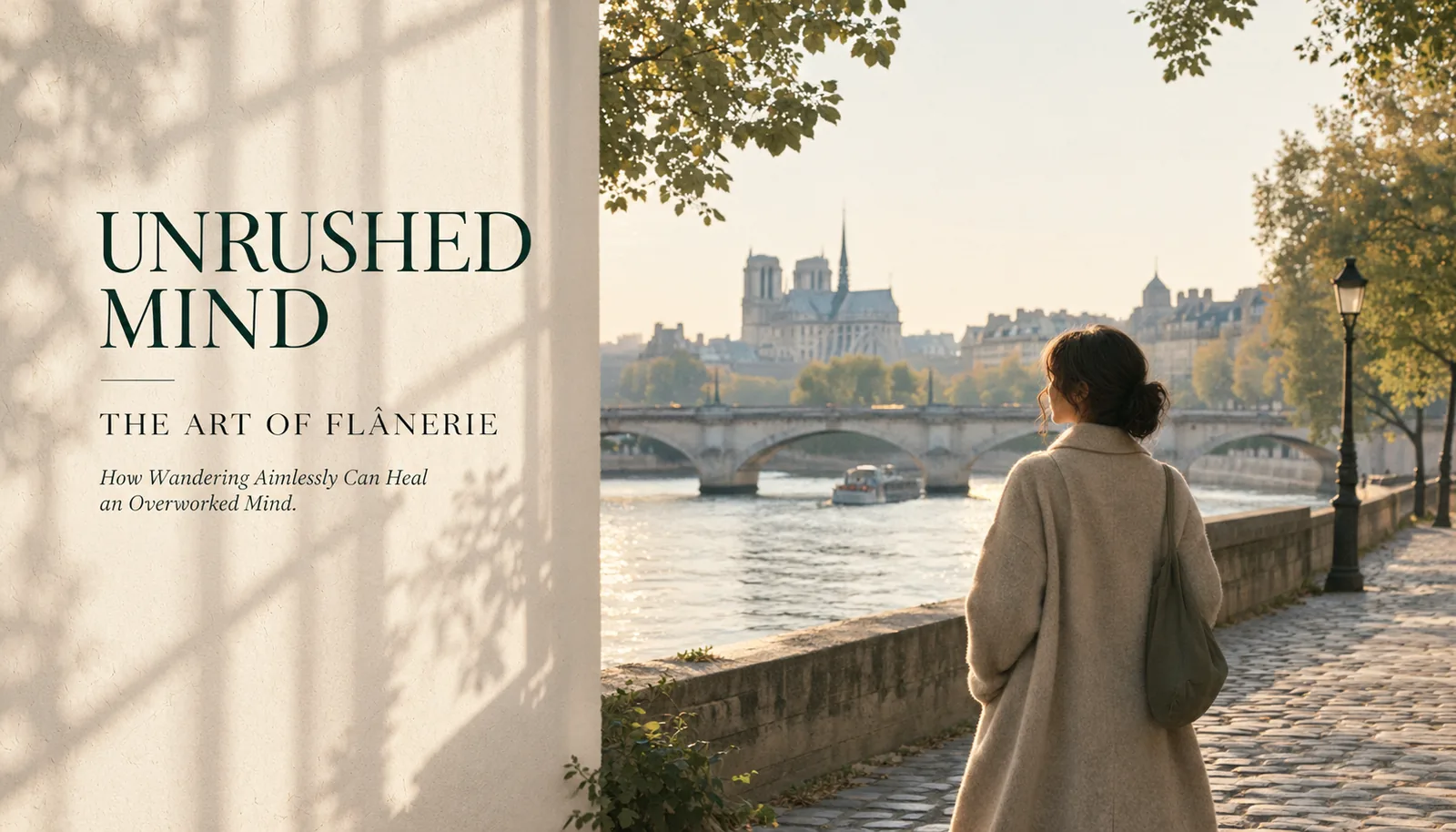
You do not need a plane ticket to Paris or a stroll along the Seine to cultivate the spirit of the flâneur. Flânerie is not a geography; it is an internal posture. You can practice it in a quiet suburban lane, through an industrial harbor district, or in the dense streets of any modern metropolis.
1. The Compass-Free Twenty Minutes
Once this week, step outside your front door with your phone switched to airplane mode and tucked securely deep inside your coat. Commit to walking for twenty minutes with no planned trajectory. At every intersection, do not calculate what route is shortest or most convenient. Ask your senses: Which street looks quieter? Which alley catches the afternoon light? Where does the breeze invite me? Allow yourself to follow curiosity instead of an algorithm.
2. Look Up Above the First Floor
Modern cities are designed to trap human attention at street level through aggressive advertisements, bright logos, and shopfront displays. Tomorrow, try walking with your gaze consciously lifted above the ground floor. Look at the second-story brickwork, the dormer windows, the gargoyles, the rooftop gardens, and the open patches of sky between buildings. The moment you look above the commercial line, the city transforms from an outdoor shopping mall into a sanctuary of human history and quiet beauty.
3. The Sidewalk Anchor
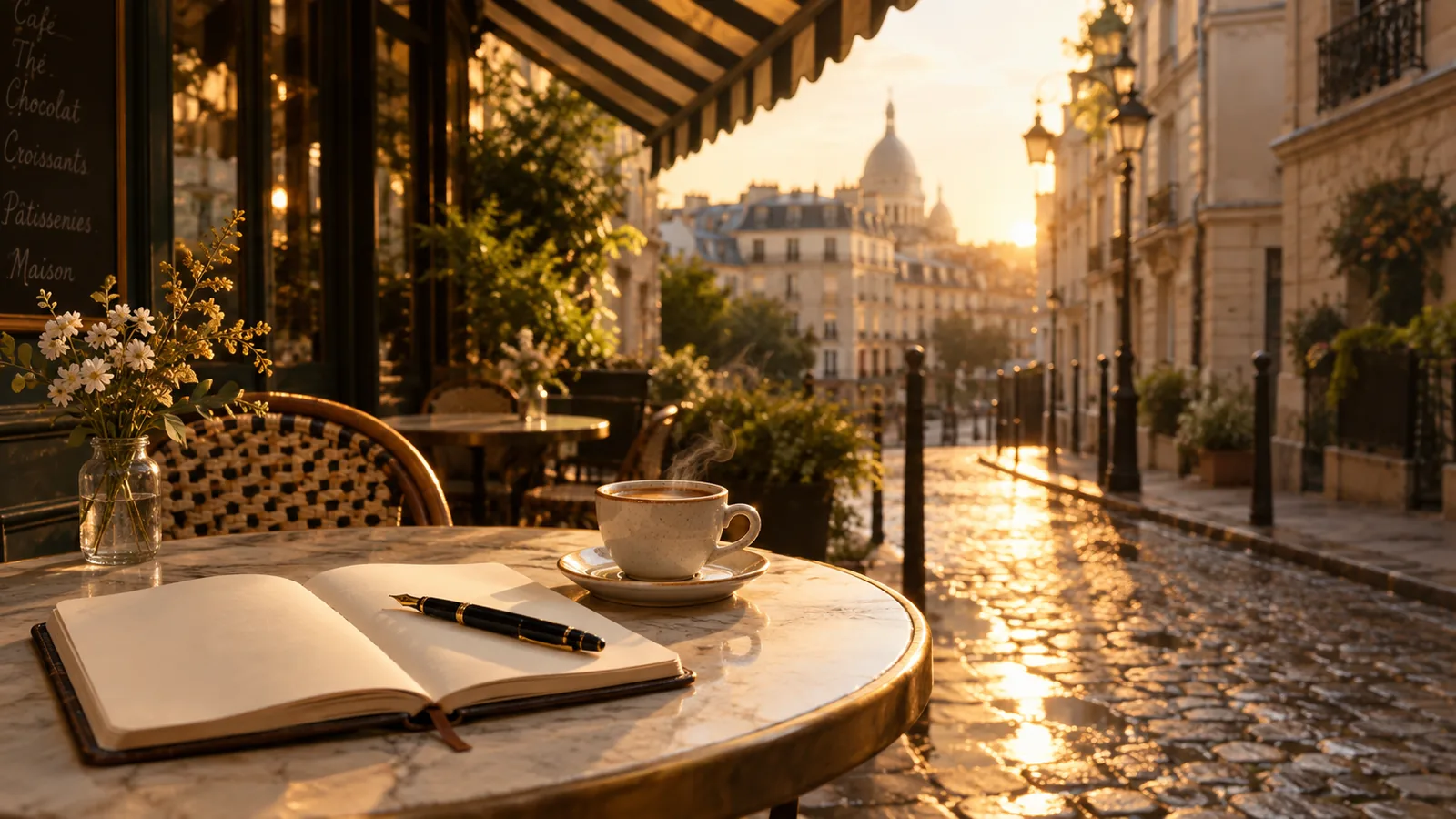
Part of being a flâneur is knowing when to stand or sit perfectly still. Find a wooden bench in a neighborhood park, or sit outside a small café with a single warm drink. Do not pull out your device to pass the time. Sit with your hands resting gently in your lap and simply watch the choreography of life: a dog happily pulling its owner toward a patch of grass, an elderly couple sharing an umbrella, the wind scattering dry leaves across the stone. Remind yourself that you do not need to manage the universe; you are allowed to simply sit back and watch it turn.
An Unhurried Parting Thought
In his iconic reflections on walking, Walter Benjamin noted that not knowing your way around a city is ordinary and dull. But to lose oneself in a city, as one loses oneself in a deep forest, requires a rare and tender education.
When you allow yourself to wander without a destination, you are not losing your time. You are giving your overworked mind permission to catch up with your body. You are remembering that your life is not a project to be completed, a schedule to be defended, or a race to be won.
Step outside. Leave the map behind. Drop your shoulders, take a long, deep breath of cool air, and let the gentle rhythm of your own unhurried footsteps guide you home to yourself.