By mid-afternoon, your eyes feel as though fine sand was rubbed beneath the lids. A dull ache pulses behind your temples, while an unexplained wave of irritability ripples through your thoughts. You assume this fatigue comes from low willpower or too little coffee. In truth, your brain is reacting to hours of staring into a […]
By mid-afternoon, your eyes feel as though fine sand was rubbed beneath the lids.
A dull ache pulses behind your temples, while an unexplained wave of irritability ripples through your thoughts.
You assume this fatigue comes from low willpower or too little coffee.
In truth, your brain is reacting to hours of staring into a sixteen-inch glowing rectangle.
Confined indoors, your vision collapses into a tight tunnel that locks your nervous system into high alert.
To break this biological lock, you need the restorative power of optic flow mental fatigue screens, where expansive horizons dissolve what the intellect cannot reason away.
The Hidden Neurobiology of the Gaze: Foveal Vigilance vs. Panoramic Calm
For hundreds of thousands of years, the visual system served as humanity’s primary survival compass.
When our ancestors tracked prey or scanned the brush, their pupils constricted into sharp focal vision.
Inside the brainstem, a neural cluster called the locus coeruleus floods the body with norepinephrine, sharpening vigilance.
This acute alertness was designed as a temporary survival sprint lasting only minutes.
Yet modern screen work demands that you hold this predatory visual lock for eight to ten continuous hours.
Because your gaze stays tethered to high-contrast pixels, your brainstem assumes danger is near, keeping sympathetic defenses perpetually engaged.
What Is Optic Flow? The Biological Antidote to Screen Overload
Fortunately, evolutionary biology also engineered a built-in off-switch for this chronic alertness.
When you walk forward through an open landscape, images of trees and ground naturally slide across your eyes.
Neuroscientists describe this dynamic lateral visual motion as optic flow.
Research at Stanford University confirms that self-generated optic flow directly quiets the amygdala, the brain’s threat-detection hub.
By moving through open space, you signal your autonomic circuits that you are walking toward safety, lowering internal alarms.
Much like the restorative power of sensory rest, visual expanse allows weary neural networks to recalibrate.

The Power of Panoramic Vision: Softening the Eyes to Quiet the Brain
You do not need to hike up a mountain to experience this neurological release.
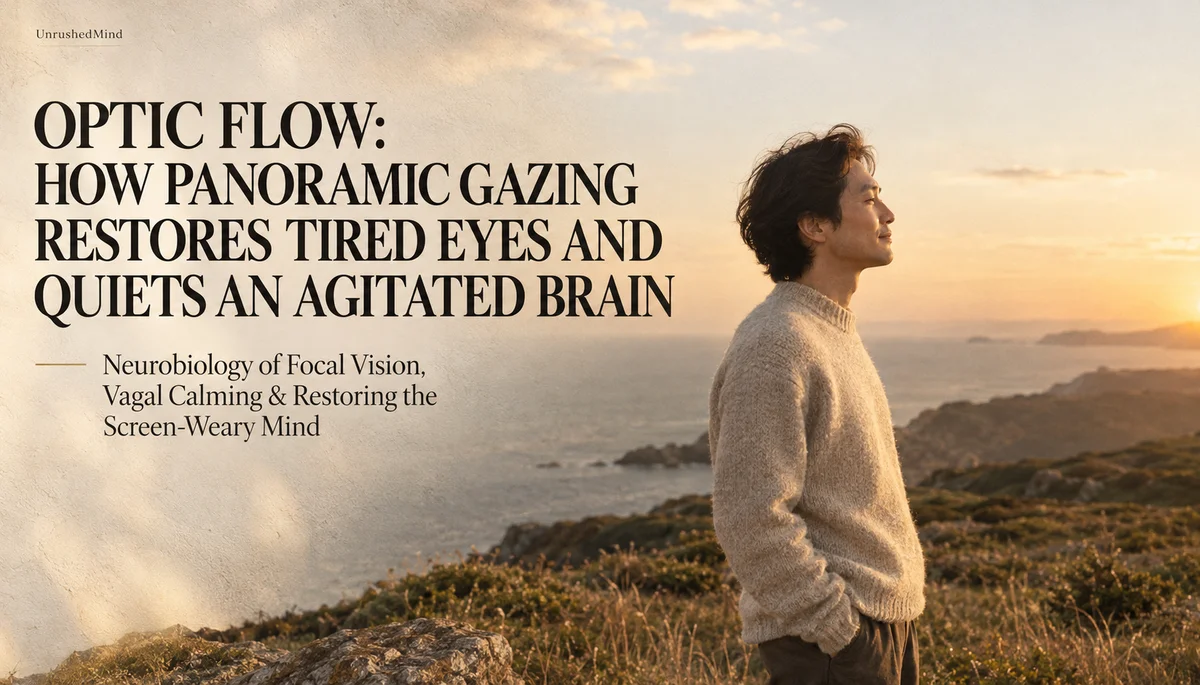
You can disengage the vigilance circuit indoors simply by shifting from focal lock into panoramic vision.
When you widen your view to perceive the ceiling, floor, and peripheral walls simultaneously, something remarkable happens.
The microscopic ciliary muscles inside your eyes, cramped from holding near-point focus, immediately relax.
Simultaneously, the parasympathetic nervous system engages, releasing acetylcholine to slow your pulse and deepen your breath.
Pairing this visual expansion with targeted vagus nerve reset practices creates an instant somatic sanctuary.
Comparative Matrix: Visual Focus and Autonomic Nervous States
The relationship between where you direct your eyes and the state of your inner biology is mechanical and immediate:
| Foveal Screen Confinement | Optic Flow & Horizon Gazing | Restored Autonomic State |
|---|---|---|
| Narrow focal fixation on a close glass rectangle under high contrast. | Expanded peripheral field with dynamic lateral visual movement. | Instantaneous shift from sympathetic alarm to parasympathetic calm. |
| Ciliary muscle spasms, dry burning corneas, and shallow apical breathing. | Complete relaxation of intraocular muscles and spontaneous sighing breath. | Deep physical decompression across the neck, jaw, and upper chest. |
| Heightened locus coeruleus firing, high cortisol, and racing internal chatter. | Down-regulation of amygdala activity and emergence of steady alpha brainwaves. | Spacious mental clarity, restored emotional patience, and grounded poise. |
Four Gentle Rituals to Release Screen Strain and Restore Peace
Reclaiming visual ease does not require abandoning technology or moving off-grid.
These four somatic rituals allow your biology to breathe:
1. The Horizon Scan
Every ninety minutes, step away from your workstation to an open window or balcony.
Pick the furthest cloud or tree on the horizon and let your eyes rest effortlessly there for two full minutes.
2. The Peripheral Soft-Eye Expansion
While seated, soften your focus until you can perceive everything above, below, and beside you without shifting your eyes.
Hold this panoramic awareness for sixty seconds while noticing how naturally your shoulders drop.

3. The Twilight Optic Flow Walk
At day’s end, take a fifteen-minute stroll outdoors without headphones or mobile screens.
Keep your head level and allow the landscape to glide past your peripheral field, clearing workday static.
4. Warm Eye Palming
Rub your palms together until they radiate soothing friction heat.
Cup your warm hands gently over closed eyes, savoring two minutes of pure, quiet darkness.
Frequently Asked Questions About Optic Flow and Screen Fatigue
Why does looking at screens make us feel mentally irritable?
Staring at a near-field screen locks your visual field into foveal focus, triggering the brain’s vigilance networks and increasing norepinephrine release.
This chronic physiological arousal mimics a survival response, exhausting mental reserves and causing emotional short-temperedness.
How quickly does panoramic vision calm the nervous system?
The transition is almost immediate because the optic nerve connects directly to brainstem autonomic control centers.
Within thirty to sixty seconds of widening your peripheral gaze, ciliary muscles relax and parasympathetic vagal tone measurably increases.
Is outdoor walking truly more effective than indoor screen breaks?
Yes, because outdoor forward motion produces genuine lateral optic flow across the retinas, which mechanically dampens amygdala hyperactivity.
Natural landscapes also provide infinite focal depth, allowing your eyes to alternate effortlessly between close steps and distant horizons.
Soften Your Gaze, Reclaim Your Sanctuary
Your mind was never meant to be confined inside a glass-framed inbox or social feed.
Whenever you feel tight, hurried, and depleted, remember that your eyes hold the biological key to your calm.
Lift your chin, gaze out toward the open horizon, and let the spacious world restore what the screen has stolen.