
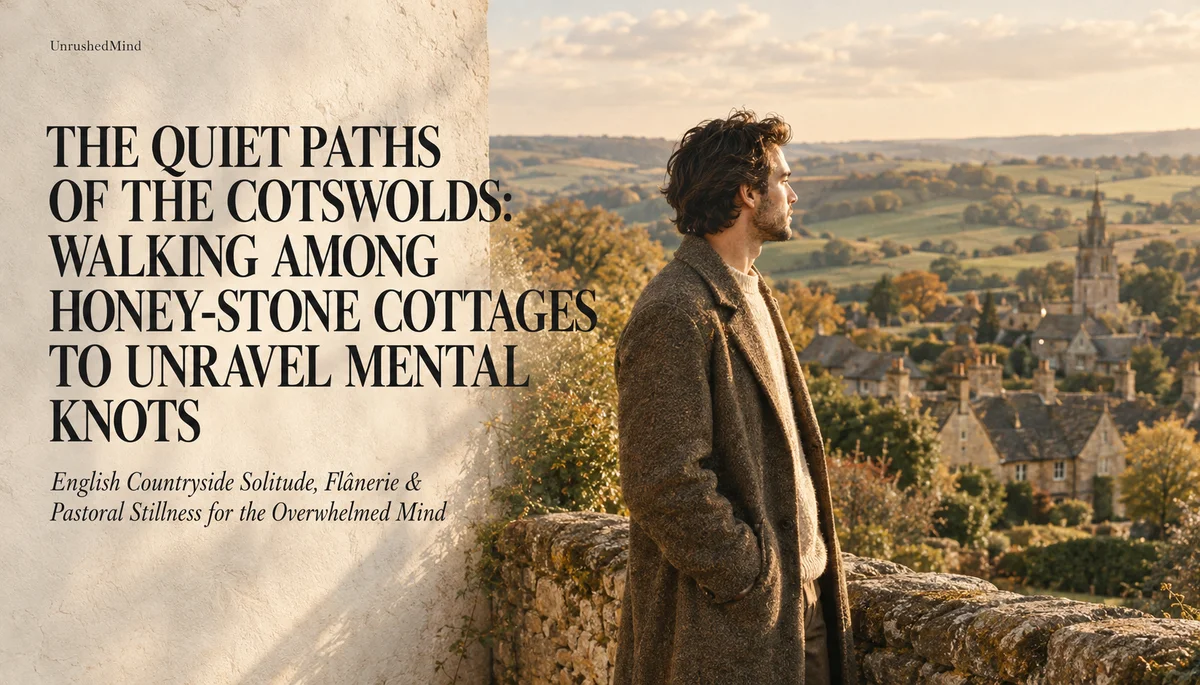
There are days when your thoughts feel like a snarled ball of twine, pulled so tight that any deliberate effort to untangle them only cinches the knots deeper. Sitting motionless in a chair staring at an unrelenting screen, you attempt to force order onto an exhausted spirit. Yet the mind was never designed to resolve […]
There are days when your thoughts feel like a snarled ball of twine, pulled so tight that any deliberate effort to untangle them only cinches the knots deeper.
Sitting motionless in a chair staring at an unrelenting screen, you attempt to force order onto an exhausted spirit.
Yet the mind was never designed to resolve its deepest existential knots while trapped in physical stasis within artificial right angles.
When cognitive bandwidth collapses, you need the restorative quietude of cotswolds slow walks, where the rhythm of your own footsteps quietly does what your conscious intellect cannot.
The Wisdom of Solvitur Ambulando: Movement as Medicine
Centuries ago, ancient philosophers coined the enduring Latin proverb Solvitur ambulando, translating simply to “it is solved by walking.”
The concept affirms that mental gridlock dissolves not through aggressive contemplation, but through unhurried ambulatory movement through natural landscapes.
As your feet move across public footpaths, gentle bilateral sensory movement systematically quiets the overstimulated prefrontal cortex, transforming internal static into luminous clarity.
Much like the contemplative art of flânerie along historic streets, solitary rambling through pastoral lanes unburdens the soul from urgency.
The Honey-Stone Sanctuary: Why Ancient Vernacular Calms the Brain
Nestled across the rolling limestone hills of Gloucestershire, the villages of the Cotswolds seem carved directly out of the living earth.
Here, every cottage, barn, and garden wall is sculpted from weathered oolitic limestone, possessing an innate golden luminescence known as honey-stone.
Unlike sterile contemporary drywall or cold reflective glass, these centuries-old honey-stone cottages radiate a gentle, grounding visual warmth that disarms the nervous system.
Their soft curves, lichen-encrusted roofs, and hand-chiseled stones echo the organic geometry that our biology recognizes as fundamentally safe.

Gazing at a cottage in Upper Slaughter that has sheltered human hearts since the seventeenth century recalibrates your temporal perspective.
These patient dwellings have endured ferocious winter storms and societal upheavals without losing their quiet dignity.
Standing before their mossy thresholds, the urgent anxieties dominating your morning inbox suddenly shrink to their rightful proportions.
The Geology of Grounding: Reclaiming an English Countryside Mind
Cultivating a peaceful english countryside mind requires a radical departure from the artificial urgency of modern life.
When you step onto an ancient bridleway bordered by dry-stone walls and grazing sheep, your visual field undergoes an expansive shift known as optic flow.
Neuroscientists have demonstrated that steady forward motion through greenery triggers calming alpha waves in the brain, inducing deep emotional stillness.
The chronic autonomic arousal of modern living melts away into the damp earth with every gravel crunch beneath your boots.
Mental State Transformation: From Digital Gridlock to Pastoral Peace
The contrast between modern cognitive overwhelm and the restorative sanctuary of pastoral walking is profound:
| The Modern Cognitive Tangle | The Cotswold Footpath Sanctuary | The Restored Inner State |
|---|---|---|
| Static confinement behind glowing screens and digital interruptions. | Unobstructed horizons of rolling green pastures and ancient rights-of-way. | Deep optical relaxation and the reactivation of default mode contemplation. |
| Aggressive rumination attempting to force immediate solutions. | Rhythmic, unhurried bilateral footsteps along limestone streams. | Natural dissolution of psychic gridlock without intellectual strain. |
| Temporal panic dictated by calendar notifications and deadlines. | Weathered dry-stone walls standing firm through centuries of history. | Restoration of profound temporal spaciousness and emotional poise. |
Four Sacred Practices to Unravel Mental Knots in the Countryside
To experience the healing alchemy of the Cotswolds, abandon the modern urge to turn walking into a fitness performance metric.
These four simple rituals help you absorb the gentle medicine of the landscape with your whole being:
1. Choose the Public Footpath Over the Tarmac
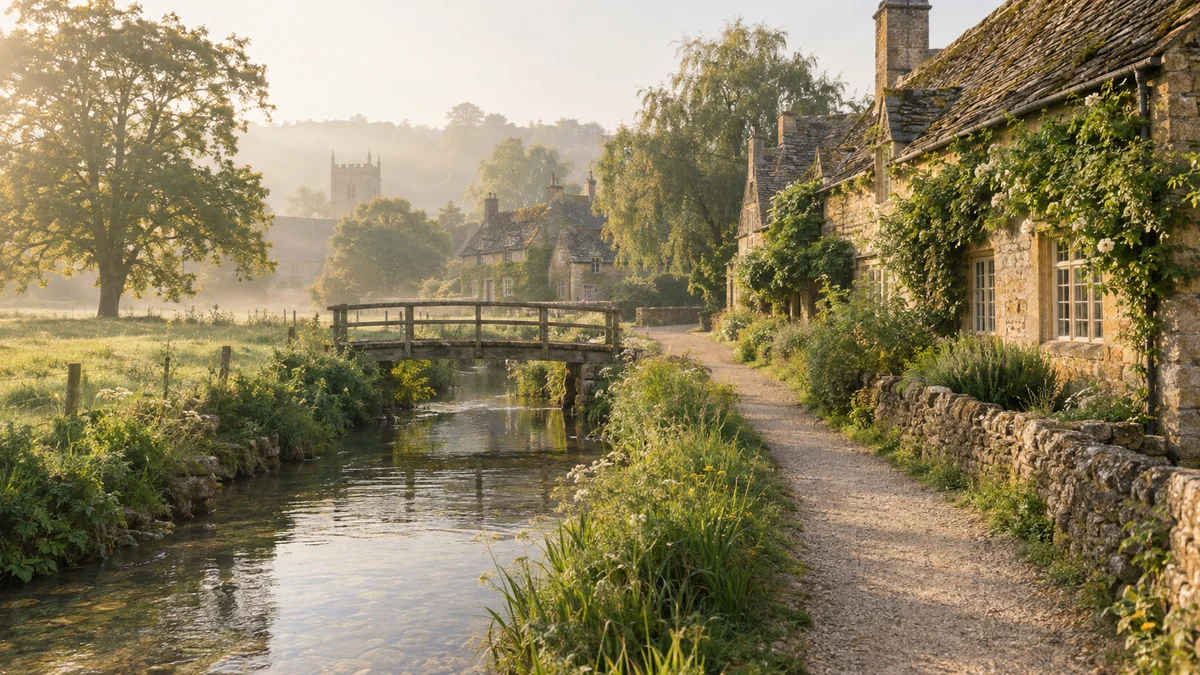
England is blessed with an ancient network of public footpaths crossing farmland, meadows, and riverbanks by legal right.
Step away from asphalt roads and navigate by wooden waymarker arrows through kiss-gates and stiles to reclaim a primal connection to common land.
2. Touch the Weathered Dry-Stone Walls
As you stroll between villages, pause beside the unmortared limestone walls that partition the landscape.
Place your bare hand against the sun-warmed stone and feel the soft textures of velvet lichen, grounding your nervous system instantly.
3. Embrace the Sanctuary of Hearthside Tea
After miles of solitary walking in the crisp countryside air, seek the low-ceilinged sanctuary of an ancient village inn.
Warm your hands beside a crackling hearth while sipping loose-leaf tea alongside warm, clotted-cream scones.
Much like the sanctuary of slow travel across scenic tracks, these modest pauses consecrate time without guilt.
4. Surrender the Metric of Miles and Paces
Do not check your smartwatch to calculate steps, speed, or burned calories.
Measure your walk instead by the scent of wild thyme, the murmur of the river, and the deepening slant of evening light.
Frequently Asked Questions About Mindful Countryside Walking
Why is slow walking in the countryside more restorative than urban walks?
Urban environments demand directed attention to filter traffic and navigation hazards, exhausting the brain’s executive networks.
Rural footpaths engage soft fascination, allowing fatigued cognitive systems to completely recharge in peaceful seclusion.
What makes the Cotswolds uniquely suited for calming mental overwhelm?
The region combines rolling topography with an unmatched density of car-free public footpaths and harmonious honey-stone architecture.
This organic balance of soft visual geometry, geological warmth, and pastoral silence creates an ideal sanctuary for decelerating racing thoughts.
How does rhythmic walking help unravel complicated life decisions?
Bilateral stimulation from rhythmic walking engages both brain hemispheres, facilitating lateral thinking and emotional de-escalation.
By discharging physical tension through your feet, intuitive answers arise spontaneously without the strain of forced analysis.
The Path Awaits Your Footsteps
Whenever your thoughts become so tangled that breathing feels shallow, remember that clarity cannot be aggressively manufactured.
Step outside, leave behind the chatter of the digital world, and let the quiet paths of the countryside receive your weary burdens.
In the gentle embrace of ancient limestone and timeless pastures, every knot unties itself when you simply walk in peace.