

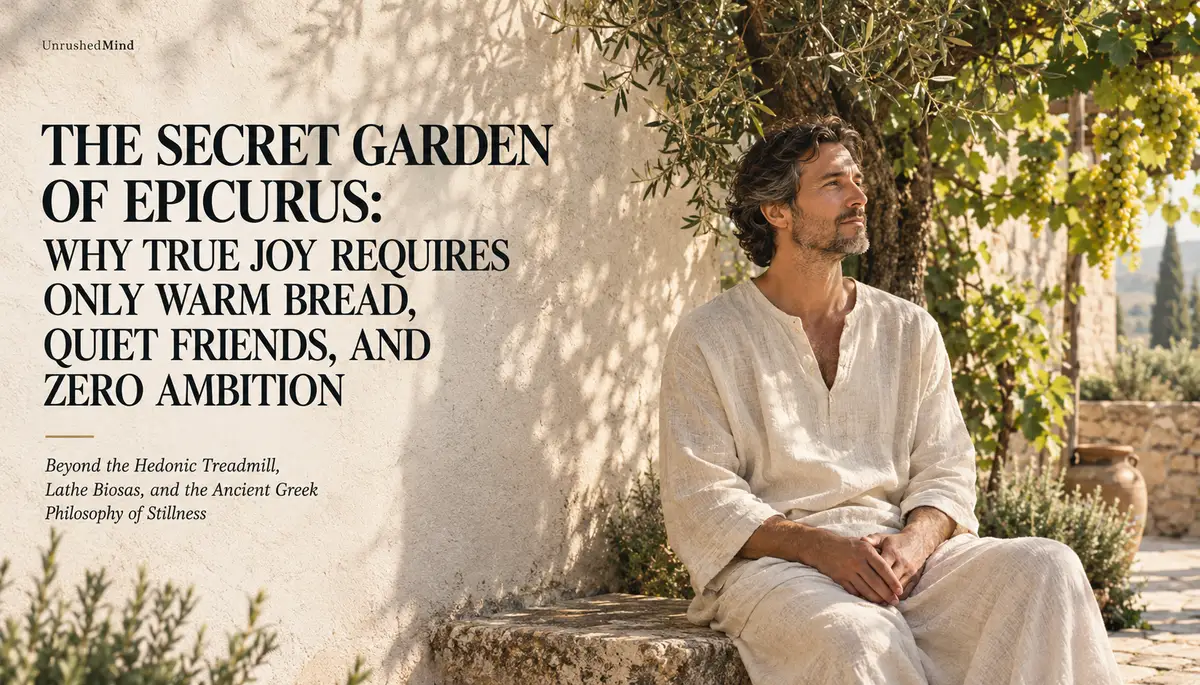
Table of Contents Hide 1. The Banquet of Exhaustion 2. The Great Slander of Epicurus 3. The Garden Beyond the City Walls 4. Diagnostic Table: Modes of Pleasure 5. 3 Gentle Anchors of the Garden Life 5.1 1. Reclaim the Sovereignty of Plain Sustenance 5.2 2. Cultivate the Sanctuary of Unhurried Friendship 5.3 3. Embrace […]
The Banquet of Exhaustion
You have attended the lavish dinners and chased the promotions, yet something inside remains hollow.
Modern culture relentlessly whispers that happiness is an arithmetic of accumulation: more income, higher status, and louder recognition.
Yet every time you reach the summit of a long-desired milestone, the promised euphoria evaporates within hours.
In its place arrives a familiar, cold knot in your stomach: the exhausting terror of having to defend what you just acquired.
You find yourself surrounded by luxury, yet your chest feels tight and your mind cannot settle.
The Epicurean garden philosophy reveals that genuine joy is not born from luxurious accumulation, but from ataraxia—the untroubled stillness of the soul. True contentment requires only three natural essentials: humble nourishment, sincere friendship, and the deliberate courage to live unnoticed.
For centuries, the human spirit has been trapped in this frantic sprint.
We mistake the fever of endless desire for the pulse of vitality.
The Great Slander of Epicurus
Few thinkers in history have been as grievously misunderstood as the ancient Greek sage Epicurus.
Today, the word “epicurean” is stamped onto luxury cruise lines, opulent steakhouses, and expensive vintage wines.
We imagine an epicurean as an indulgent gourmand who spends evenings lounging on velvet cushions, gorging on delicacies.
Yet historical reality paints an entirely different portrait.
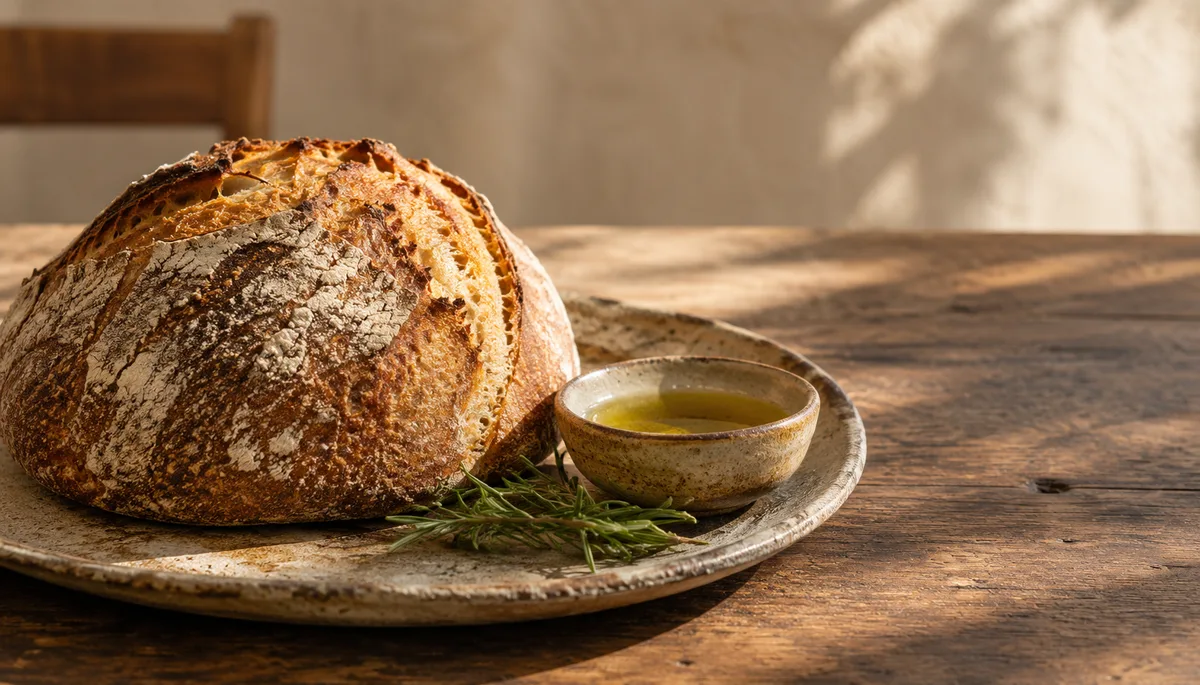
In third-century Athens, Epicurus lived primarily on dry barley bread, sun-dried olives, and fresh spring water.
When he wished to celebrate a festive occasion with his companions, he would write: “Send me a little pot of cheese, so that I may indulge when I wish.”
Epicurus understood a radical physiological truth: the human body’s genuine needs are remarkably small and easily satisfied.
Pain arises not from lacking luxury, but from the artificial anxiety of desiring what is unnecessary.
The Garden Beyond the City Walls
In an era dominated by political ambition and imperial conquests, Epicurus did something scandalous.
He turned his back on the bustling Athens Agora and the ruthless games of political power.
Just outside the city gates, he purchased a walled plot of land with fruit trees and a small vegetable garden, simply known as The Garden.
Above the entrance hung a quiet inscription welcoming weary travelers to rest, promising that here, pleasure was considered the highest good.
Crucially, The Garden welcomed everyone: women, slaves, outcasts, and scholars sat together as equals.
Epicurus encapsulated his entire social doctrine in two quiet Greek words: Lathe biosas—”Live unnoticed.”
He saw that public acclaim is an invisible leash that surrenders your peace of mind to the fickle whims of strangers.
Diagnostic Table: Modes of Pleasure
To untangle our relationship with contentment, Epicurus distinguished between natural peace and artificial craving.
| Mode of Living | Primary Source of Desire | Ultimate Mental State |
|---|---|---|
| The Status Chaser | Unnatural and unnecessary desires: public fame, titles, luxury goods. | Chronic anxiety, hyper-vigilance, and perpetual fear of falling behind. |
| The Vulgar Hedonist | Sensory excess, binge consumption, and rapid dopamine spikes. | Sensory burnout, physical exhaustion, and painful emotional crashes. |
| The Epicurean Sage | Natural and necessary essentials: simple food, quiet shelter, deep friendship. | Ataraxia: Unshakable inner calm, somatic safety, and joyful ease. |
3 Gentle Anchors of the Garden Life
You do not need to move to an ancient Greek orchard to enter the garden state of mind.
You only need to practice three quiet re-alignments in your daily routine.
1. Reclaim the Sovereignty of Plain Sustenance
When our senses are constantly bombarded by hyper-palatable foods, our biological baseline for pleasure becomes warped.
Practice returning your palate to clean simplicity: a slice of warm, crusty bread, crisp greens, and clean water.
Notice the extraordinary relief that comes when your meal requires no performance, no reservation, and no exorbitant bill.
As Epicurus observed, plain water and barley cakes bring supreme delight when consumed by someone who is truly hungry.

2. Cultivate the Sanctuary of Unhurried Friendship
Epicurus taught that of all the means which wisdom acquires to ensure happiness, friendship is by far the most significant.
Yet modern socialization often feels like professional networking or performative brunching.
Step away from crowds that demand a polished resume or an entertaining facade.
Seek out one or two gentle souls with whom you can sit in comfortable silence on a sunlit veranda.
True friendship provides the nervous system with what psychologists call core co-regulation: biological safety without judgment.
3. Embrace the Freedom of Zero Ambition
We are conditioned to treat our lives as a venture capital project that must continuously scale.
What if your greatest victory this year was simply remaining peaceful, kind, and unhurried?
Practice the quiet dignity of Lathe biosas by allowing yourself to be entirely ordinary in the eyes of the crowd.
When you stop competing for applause, the exhausting need to prove your existence gently falls away.
You discover that life was never a race to be won, but a garden to be quietly inhabited.
Frequently Contemplated Questions
How does Epicureanism differ from Stoicism?
While Stoicism emphasizes duty, resilience, and endurance through hardship, Epicureanism focuses on the gentle elimination of unnecessary desires and physical pain to achieve quiet mental serenity.
Did Epicurus promote laziness or asceticism?
Neither. Epicurus rejected ascetic suffering just as firmly as he rejected hedonistic bingeing; his goal was balanced well-being where all natural physical and social needs are joyfully met.
How can I practice Epicureanism in modern city life?
Create your own metaphorical garden: establish clear boundaries against status comparison, eat unhurried meals with trusted companions, and decline social invitations that drain your sovereign energy.