You have spent years carefully smoothing plaster over your private fractures, terrified that the world might discover where you once broke. Whenever someone draws near, a quiet panic tightens in your throat, urging you to conceal the divorce, the bankruptcy, the breakdown, or the quiet years lost to grief. You carry yourself like fragile porcelain […]
You have spent years carefully smoothing plaster over your private fractures, terrified that the world might discover where you once broke.
Whenever someone draws near, a quiet panic tightens in your throat, urging you to conceal the divorce, the bankruptcy, the breakdown, or the quiet years lost to grief.
You carry yourself like fragile porcelain in a crowded room, convinced that being broken means being ruined.
Quick Answer: The Japanese art of Kintsugi repairs broken ceramics using natural urushi lacquer dusted with pure gold, transforming fractures into luminous focal points. Applied to human suffering, it reveals that your emotional scars are not sources of shame, but sacred evidence of resilience that make your story uniquely exquisite.
The Wabi-Sabi Aesthetics of Brokenness: Why Perfection Is an Illusion
In the late fifteenth century, the Japanese shogun Ashikaga Yoshimasa sent a damaged Chinese celadon tea bowl back to China for repairs.
It returned bound by crude, ugly metal staples, technically functional yet aesthetically dead.
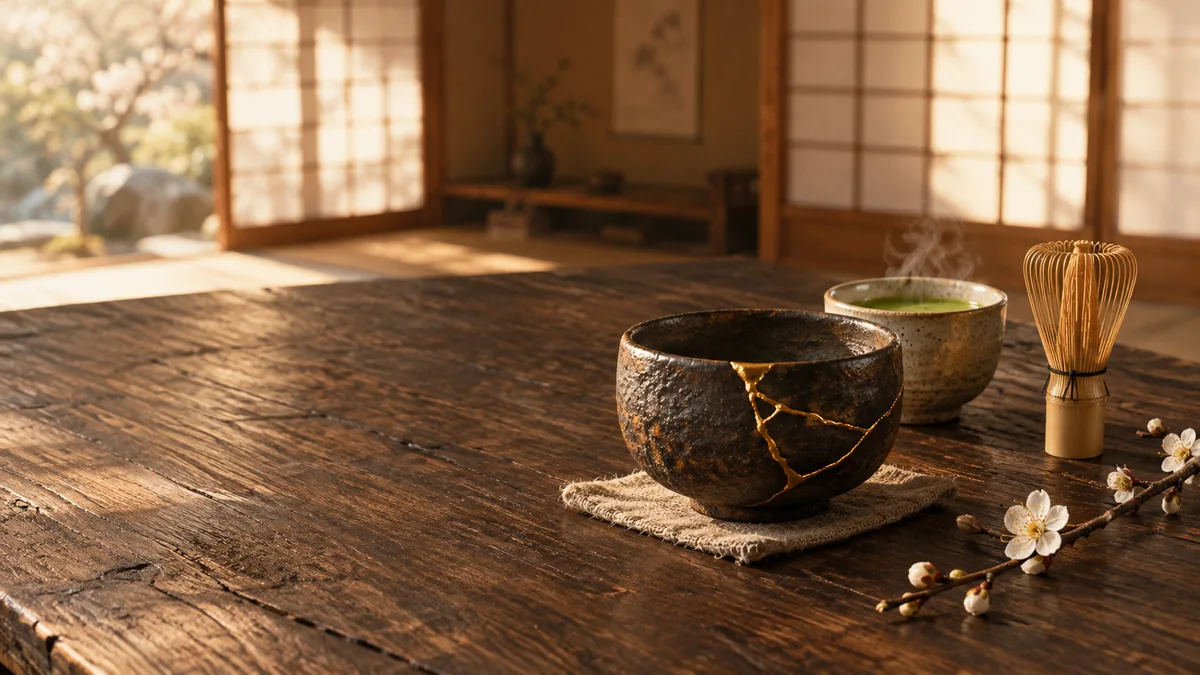
Dismayed by this mechanical patch, Kyoto craftsmen devised an entirely different philosophy of mending called kintsukuroi—golden joinery.
Rather than disguising the fracture with deceptive glue, they highlighted every jagged rupture with glowing 24-karat gold powder.
They understood what modern culture desperately forgets: true beauty does not reside in pristine, untouched symmetry.
Under the Japanese aesthetic of wabi-sabi, true elegance emerges from impermanence, asymmetry, and the honorable marks of time.
A teabowl that has never dropped onto stone has no narrative, no memory, and no character.
Just as we discovered in our exploration of The Art of Ma: Japanese Negative Space and Stillness, it is often the pauses and empty spaces—the fractures themselves—that give an object its transcendent soul.
Urushi and Gold: The Alchemical Ritual of Slow Mending
Authentic Kintsugi is an exercise in radical patience, requiring weeks or months to complete.
The artisan uses urushi, the sap of the lacquer tree, which cures only in darkness and high humidity.
If you rush the curing process with artificial heat, the lacquer cracks, spoils, and weakens.
The resin demands stillness, cool air, and unhurried time before it can bear the weight of pure gold dust.
Your emotional healing follows this exact biological rhythm.
When our lives shatter, our immediate reflex is to demand instant cosmetic recovery—forcing ourselves to smile, produce, and perform before the emotional clay has even bonded.
Yet forced positivity is merely cheap plastic filler that shrinks under the heat of reality.
As Stoic philosophy reminds us in Amor Fati: Loving Your Fate, our task is not merely to endure our wounds, but to love the jagged journey that sculpted us.
| Emotional Dimension | Cosmetic Concealment | Kintsugi Reverence |
|---|---|---|
| Inner Posture | Terror of exposure; frantic energy spent hiding personal flaws and failures. | Quiet self-possession; honoring scars as visible testament of survival. |
| Pacing of Recovery | Forced speed; toxic positivity that rushes to look functional within weeks. | Unhurried curing in the dark; honoring the necessary seasons of grief and rest. |
| Relationship with Wounds | Viewing past suffering as a shameful defect that devalues the self. | Viewing healed seams as golden ribbons that transform the soul into a masterpiece. |

The 4-Step Architecture of Golden Healing for Wounded Souls
Applying the wisdom of Kintsugi to your daily life does not require artistic talent.
It requires cultivating a reverent tenderness toward the pieces of yourself that shattered.
1. Gather the Ceramic Shards Without Blame
When catastrophe strikes, the impulse is to kick the broken pieces under the rug or blame yourself for dropping the bowl.
Instead, sit quietly on the floor with your grief.
Acknowledge every jagged piece—the lost trust, the bruised ego, the tired body—without judgment or self-punishment.
2. Allow the Lacquer of Stillness to Cure
Resist the compulsive need to announce to the world that you are already healed and thriving.
Real internal mending takes place in the dark, quiet chambers of your unhurried daily routines.
Give yourself the gift of several quiet months to knit back together in quiet solitude.
3. Dust Your Hard-Won Lessons with Pure Gold
Once the fracture has healed, do not pretend it never happened.
Reflect on the profound compassion, humility, and fierce boundary-setting that your suffering birthed within you.
Those insights are your gold dust, illuminating the jagged lines of your personal transformation.
4. Place the Repaired Vessel Back on the Altar
Step back into the world carrying your history with unblemished dignity.
You do not need to hide your past struggles or apologize for not being a flawless statue.
A healed, gold-dusted soul possesses a magnetic warmth that pristine people can never radiate.
Frequently Asked Questions About Emotional Kintsugi
Does celebrating emotional scars mean dwelling in past trauma?
Not in the slightest.
Kintsugi does not keep the vessel broken; it completes the mending with supreme craftsmanship so the cup can hold warm tea once again.
How do I stop feeling defective next to people who appear unbroken?
Remember that no human being travels through this life without severe fractures.
Those who appear smooth and unbroken are usually expending enormous, exhausting energy concealing their fissures behind polished porcelain masks.
Can broken relationships ever undergo a genuine Kintsugi repair?
Yes, provided both individuals possess the humility to work with natural lacquer rather than quick-drying lies.
When two people honestly confront their betrayal or misunderstanding, the rebuilt bond often becomes far stronger than the original connection.
Conclusion: The Sacred Sanctuary of Your Mended Soul
The universe never asked you to remain an untouched, sterile object behind museum glass.
You were born to be used, to drink deeply of life, and occasionally to fall and break against the stone.
Your cracks are not structural failures; they are the exact places where the divine light of your resilience enters.
Lay down your cosmetic shame, admire the golden seams that hold you together, and walk forward in peace.