

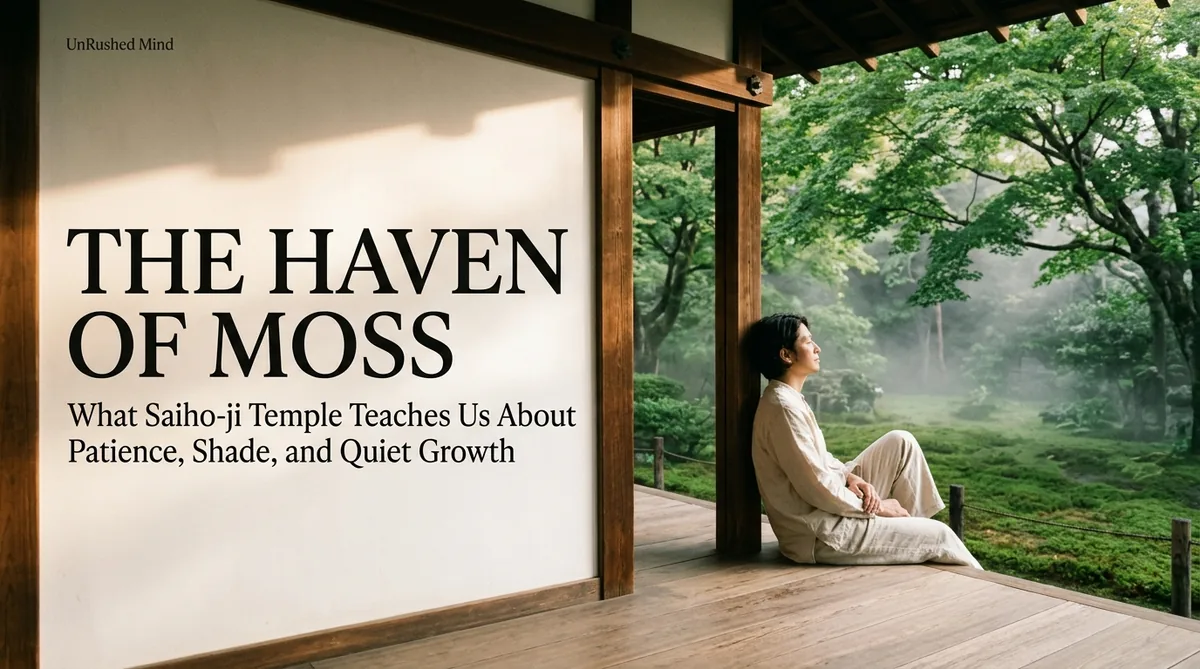
There is a quiet ache when everyone around you seems to bloom under bright lights, while your own life remains hidden in the shade. You watch peers collect rapid praise, and an inner voice whispers that you have fallen behind. In our collective obsession with fast blossoms, we have forgotten that enduring life does not […]
There is a quiet ache when everyone around you seems to bloom under bright lights, while your own life remains hidden in the shade.
You watch peers collect rapid praise, and an inner voice whispers that you have fallen behind.
In our collective obsession with fast blossoms, we have forgotten that enduring life does not demand the scorching glare of center stage.
To understand the art of flourishing without applause, we look to the western hills of Kyoto, to the quiet grounds of Saiho-ji temple.
The Agony of the Shade: Why Modern Culture Demonizes Slow Seasons
Visiting the Saiho-ji moss temple in Kyoto reveals that enduring growth does not require immediate sunlight. True resilience emerges when we surrender the need for instant validation and allow our quiet seasons to root deeply in shadowed soil.
Modern culture treats quiet intervals as failure. We are taught that if a project or personal healing does not produce swift fruit, it is defective.
Yet this urgent demand for constant visibility burns out the nervous system and exhausts the spirit.
Forcing a tree to fruit out of season depletes its sap. Forcing a human heart to constantly perform starves its roots.
Saiho-ji teaches us that resilience is not found in grand theatrical displays, but in the quiet capacity to absorb moisture and cling to bedrock. When you stop forcing seasons, you become unshakable.

Breathe for a moment and consider the biology of moss.
Unlike flowering cherry blossoms that blaze brilliantly for seven days before scattering into mud, moss never attempts to dazzle the passerby with sweet fragrances or vibrant petals.
It does not compete for the sun canopy. It asks only for damp earth, morning mist, and the patient shelter of ancient maples.
Kokedera: The Temple That Allowed Nature to Reclaim Its Wounds
Saiho-ji, affectionately known across Japan as Kokedera (The Moss Temple), was not originally designed to be a carpet of green velvet.
During the fourteenth century, Zen master Muso Soseki designed it as a classical dry landscape and pond garden. Over subsequent centuries, devastating floods and civil warfare reduced the pavilions to ash.
When human ambitions crumbled and the temple lay neglected, nature did not abandon the grounds.
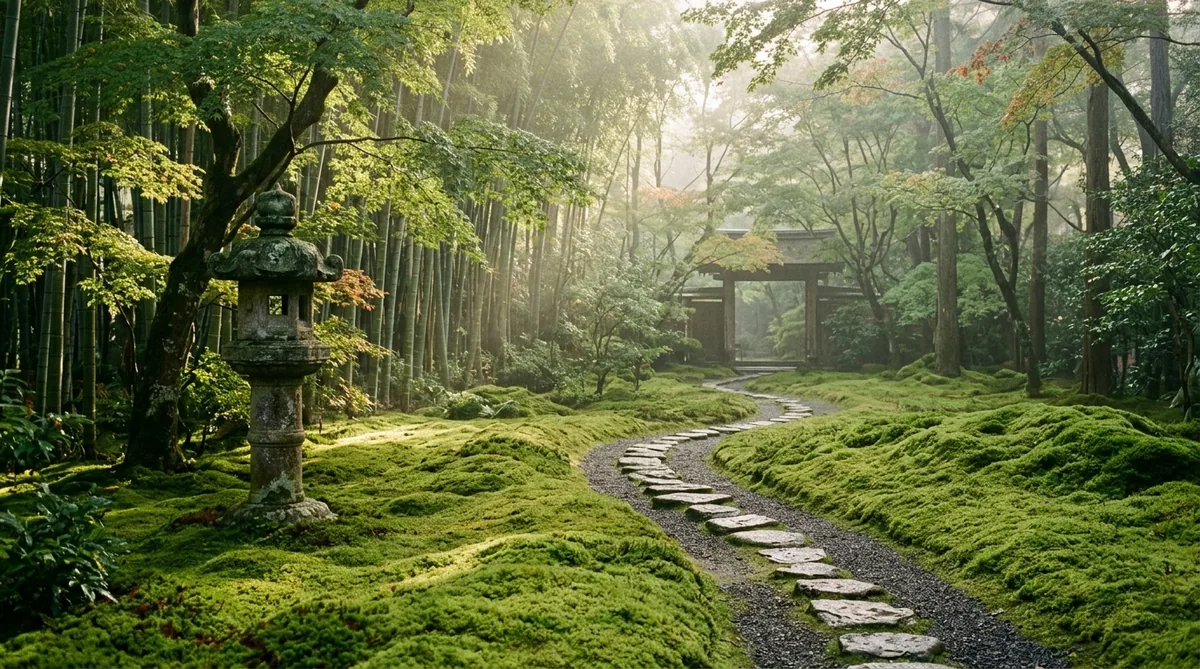
Slowly, droplet by droplet and spore by spore, over one hundred and twenty varieties of moss crept across the scarred soil and softened the charred stones.
What humans perceived as abandonment, the moss saw as an invitation to heal.
| Life State | The Dazzled Bloom (Living for the Spotlight) | The Enduring Moss (Growing in the Shade) |
|---|---|---|
| Pacing | Urgent, frantic, and dependent on outer weather | Unhurried, subterranean, and anchored in seasonal calm |
| Rooting | Surface-level reach seeking instant applause | Micro-fibers clinging gently to stone without force |
| Sunlight | Demands relentless exposure; withers in shade | Thrives in cool dampness; turns neglect into green life |
| Longevity | Spectacular for a brief week, then discarded | Endures across centuries, undisturbed by shifting winds |
This is the timeless wisdom of Wabi-Sabi—finding sublime grace in impermanence, modesty, and the gentle weathering of time.
The garden is not precious because it was forced into perfection. It is sacred because it was allowed to take centuries to mend its own wounds.
The 3 Disciplines of Quiet Growth
When you find yourself in an invisible season of your life, Saiho-ji offers three foundational practices to steady your heart.
1. Welcoming the Damp Seasons
We often resent our periods of grief, obscurity, or fatigue because we mistake them for stagnation.
Yet the moss reminds us that shade is not the absence of life, but the quiet workshop of renewal.
Allow yourself to exist without an audience. The dampness that feels so uncomfortable today is softening the rigid edges of your pride.
2. Rooting Without Shallow Vanity
True moss does not possess deep taproots that drain the soil dry; instead, it anchors itself through delicate hair-like structures called rhizoids.
It absorbs moisture directly from the humid air, content with whatever the morning provides.
You do not need massive wealth, thousands of followers, or loud external approval to build an unshakeable sense of self. Contentment is the art of drinking deeply from the simple air of this single present hour.
3. The Geometry of Centuries
A cherry blossom thinks in days; a stalk of bamboo thinks in seasons; but moss thinks in decades and centuries.
When you walk through Kokedera, you are treading on living organisms that survived the rise and fall of samurai dynasties and industrial revolutions.
Release the frantic deadline you placed upon your life. You do not have to conquer the world by thirty, nor finish your masterpiece by tomorrow.
Mindful Reflections on Slow Living & Patience
Mindful Reflection Notice
True restoration requires honoring your natural rhythm. If feelings of inadequacy or fatigue persist, speak gently with a licensed counselor or mindful health professional. Quiet growth is a lifelong cultivation, never a solitary burden.
You do not need to be a blazing sun to possess worth.
Sometimes, the most profound thing you can do for this frantic world is simply to be the soft green carpet that cushions a tired traveler’s fall.