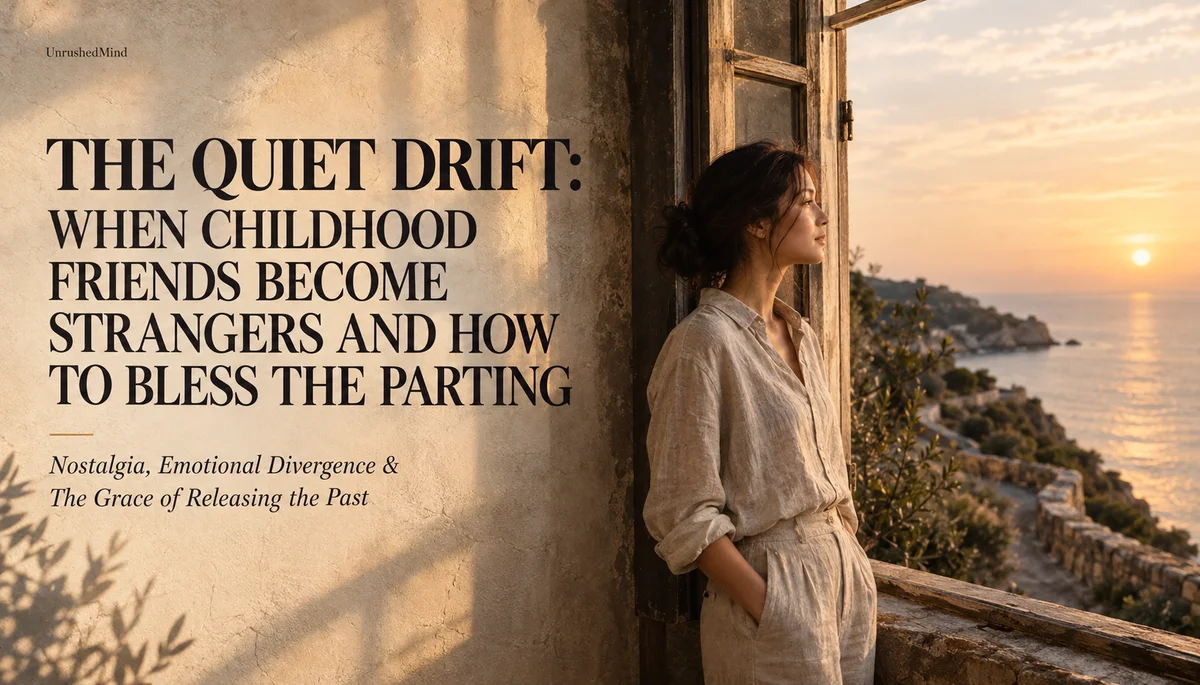
The Quiet Drift: When Childhood Friends Become Strangers and How to Bless the Parting You sit across from someone who once held the intimate map of your childhood heart. You shared bicycles, scraped knees, whispered secrets under blankets, and swore an eternal allegiance against the adult world. Yet tonight, the conversation stumbles over polite generalities […]
The Quiet Drift: When Childhood Friends Become Strangers and How to Bless the Parting
You sit across from someone who once held the intimate map of your childhood heart.
You shared bicycles, scraped knees, whispered secrets under blankets, and swore an eternal allegiance against the adult world.
Yet tonight, the conversation stumbles over polite generalities and strained silences.
You grasp for shared ground, only to realize the only bridge connecting you is a past that neither of you inhabits anymore.
This is the silent heartache of adult life: the quiet drift of childhood friendships.
The grief of outgrowing childhood friends is an ambiguous loss occurring when people mature along diverging psychological trajectories. Rather than forcing awkward familiarity, healing comes from honoring the friendship’s past season while releasing guilt and blessing their independent journey with quiet grace.
The Nostalgia Trap: Confusing Shared Proximity with Present Resonance
Childhood friendships are almost always forged by accidental circumstance: living on the same street, sitting in adjacent desks, or sharing the same playground.
In youth, genuine connection requires little more than playfulness, physical presence, and mutual availability.
Adult companionship, however, demands something infinitely more complex: alignment in values, emotional vulnerability, and shared worldviews.
When we cling to old bonds solely because of shared history, we fall into the insidious nostalgia trap.
We force our current selves to perform an outdated role, laughing at tired inside jokes just to keep a fragile ghost alive.
As explored in our reflection on mourning the living, grieving someone who is still physically present is among the quietest sorrows we ever endure.
You are not mourning the human being across the table; you are mourning the lost innocence of the world you once shared.
The Silent Shame of Evolution: Why Outgrowing Others Feels Like Betrayal
Our culture reveres lifelong friendships as the ultimate badge of loyalty and steadfast character.
When you begin to outgrow someone from your youth, an insidious voice whispers that you have become pretentious, disloyal, or cold.
You wonder if you should conceal your new passions, quiet your changing spiritual views, or shrink your ambitions just to keep the peace.
Yet developmental psychology teaches us that emotional differentiation is the cornerstone of psychological maturity.
Human beings are not stagnant statues carved into fixed stone; we are dynamic rivers that carve distinct canyons through time.
As discussed in our study on the quiet art of walking away, walking on a diverging path is not an act of hostility.
To stay identical to who you were at fifteen just to keep an old companion comfortable is not loyalty; it is self-abandonment.

Three Stages of Friendship Evolution: Strained Clinging to Sacred Release
Navigating friendship divergence requires moving from anxious denial toward compassionate acceptance.
| The Strained Clinging | The Calibrated Drift | The Sanctuary of Blessed Parting |
|---|---|---|
| Forces artificial catch-ups fueled by guilt and social obligation. | Recognizes the emotional distance without staging dramatic confrontations. | Honors the friendship as a sacred, completed chapter of life. |
| Shrinks personal growth to match outdated conversational scripts. | Ceases overcompensating while establishing gentle psychological boundaries. | Stands securely in one’s authentic evolution with zero resentment. |
| Experiences simmering irritation after every awkward interaction. | Allows communication rhythms to slow naturally across seasons. | Feels peaceful tenderness whenever an old memory comes to mind. |
| Demands that every childhood bond must endure until old age. | Acknowledges that people serve different purposes across lifespan stages. | Releases companions with genuine blessings for their separate happiness. |

Four Compassionate Disciplines to Bless the Parting
Releasing an old companion does not require a dramatic scene or bitter recrimination; it is an inner art of gentle surrender.
1. Separate Nostalgia from Contemporary Compatibility
Cherishing an old memory does not obligate you to spend next Saturday afternoon together.
Allow the beauty of past companionship to exist purely as a completed historical masterpiece.
When you treat nostalgia as a sacred keepsake rather than an unpaid debt, obligation dissolves.
2. Stop Auditioning for Who You Used to Be
Refuse the temptation to slip into your childhood persona just to preserve superficial comfort.
Show up as you are today: honest, calm, and grounded in your current truth.
If the authentic version of you no longer fits beside them, accept that reality without apology.
3. Honor the Season Without Forcing the Lifetime
Some relationships are exquisite temporary shelters built for the storms of youth.
They taught you loyalty, sparked your early laughter, and shielded you from loneliness during formative years.
Recognizing that a bond has served its sacred purpose allows you to honor the season without forcing the lifetime.
4. Send Silent Blessings Across the Distance
When an old friend crosses your mind, replace the impulse to reach out from guilt with a quiet blessing.
Wish them prosperity, profound peace, and companions who mirror their current heart.
Love does not always mean holding hands; sometimes love means having the courage to bless the parting.
Frequently Asked Questions
The Sacred Freedom of Releasing with Love
You do not have to carry every person you ever loved into every room of your future.
Some companions were meant to be the warm sun of your morning, not the lantern of your midnight.
Bow your head in quiet gratitude for the miles you walked together on the same path.
Bless the crossroads where your steps diverged, and trust the quiet beauty of the road ahead.
In releasing them with an untroubled heart, you honor both who they were and who you are becoming.