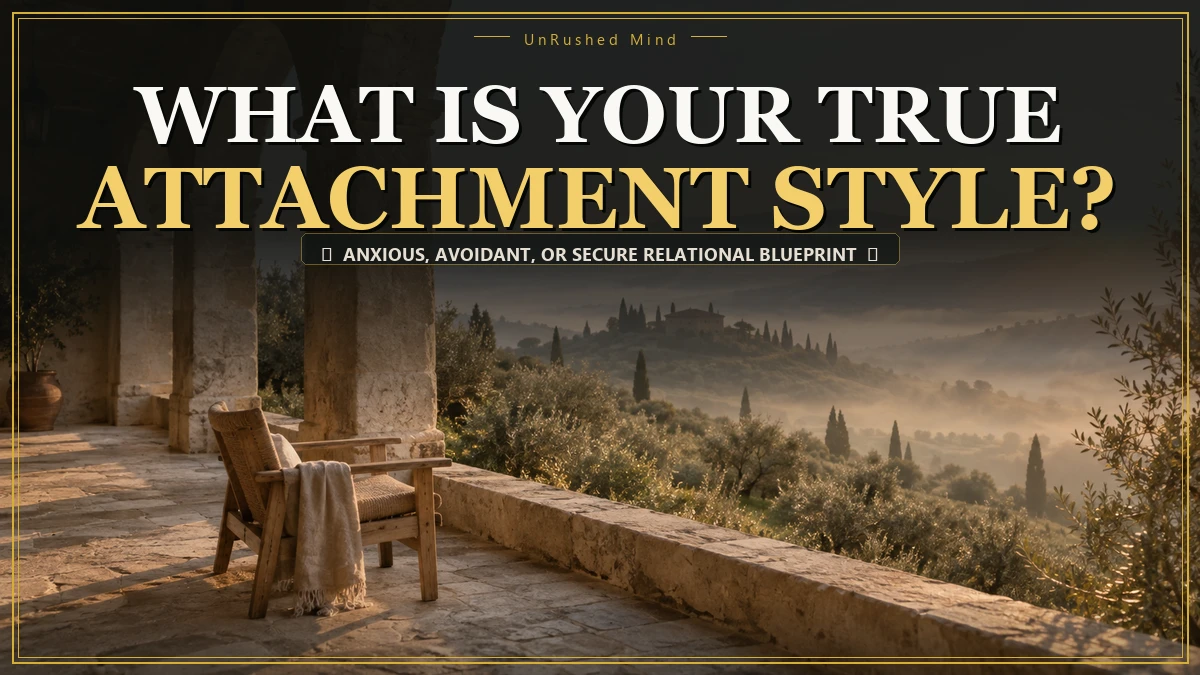
Do you lean toward anxious hyper-vigilance, avoidant self-reliance, or secure interdependence? Grounded in Columbia University clinical research by Dr. Amir Levine and Rachel Heller, discover your core relational blueprint.
How do you instinctively react when someone you love pulls away, delays a message, or asks for deeper emotional vulnerability?
Reflect on these eight everyday scenarios in the assessment below to identify whether your relational operating system leans toward Anxious-Preoccupied, Dismissive-Avoidant, or Secure Interdependence.
The Adult Attachment Styles Assessment: Discover Your Core Relational Blueprint
How do you navigate vulnerability, emotional distance, and intimacy in relationships? Grounded in Adult Attachment Theory and clinical research from Columbia University, answer these 8 scenario-based reflections to uncover your dominant relational blueprint—Secure, Avoidant, or Anxious.
This self-assessment is designed for educational and personal reflection purposes regarding mental restoration, burnout symptoms, and stress levels. It does not replace professional clinical diagnosis, psychiatric care, or licensed medical therapy.
The Science of Adult Attachment Architecture
In 1987, psychologists Cindy Hazan and Phillip Shaver uncovered a profound biological truth: the emotional attachment bonds we formed in childhood do not vanish in adulthood. Instead, they evolve into subconscious relational operating systems—governing whether we welcome intimacy, build fortress walls, or obsessively scan for signs of rejection.
As Columbia University psychiatrists Dr. Amir Levine and Rachel Heller demonstrated, our attachment styles are neurobiological adaptations designed to protect us. Understanding your relational blueprint is the first step toward transforming anxious hyper-vigilance or avoidant withdrawal into grounded, sovereign intimacy.
Architectural Profile Decodings & Restoration Guidance
Every intuitive choice or score threshold mirrors an underlying autonomic state. Below are the comprehensive psychological and neurobiological decodings for each result profile:
🟢 Secure Relational Grounding: High Autonomy & Open Intimacy (0 – 5 Points)
✦ Autonomic State: Your relational blueprint reflects **Secure Attachment**. You view vulnerability not as a danger, but as the natural soil from which genuine intimacy grows.
✦ Mechanism: You possess the rare emotional capacity for *Interdependence*—remaining whole and self-directed in your sovereignty while comfortably offering and receiving affection without games or hidden anxiety.
✦ Gentle Micro-action: 1. Continue Direct & Gentle Communication: Maintain your natural habit of stating emotional needs without apology or resentment. 2. Hold Space for Non-Secure Partners: When relating to partners who lean anxious or avoidant, your calm consistency acts as a regulating anchor. 3. Nourish Emotional Awe: Continue prioritizing shared unhurried moments, deep conversations, and tranquil retreats.
🌿 Read Relational Guide: De-escalating Emotional Hyper-Vigilance ➔
🟡 Dismissive-Avoidant Pattern: The Protective Armor of Self-Reliance (6 – 13 Points)
✦ Autonomic State: Your assessment reveals a **Dismissive-Avoidant relational tendency**. Your fierce independence is not coldness; it is an intelligent subconscious armor developed early in life when expressing vulnerability felt unsafe or met with disappointment.
✦ Mechanism: When emotional intimacy deepens, your nervous system triggers *Deactivating Strategies*—nitpicking small flaws, craving excessive alone time, or feeling sudden claustrophobia—to protect your sovereign control.
✦ Gentle Micro-action: 1. Distinguish Suffocation from Connection: Notice when your instinct to pull away is a protective phantom rather than an actual violation of your boundaries. 2. Micro-Shares of Vulnerability: Practice sharing one small, imperfect feeling each week before retreating behind your walls. 3. Somatic Stress Discharge: Avoidant individuals frequently store emotional suppression as physical tension in the hips, shoulders, and jaw.
🌿 Read Your Guide: Breaking the Cycle of Pulling Away in Relationships ➔
🔴 Anxious-Preoccupied Pattern: Hyper-Vigilant Attachment & Craving Safety (14 – 24 Points)
✦ Autonomic State: Your assessment reveals an **Anxious-Preoccupied attachment pattern**. You possess a super-sensitive relational radar that instantly detects micro-shifts in a partner’s tone, facial expressions, and responsiveness.
✦ Mechanism: You are not ‘too needy’ or ‘dramatic’—your attachment system is simply caught in survival mode, interpreting emotional distance as existential abandonment. You often engage in *Protest Behaviors* (over-texting, withdraw-to-punish, or seeking constant reassurance) in an attempt to restore connection.
✦ Gentle Micro-action: 1. Soothe the Somatic Alarm First: When a delayed text triggers panic, pause for 90 seconds. Touch your heart, exhale slowly through pursed lips, and remind your body: ‘I am safe in this moment.’ 2. Shift from Protest to Clear Need: Replace testing your partner with clean, non-accusatory language: ‘I’m feeling tender right now and would love a reassuring hug.’ 3. Anchor Your Self-Compassion Perimeter: Your worth is not defined by someone else’s immediate availability.
🌿 Read Your Solution: Ending the Anxious-Avoidant Dance & Healing Insecurity ➔
📚 Academic & Clinical Foundation: Adult Attachment Theory (Cindy Hazan & Phillip Shaver, 1987), Dr. Amir Levine & Rachel Heller (Columbia University Division of Child & Adolescent Psychiatry — Authors of ‘Attached’), and Emotionally Focused Therapy (Dr. Sue Johnson)
🌿 Mindful Reflection Notice: This self-assessment is designed solely for educational, self-inquiry, and personal reflection purposes. It does not constitute medical, psychiatric, or clinical psychological advice, diagnosis, or treatment. If you are experiencing acute emotional distress, severe burnout, or chronic physical symptoms, please consult a qualified healthcare professional.