
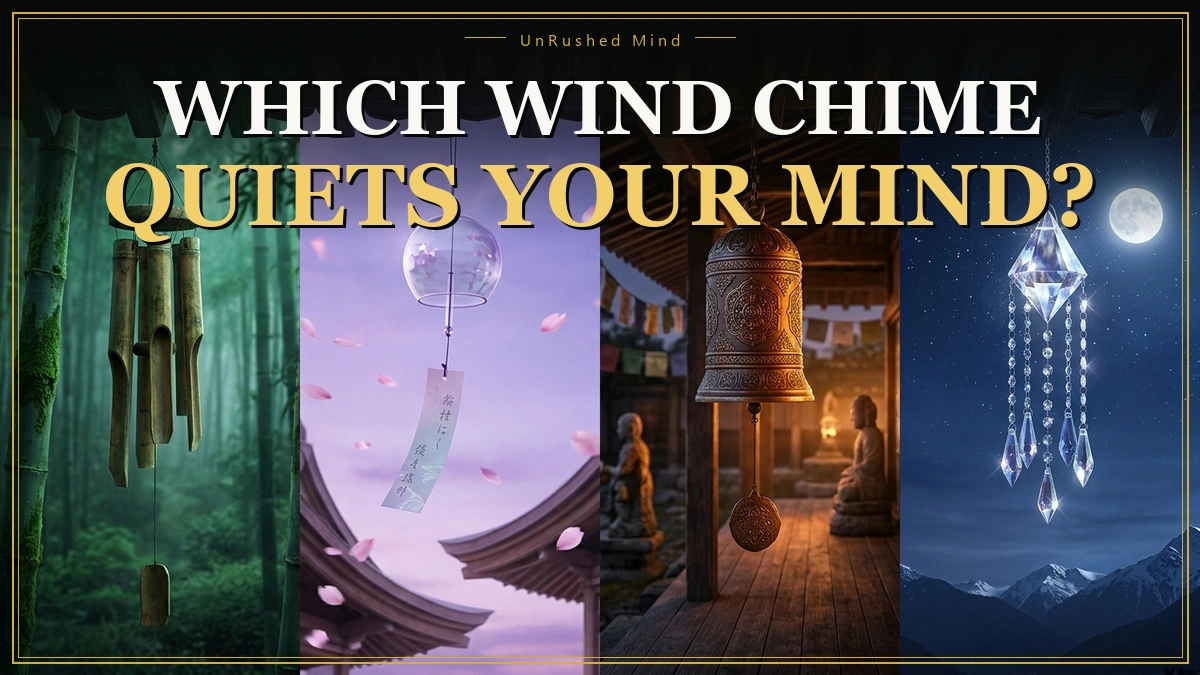
Which acoustic timbre calms your nervous system first—bamboo wood, ceramic Furin, 432Hz Tibetan bronze, or sparkling quartz? Select 1 of 4 to immediately reveal your personalized acoustic resonance decoding and restoration practice.
Listen to the quiet voice of your intuition: Take one slow, unhurried breath. When you open your eyes, which wind chime softens your racing thoughts first amid the modern noise?
Select one of the four hand-tuned acoustic resonances in the interactive tool below to immediately reveal your personalized psychoacoustic decoding and nervous system restoration practice.
This self-assessment is designed for educational and personal reflection purposes regarding mental restoration, burnout symptoms, and stress levels. It does not replace professional clinical diagnosis, psychiatric care, or licensed medical therapy.
The Psychoacoustics of Autonomous Restoration
In psychoacoustics and autonomic neuroscience, our sensory choices are never accidental. Natural harmonic frequencies produce a biological phenomenon known as acoustic entrainment—the tendency of brainwave frequencies to synchronize with rhythmic external stimuli.
Low-frequency woody resonances stimulate proprioceptive earthing receptors, while crystalline and bronze harmonic decays down-regulate sympathetic hyper-arousal. According to Rachel and Stephen Kaplan’s Attention Restoration Theory (ART), these soft acoustic textures engage our involuntary attention, allowing our depleted prefrontal cortex to rest and replenish its cognitive reserves.
Architectural Resonance Decodings: Explore Your Selected Frequency
Each acoustic timbre interacts with specific neural pathways. Below are the comprehensive psychoacoustic decodings for each restorative wind chime:
🎋 Resonance 01: The Bamboo Wind Chime (Sensory Earthing)
✦ Autonomic State: Sensory overload, mental scatter, and nature-deficit hyper-vigilance caused by prolonged digital exposure.
✦ Acoustic Mechanism: Hollow woody timbres generate organic pink noise and low-frequency resonance that ground the central nervous system, lowering acute sympathetic arousal.
✦ Gentle Micro-action: Step barefoot onto natural soil or unpolished wood for 3 minutes, taking 4 deep belly breaths to ground kinetic tension.
🎐 Resonance 02: Furin Ceramic Bell (Relational Clarity & Boundaries)
✦ Autonomic State: Fawn response, emotional enmeshment, and exhaustion from absorbing the unspoken tension and demands of others.
✦ Acoustic Mechanism: The crisp, brief, crystalline chime of ceramic creates an immediate acoustic boundary in the auditory cortex, interrupting interpersonal hyper-vigilance.
✦ Gentle Micro-action: Practice the Grace of Saying ‘No’: pause 10 seconds before responding to any non-urgent request today.
🔔 Resonance 03: Bronze 432Hz Bell (Somatic Unfreezing & Psoas Release)
✦ Autonomic State: Deep dorsal vagal freeze, chronic muscle tightening around the jaw and hips, and functional numbness from sustained burnout.
✦ Acoustic Mechanism: 432Hz harmonic undertones stimulate interoceptive mechanoreceptors along the vagus pathway, inducing deep autonomic down-regulation.
✦ Gentle Micro-action: Place one warm hand over your sternum and exhale with an audible low hum for 6 breath cycles to gently release somatic tension.
✨ Resonance 04: Bohemian Crystal Chime (Cognitive Deceleration & Theta Rest)
✦ Autonomic State: Mental racing, rumination loops, and sleep onset latency (“tired but wired” neurochemistry).
✦ Acoustic Mechanism: High-purity crystalline vibrations slow accelerated beta brainwaves into restful alpha and theta rhythms through acoustic brainwave entrainment.
✦ Gentle Micro-action: Dim all blue-light screens 60 minutes before sleep and listen to gentle ambient acoustics while resting your eyelids.
📚 Academic Sources & Clinical Citations: Helmholtz Acoustic Resonance Theory, Brainwave Entrainment Neuroscience (Dr. Margaret Patterson), and Attention Restoration Theory (Prof. Stephen & Rachel Kaplan, University of Michigan).
🌿 Mindful Reflection Notice: This self-assessment is designed solely for educational, self-inquiry, and personal reflection purposes. It does not constitute medical, psychiatric, or clinical psychological advice, diagnosis, or treatment. If you are experiencing acute emotional distress, severe burnout, or chronic physical symptoms, please consult a qualified healthcare professional.