When you return home at the close of an exhausting day, examine what happens the moment you close the front door behind you. You kick off your stiff street shoes. You hang your heavy winter coat on the rack. You unfasten your watch and place your keys into a ceramic bowl on the console table. […]
When you return home at the close of an exhausting day, examine what happens the moment you close the front door behind you.
You kick off your stiff street shoes. You hang your heavy winter coat on the rack. You unfasten your watch and place your keys into a ceramic bowl on the console table. Yet, beneath your clothing, an invisible set of armor remains stubbornly welded to your skeleton.
Your shoulders remain hitched upward toward your earlobes, locked in a defensive brace against demands that ceased hours ago. Your jaw remains clenched so tightly that your molars ache. Your diaphragm remains shallow and frozen, trapping stale air in the upper lobes of your lungs as though your body is perpetually anticipating a sudden blow. In your gut, a low-grade, acidic tension coils tightly around your digestive organs.
You have changed into loose cotton lounger pants, but your nervous system is still wearing the full plate armor of modern survival.
If you recognize this bone-deep stiffness, please pause and receive this fundamental somatic truth: Your body is not broken, rebellious, or failing you.
What you are carrying is what somatic psychologist Wilhelm Reich famously identified as chronic muscular armoring—the physical crystallization of psychological defense. Every time you swallowed an honest truth to prevent conflict, forced a polite smile while burning with exhaustion, absorbed an aggressive deadline, or shouldered an emotional burden alone, your fascia contracted to protect your tender center. Over weeks, months, and years, that defensive contraction became your default state of being.
You cannot simply command your nervous system to “relax” with an intellectual thought. The body does not speak in abstract concepts; it speaks in temperature, gravity, tactile safety, and surrender.
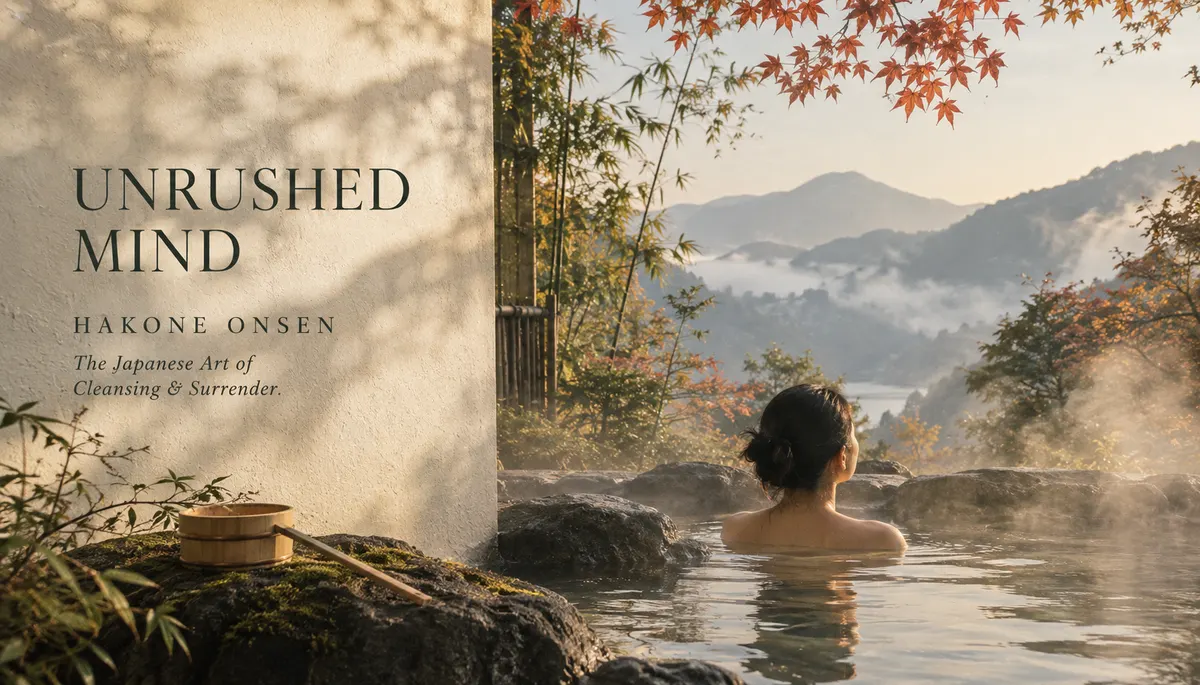
High in the forested volcanic peaks southwest of Tokyo lies an ancient landscape where humans have journeyed for over twelve centuries to disarm: Hakone Onsen (箱根温泉). In this misty caldera of boiling earth and steaming mineral pools, the Japanese culture did not merely develop a hygiene routine. They perfected a sacred, time-tested somatic art—the art of Toji (湯治), the therapeutic surrender of the exhausted human animal to the buoyant, maternal embrace of geothermal waters.
Hakone Onsen is the ancient Japanese art of geothermal water cleansing (Toji), rooted in volcanic mineral springs and Shinto purification (Misogi). Beyond physical bathing, it is a sacred somatic ritual—stripping away psychological armor, surrendering bodily weight to buoyant warmth, and dissolving chronic exhaustion into mineral-rich stillness.
The Sacred Geography of Hakone: Where Earth Whispers Her Ancient Warmth
To understand why Hakone possesses such extraordinary somatic power, one must look at the wild geology that breathes beneath its cedar slopes.
Hakone is not an ordinary mountain range. It is an active volcanic caldera that collapsed and reformed across hundreds of thousands of years. Just beneath its carpet of moss, ancient Cryptomeria trees, and bamboo groves, subterranean magma chambers heat underground rivers to boiling temperatures. In the primordial valley of Owakudani—the “Great Boiling Valley”—sulfurous steam vents roar from the rocky mountainside, filling the cool alpine air with mineral vapor and reminding every traveler that the earth beneath our feet is intensely alive.
As water filters slowly through subterranean basalt, granite, and volcanic ash across centuries, it becomes saturated with a dense pharmacy of bioavailable minerals: sulfur, sodium bicarbonate, sulfates, and chloride. These waters burst forth in seventeen historic spring zones known collectively as the Hakone Jūnanayu (箱根十七湯).
Since the Nara period (710–794 AD), weary pilgrims, wandering Zen monks, and poet-philosophers have walked the steep, cobblestone mountain paths of the ancient Tōkaidō Highway to reach Hakone. Following brutal civil wars, samurai warriors rode into these steaming ravines not only to clean blade wounds and soothe broken bones, but to wash away the phantom horrors of combat.
Much like the unhurried wanderers who found solace in the quiet alleys of Paris in The Art of Flânerie, travelers who arrived in Hakone understood that travel was not about conquering geographic milestones. It was about finding a sanctuary where the exhausted soul could finally stop performing and dissolve its weary burdens.
Hadaka no Tsukiai: The Sacred Nakedness of the Dressing Room
The true medicine of the Japanese onsen begins long before your skin touches a single drop of mineral water. It begins in the quiet, cedar-paneled threshold of the Datsuiba (脱衣場)—the changing room.
In modern Western society, bathing is almost always solitary, hurried, and functional. Furthermore, modern life is obsessed with costume. Every morning, we carefully select the garments that project our competence, our social status, our wealth, and our aesthetic taste. We wear designer suits, tailored denim, luxury watches, and cosmetic makeup. These clothes serve as our social shield; they tell the world who we are and protect our vulnerable interior from exposure.
When you step into an onsen changing room, that entire architecture of social defense is systematically dismantled.
You are given a small woven basket or a wooden locker with a numbered brass key on an elastic band. One by one, every external identifier is removed:
- Your smartphone—the digital tether that keeps your amygdala hooked to the frantic demands of the social clock, as we dismantled in The Myth of Falling Behind and Digital Sabbath—is locked inside the drawer and powered down.
- Your watch, rings, and jewelry are laid aside.
- Your tailored clothing, socks, and shoes are folded away.
You are left holding only a single, modest white cotton modesty towel (tenugui), no larger than a kitchen napkin.
For many Western travelers and newcomers, this threshold triggers an immediate flare of vulnerability and awkwardness. We are conditioned to hide our bodies, to feel shame over soft bellies, surgical scars, rounded shoulders, stretch marks, and aging skin.
Yet, as you slide open the frosted glass door and step into the humid, cedar-scented mist of the bathhouse, a miraculous psychological shift occurs.
Around you are other human beings of every age and shape: elderly grandmothers with paper-thin skin, young parents, working professionals, and children. Nobody is staring. Nobody is evaluating, judging, or comparing. Everyone is existing simply as an unclothed biological mammal in a shared space of healing.
The Japanese refer to this profound phenomenon as Hadaka no Tsukiai (裸の付き合い)—literally, “naked communion” or “fellowship without clothes.”
When there are no pockets in which to hide a business card, no labels to signal net worth, and no fabric to conceal our human imperfections, social hierarchy collapses. The CEO and the carpenter sit beside each other on low wooden stools, scrubbing their backs with the same quiet humility. In this sacred vulnerability, the exhausting effort of maintaining a false persona vanishes. You are permitted to be exactly what you are: a soft, breathing, mortal creature in need of warmth.
The Somatic Science of Toji: Why Geothermal Immersion Resets the Nervous System
Why does a twenty-minute soak in a natural volcanic spring produce a depth of somatic tranquility that a standard domestic bath can never replicate?
The answer lies in the ancient practice of Toji (湯治)—which translates directly as “hot spring cure” or “water therapy.” For centuries, Japanese physicians prescribed extended stays at hot spring ryokans for patients suffering from rheumatism, skin ailments, nervous breakdown, and chronic fatigue. Today, modern environmental physiology and balneology (the medical science of mineral springs) have mapped out the precise physiological mechanisms behind Toji:
1. Hydrostatic Pressure and the Vagal Reflex
When you submerge your body up to your collarbones in water, the physical weight of the liquid exerts uniform, gentle hydrostatic pressure against your entire surface area.
On land, your circulatory system must constantly battle gravity to pump blood from your lower extremities back up to your heart. Under the gentle compression of onsen water, venous blood and lymphatic fluid are effortlessly guided upward from your legs and abdomen into the thoracic cavity.
This sudden increase in central venous volume triggers sensitive baroreceptors in your carotid sinus and aortic arch. The brain instantly interprets this signal as: “We are safe, we are supported, and the heart does not need to strain.” The vagus nerve fires, dramatically lowering your resting heart rate and disengaging the sympathetic nervous system’s fight-or-flight throttle—a restorative downshift identical to the neurobiological reset we explored in The NSDR Protocol.
2. Thermal Vasodilation and Heat Shock Proteins
Natural onsen waters typically range between 40°C and 42°C (104°F to 108°F). This deep, pervasive heat produces immediate peripheral vasodilation:
- Capillaries in your skeletal muscles expand, increasing systemic blood flow by up to 300%.
- Lactic acid, inflammatory cytokines, and cellular debris that have stagnated inside tense muscle fibers are flushed into the circulation to be cleared by the kidneys and liver.
- The thermal stimulus activates the cellular synthesis of Heat Shock Proteins (specifically HSP70)—vital chaperone molecules that repair damaged cellular structures, reduce systemic inflammation, and bolster immune resilience.
3. Transdermal Mineral Absorption
Unlike chlorinated municipal tap water, Hakone’s volcanic springs are dense mineral broths:
- Sulfur Springs (Iō-sen): Abundant in Owakudani and Sengokuhara, sulfur ions penetrate transdermally through the skin, dilating deep blood vessels, clearing respiratory passages, and softening hardened connective tissue.
- Sodium Bicarbonate Springs (Jūsō-sen): Known throughout Japan as Bijin-no-yu (“waters of beauty”), bicarbonate neutralizes skin acidity, gently emulsifies dry keratin, and creates a silky, soothing barrier that locks moisture into the epidermis.
- Chloride Springs (Enka-butsu-sen): Salt-rich geothermal waters leave a microscopic mineral salt film across the skin that prevents evaporative heat loss, keeping your core body temperature elevated and your joints deeply warmed for hours after you step out of the bath.
4. Gravitational Liberation: The Gift of Buoyancy
Archimedes’ principle dictates that a body submerged in water experiences an upward buoyant force equal to the weight of the displaced liquid. When immersed to your neck, your body weight is reduced by roughly 90%.
For a tired nervous system that has spent decades bearing the downward crush of gravity, this 90% reduction in mechanical load is pure bliss. Your intervertebral discs decompress. The hip flexors and sacroiliac joints release their chronic grip. The postural muscles along your spine can finally let go of their constant vigil. As we learned when analyzing physical exhaustion in The 7 Types of Rest and somatic bracing in Where Does Your Body Store Unspoken Emotions?, you cannot heal tension while your muscles are still holding your weight. Buoyancy gives your muscles permission to go limp.
Somatic Comparison: The Armor of Modernity vs. The Surrender of Onsen
To see clearly how geothermal cleansing unwinds chronic stress, consider the profound physiological contrast between modern daily life and the onsen sanctuary:
| Dimension of Experience | Modern Daily Routine (The Armor) | Hakone Onsen Immersion (The Surrender) |
|---|---|---|
| Somatic Posture & Gravity | Compressed by gravity; seated slouching or rigid standing; chronic tension in neck, shoulders, and lower lumbar. | 90% buoyant weightlessness; spinal decompression; complete muscular relaxation and gravitational release. |
| Psychological Identity | Constantly performing status; wearing social masks, professional attire, and guarding vulnerabilities. | Hadaka no Tsukiai (Naked Communion); radical equality; zero clothing, titles, or pretense. |
| Autonomic Nervous State | Chronic sympathetic arousal (fight-or-flight); elevated cortisol, shallow chest breathing, elevated vascular resistance. | Profound parasympathetic activation (rest-and-digest); enhanced vagal tone, lowered heart rate, deep abdominal breathing. |
| Thermal & Cellular Impact | Sedentary chill or artificial air conditioning; restricted peripheral blood flow; accumulation of metabolic waste. | Deep hyperthermic conditioning (40°C–42°C); vasodilation; synthesis of protective Heat Shock Proteins (HSP70). |
| Sensory Environment | Sensory fragmentation; harsh blue-light screens, mechanical humming, sirens, and rapid algorithmic alerts. | Natural sensory sanctuary; acoustic murmur of flowing water, scent of Hinoki cedar and sulfur, steam on cold skin. |
| Emotional & Existential Tone | Hyper-vigilance, guilt of resting, feeling perpetually behind in life, and fear of losing control. | Sublime surrender; letting the water hold what you cannot; peaceful acceptance of impermanence and mortal fragility. |
The 4-Phase Hakone Cleansing Protocol: From Washing to Complete Surrender
Experiencing the restorative magic of an onsen requires more than merely jumping into hot water. In Japan, bathing is an intentional choreography—a mindful progression that mirrors the Shinto ritual of Misogi (禊), the washing away of spiritual and physical stagnation (kegare).
When you visit a traditional Japanese onsen or want to recreate this healing ritual at home, follow this four-phase protocol:
Phase 1: The Washing Ritual (Kakeyu & The Shower Stool)
One of the most sacred rules of the onsen is that the communal bath is never for washing; it is exclusively for soaking. You must enter the hot water completely, pristine clean.
- Take Your Seat on the Low Stool: Walk to the washing stations lining the perimeter of the bathhouse. Sit down on the small wooden or resin stool. Sitting to wash is an intentional practice—it keeps soapy spray from splattering onto neighbors and grounds your body close to the earth.
- Lather Mindfully: Using natural soap, a washcloth, and warm water from the handheld showerhead, wash your body from scalp to soles. Do not rush this step. Treat the act of washing your skin not as a chore, but as a tender ritual of self-compassion, echoing the emotional forgiveness we practiced in Making Peace with Your Younger Selves.
- Practice Kakeyu (掛け湯): Before entering the bath, take a small wooden cedar bucket (oke), scoop warm water from the designated pouring basin, and pour it repeatedly over your feet, knees, wrists, shoulders, and chest. Kakeyu serves two vital functions: it rinses away any lingering soap residue, and it gently acclimatizes your cardiovascular system to the high temperature of the mineral spring, preventing thermal shock and sudden dizziness.
Phase 2: Hanshinyoku (The Half-Body Entry)
Never submerge yourself abruptly into a 41°C geothermal pool. The sudden temperature spike can cause a rapid surge in blood pressure.
- Step In Slowly: Ease your feet into the water, feeling the silkiness of the minerals against your skin. Walk slowly down the submerged stone steps.
- Sit at the Halfway Mark: Sit on the submerged stone ledge so the water reaches only to your navel or lower ribcage, leaving your chest, heart, and arms exposed to the cooler air.
- Rest for Two Minutes: Stay in this half-body soak (Hanshinyoku) for two to three minutes. Place your small cotton washcloth, folded neatly and soaked in cool water, gently atop your head. This traditional Japanese technique stabilizes intracranial blood vessels, preventing lightheadedness while your lower body absorbs the heat.
Phase 3: The Full Somatic Surrender in the Rotenburo
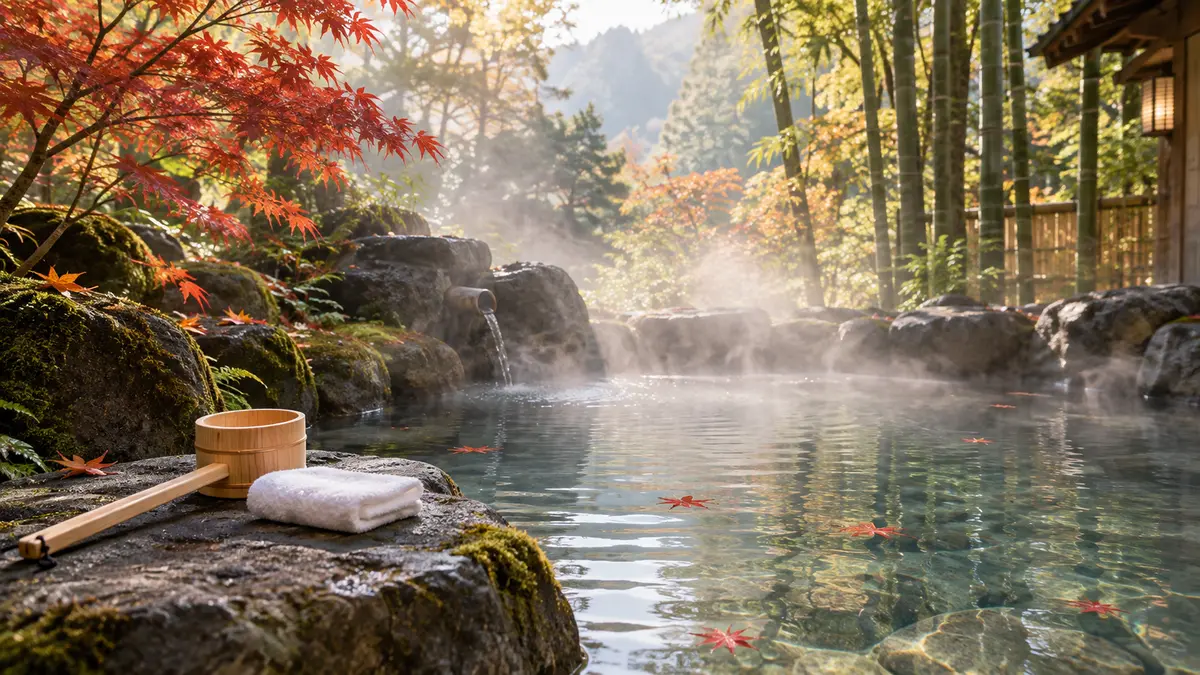
Once your body has warmed from within, it is time for the pinnacle of the onsen experience: stepping into the Rotenburo (露天風呂)—the outdoor open-air stone bath.
- Submerge to the Shoulders: Slide silently into the outdoor pool until the mineral water laps against your collarbones. Find a smooth, natural boulder shaped by centuries of volcanic flow and rest your head against it.
- Engage the Sensory Contrast: Feel the intoxicating contrast of nature: the water cradles your body in 41°C liquid warmth, while a crisp autumn mountain breeze caresses your forehead, cheeks, and exposed scalp. Overhead, ancient maple leaves filter the pale sky, much like the gentle sunlight we encountered in Shinrin-Yoku.
- Release the Breath: Close your eyes. Take a deep inhalation of the sulfur and cedar steam through your nose, hold it for three seconds, and release an audible, trembling sigh through your mouth.
- The Surrender Mantra: Silently remind yourself: “For the next fifteen minutes, there is nothing I need to solve, nowhere I need to be, and no one I need to please.” Much like the Stoic wisdom of Epictetus in The Dichotomy of Control and the graceful art of stepping back in The Grace of Saying ‘No’, let go of the steering wheel. Let the mineral water hold your weight. Let your nervous system drown its fatigue in the deep warmth of the earth.
Phase 4: Yuagari (The Gentle Cooling & Re-Entry)
Knowing when to step out is as vital as knowing how to soak.
- Respect the 15-Minute Threshold: Do not stay submerged past the point of comfort. When you feel a gentle bead of perspiration forming on your forehead and a light pulsation behind your temples (typically after 10 to 15 minutes), stand up very slowly to avoid orthostatic hypotension.
- Do Not Rinse With Tap Water: Step out onto the cedar deck. Unless you have exceptionally sensitive skin that reacts to sulfur, do not rinse under the tap shower. Allow the mineral salts, bicarbonate, and trace elements to dry naturally on your skin; they will form a protective cocoon that locks in warmth and nourishes the dermal microbiome.
- The Yuagari Sanctuary: Wrap yourself in a soft, breathable cotton Yukata robe. Move into the tatami resting lounge (Otakujō). Pour yourself a tall glass of cold mountain spring water or roasted green tea (Hōjicha). Sit quietly for at least twenty minutes. Feel the profound, heavy, golden languor circulating through your limbs—what the Japanese call Yuagari no Kokochi, the heavenly sensation of having been reborn from water.
Bringing the Onsen Sanctuary Home: The Evening Cleansing Ritual
You may be sitting thousands of miles away from the misty slopes of Mount Hakone, trapped in an urban apartment or a suburban home. You may not be able to board a flight to Haneda tomorrow morning.
Yet, the philosophical and somatic essence of the onsen is not confined to Japanese geography. It is an attitude of reverence, vulnerability, and surrender that you can cultivate in your own bathroom tonight.
To create an evening onsen sanctuary in your home:
- Banish the Synthetic Matrix: Before you turn on the water, remove your smartphone, laptop, and tablet from the bathroom. Place them in another room entirely. The onsen cannot exist in the presence of push notifications.
- Soft Visual Sanctuary: Turn off the glaring overhead fluorescent or LED bathroom lights. Light two beeswax candles or place a single warm-tinted amber lamp in the corner. Let the room soften into shadows.
- Replicate Volcanic Minerals: You cannot conjure a geothermal magma vent, but you can saturate your tap water with therapeutic earth minerals. Add two cups of pure Epsom salts (magnesium sulfate) and one-half cup of Himalayan pink salt or sodium bicarbonate (baking soda) to a deeply filled tub. Magnesium absorbs transdermally to relax cramped muscle fibers, while bicarbonate creates the silky, soothing texture of a Japanese hot spring.
- Aromatherapy of the Sacred Woods: Add four to six drops of pure essential oil extracted from Japanese Hinoki cypress (Chamaecyparis obtusa), Atlas cedarwood, or pine. Inhaling these wood terpenes triggers the exact same autonomic calming reflex as an outdoor bath in Hakone.
- Wash Before You Soak: Even in your own bathtub, wash your skin thoroughly in the shower first. Entering a crystal-clear, steaming tub with pristine clean skin signals to your subconscious mind that this bath is not a mundane cleaning chore—it is a sacred altar of restorative stillness.
- Surrender to the Warmth: Submerge yourself to your chin. Place a cool, damp cloth across your forehead. Close your eyes. Feel the water push gently against your ribs. Whispering your gratitude for the day that has passed, allow every knot of invisible armor to soften, dissolve, and float away into the quiet, maternal dark.
The Ultimate Letting Go: Remembering You Are Nature
At its deepest philosophical core, the onsen is a teacher of profound humility.
In our frantic modern lives, we spend our days pretending that we are machines. We demand that our brains produce constant creative output without rest. We treat our bodies like convenient vehicles whose sole purpose is to transport our heads from one meeting to the next. We strain to maintain total control over our careers, our families, our finances, and our reputations.
And then, we step into the hot mineral waters of Hakone.
We feel the heat generated by the molten core of our planet. We breathe steam born from rain that fell upon ancient cedar forests hundreds of years ago. We float, completely weightless, stripped of our clothes, our titles, and our defense mechanisms.
In that quiet steaming pool, the illusion of separation dissolves. You realize that you do not need to fight, claw, and armor yourself against reality. You are not an isolated island battling the currents of the world. You are a biological organism woven into the very fabric of the living earth.
When the world asks too much of you, when your muscles ache with unshed tears and unvoiced boundaries, remember Hakone. Remember that somewhere on this earth, warm water is bubbling patiently up through dark stone, waiting to receive your weary bones, dissolve your heavy armor, and whisper the oldest truth in human history:
You are allowed to put the burden down. You are safe. You can let the water hold you.
Frequently Asked Questions (FAQ)
What makes Hakone onsen so famous in Japan?
Hakone is celebrated worldwide for its extraordinary geothermal diversity and ancient history. Situated in a volcanic caldera beneath Mount Fuji, Hakone features 17 distinct hot spring areas (Hakone Jūnanayu) producing over 25,000 liters of mineral water every minute. The springs range from milky sulfur baths in Owakudani to clear alkaline and chloride waters in Yumoto, offering customized therapeutic relief for joints, skin, and nervous system recovery.
What is the concept of “Hadaka no Tsukiai” in onsen culture?
Hadaka no Tsukiai translates to “naked communion” or “fellowship without clothes.” It is the Japanese cultural philosophy that stripping away all clothing, jewelry, and social status before entering a communal bath allows people to meet in radical equality and vulnerability. Without business suits, luxury items, or pockets to hold business cards, social hierarchy dissolves, fostering profound emotional relief and authentic human connection.
How does onsen water scientifically help with burnout and muscle tension?
Soaking in geothermal mineral water alleviates burnout through four biological mechanisms:
- Hydrostatic Pressure: Compression against the skin shifts venous blood to the heart, activating the vagus nerve and lowering resting heart rate.
- Thermal Vasodilation (40°C–42°C): Increases systemic blood circulation by up to 300%, flushing lactic acid and synthesizing protective Heat Shock Proteins (HSP70).
- Gravitational Buoyancy: Reduces perceived body weight by roughly 90%, allowing chronically braced spinal and shoulder muscles to completely relax.
- Mineral Absorption: Sulfur, magnesium, and bicarbonate ions penetrate the epidermis, soothing inflammation, easing joint stiffness, and promoting deep nocturnal sleep.
Can I experience onsen if I have tattoos?
Historically, Japanese onsens banned tattoos due to their association with organized crime (Yakuza). However, as international travel has grown and Hakone has modernized, many traditional ryokans and public onsens now provide waterproof skin-colored patches (seal) to cover small tattoos. Furthermore, travelers with extensive tattoos can reserve private hot spring baths (Kashikiri-buro) or stay in ryokan rooms featuring private outdoor stone onsen baths on their private balconies.