Look up from your screen for a brief second and examine the immediate space around you. In all likelihood, you are encased within flat drywall, reinforced concrete, and synthetic polymers. You are breathing air that has been mechanically filtered, recirculated through metal ducts, and stripped of organic vitality. Overhead, fluorescent bulbs or harsh LED fixtures […]
Look up from your screen for a brief second and examine the immediate space around you.
In all likelihood, you are encased within flat drywall, reinforced concrete, and synthetic polymers. You are breathing air that has been mechanically filtered, recirculated through metal ducts, and stripped of organic vitality. Overhead, fluorescent bulbs or harsh LED fixtures cast an unrelenting, artificial glare that completely ignores the natural arc of the sun. In front of you, a high-definition monitor or glass smartphone delivers hundreds of notifications, emails, algorithmic alerts, and digital demands every single hour.
At the end of an ordinary day in this artificial ecosystem, you feel a profound, bone-deep exhaustion.
Your eyes burn with a dry, persistent sting. Your neck and upper trapezius muscles are locked into rigid knots of defensive armor. Your skull feels tight, congested, and cognitive overheating clouds your capacity to think. You try to rest by collapsing onto a synthetic couch, yet your nervous system continues to hum with a frantic, restless vibration—an anxious insomnia that refuses to surrender to restorative sleep.
If you have felt this quiet, agonizing depletion, please know this with absolute certainty: There is nothing broken inside your biology.
What you are experiencing is not personal inadequacy, lack of stamina, or clinical weakness. It is the acute somatic distress of an animal trapped inside an unnatural cage.
For 99.9% of human evolutionary history, our ancestors spent their lives entirely immersed beneath open skies, navigating dense temperate forests, listening to the rhythmic murmur of moving water, and resting upon living moss and loam. Our eyes were designed to register the undulating greens of canopy foliage, not flat pixels. Our lungs evolved to inhale the rich volatile aerosols of pine needles and damp earth, not drywall dust. Our auditory cortex was sculpted to find safety in the rustle of leaves and distant birdsong, not the high-pitched hum of traffic and synthetic alerts.
In a few short generations, we have exiled ourselves into concrete boxes and severed our connection to the living world. The result is what researchers now term Nature Deficit Disorder—a state of chronic sensory deprivation, immune downregulation, and cognitive exhaustion.
Fortunately, the living earth has not forgotten us.
Deep within the ancient cedar, cypress, and beech forests of Japan lies a time-tested medical and philosophical sanctuary known as Shinrin-Yoku (森林浴)—the art and neurobiology of forest bathing. It is an unhurried, sensory communion that offers the modern overstimulated mind the most potent antidote to chronic exhaustion ever discovered.
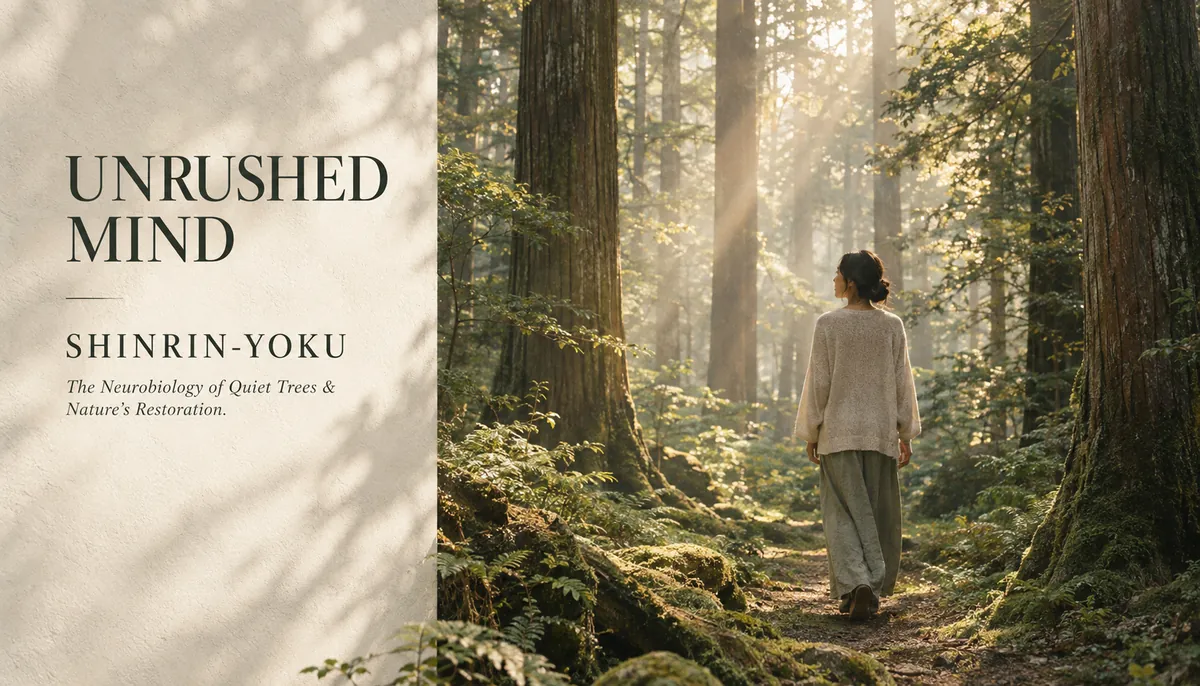
Shinrin-Yoku (森林浴), or forest bathing, is the Japanese practice of immersing one’s senses in the restorative atmosphere of the woods. Developed in 1982, it is not strenuous hiking, but a slow sensory surrender—utilizing tree phytoncides, quiet acoustic landscapes, and natural fractal light to down-regulate the nervous system, lower stress hormones, and restore cognitive clarity.
The Living Atmosphere: What Is Shinrin-Yoku (And What It Is Not)
To receive the profound biological medicine of the forest, we must first untangle forest bathing from our modern, achievement-obsessed conditioning.
When modern culture ventures into nature, it almost immediately weaponizes the landscape for productivity and athletic validation. We lace up performance trail-running shoes, strap GPS-tracking smartwatches to our wrists, measure elevation gains, calculate heart rate zones, and obsess over reaching a geographic summit before sundown. We transform the woods into an outdoor gymnasium—another arena where we can push, grind, conquer, and collect digital badges.
Shinrin-Yoku is the exact antithesis of this aggressive pursuit.
The word itself was coined in 1982 by Tomohide Akiyama, the visionary Director General of Japan’s Ministry of Agriculture, Forestry, and Fisheries. Akiyama recognized that the explosive economic boom of post-war Japan had created a catastrophic epidemic of karoshi (death from overwork), severe corporate burnout, and nervous system collapse. He proposed a national public health initiative: encourage overworked city dwellers to visit designated therapeutic forests to simply “bathe” (yoku) in the healing atmosphere of the woods (shinrin).
In true Shinrin-Yoku, there is no finish line. There is no summit to conquer, no distance to record, no calorie-burn goal to satisfy, and no checklist to complete. If you hike five miles in two hours with a furrowed brow and an accelerated pulse, you have had a vigorous workout—but you have not experienced a single moment of forest bathing.
During a traditional forest therapy walk, you might travel less than one kilometer over the course of two or three hours. You wander aimlessly, pausing whenever a patch of velvet moss catches your eye. You sit against the broad, mossy trunk of an ancient hemlock. You listen to the liquid cadence of a shallow stream spilling over smooth granite stones. You close your eyes and let the cool mountain breeze wash over your exposed wrists and neck.
Much like the Parisian philosophy of the unhurried wanderer we explored in The Art of Flânerie, forest bathing is an act of sovereign surrender. It is permission to lay down your armor, step outside the artificial urgency of society’s clock as examined in The Myth of Falling Behind, and let the forest hold you in its ancient, unhurried embrace.
The Invisible Medicine: Phytoncides, Natural Killer Cells, and the Biology of Calm
While poet-philosophers and Zen monks have long intuitively understood the tranquil power of the wilderness, modern clinical medicine has now revealed the precise molecular mechanisms that make trees so extraordinarily restorative to human health.
The pioneer of this scientific revolution is Dr. Qing Li, a professor of environmental immunology at Nippon Medical School in Tokyo and the founding president of the Japanese Society of Forest Medicine. Over two decades of rigorous clinical trials, Dr. Li and his colleagues took stressed, urban professionals and measured their blood, saliva, heart rate variability, and immune markers before, during, and after forest immersion.
What they uncovered stunned the global medical community. The calming effect of the woods is not merely a psychological placebo or a romantic feeling. It is a measurable, biochemical transformation driven by three primary physiological mechanisms:
1. Phytoncides: The Tree’s Aromatic Immune Defense
Trees cannot run away when attacked by predatory insects, harmful bacteria, or invasive fungal blights. To survive, plants have evolved sophisticated chemical defense systems. They synthesize and exude volatile organic compounds known as phytoncides (derived from the Greek phyton meaning plant, and the Latin caedere meaning to kill).
When you step into a grove of evergreens—such as Japanese Hinoki cypress, cedar, Scots pine, or spruce—that crisp, clean, invigorating scent filling your nostrils is rich with terpenes: primarily alpha-pinene, beta-pinene, d-limonene, and camphene.
When you inhale these natural airborne aerosols, they pass directly through your olfactory bulb and enter your bloodstream. Clinical trials led by Dr. Li demonstrated that breathing forest air saturated with phytoncides triggers a dramatic, sustained surge in human Natural Killer (NK) cells—a specialized subclass of white blood cells that serve as the body’s primary frontline defense against viral infections and early-stage oncogenic tumor formations.
Following a three-day forest therapy retreat:
- NK cell activity inside participants surged by more than 50%.
- Levels of essential intracellular anti-cancer proteins—perforin, granzyme A/B, and granulysin—elevated significantly.
- Astonishingly, this heightened immune defense did not vanish upon returning to the city; the elevated NK cell baseline persisted for over 30 days after leaving the forest.
2. Autonomic Realignment: Silencing the Chronic Alarm
In the modern workplace, the sympathetic nervous system is trapped in a state of low-grade, perpetual activation (fight-or-flight). Cortisol runs high, blood pressure stays elevated, and the vagal brake is disengaged—a pattern we dissected in our somatic investigation on Where Does Your Body Store Unspoken Emotions?.
Within just twenty minutes of unhurried forest immersion, the human autonomic nervous system undergoes a profound recalibration:
- Salivary Cortisol & Adrenaline: Clinical saliva swabs reveal a steep, statistically significant plunge in circulating cortisol, adrenaline, and noradrenaline levels compared to urban walking.
- Vagal Tone & Heart Rate Variability (HRV): High-frequency HRV metrics climb, indicating that the vagus nerve has successfully engaged the parasympathetic nervous system (rest-and-digest). Blood vessels dilate, resting heart rate drops, and systemic vascular resistance eases.
- Cellular Restoration: In terms of neurochemical impact, forest bathing achieves the same somatic downregulation as structured protocols like NSDR (Non-Sleep Deep Rest), while simultaneously satisfying the desperate biological need for sensory and natural restoration identified in The 7 Types of Rest.
Soft Fascination and Komorebi: Restoring the Fractured Mind
Beyond cellular immunity and cardiovascular relief, the forest performs its most exquisite healing upon the human brain’s prefrontal cortex.
In the late 1980s, environmental psychologists Rachel and Stephen Kaplan at the University of Michigan formulated a groundbreaking framework known as Attention Restoration Theory (ART). The Kaplans proposed that the human brain utilizes two distinct modes of attention:
1. Directed Attention: The Finite Muscle of Modern Work
Directed attention is the effortful, voluntary cognitive energy you expend to focus on tasks that do not possess inherent biological novelty. You use directed attention to analyze spreadsheets, write code, respond to urgent emails, navigate heavy freeway traffic, and ignore distracting chat pings.
Because directed attention requires the active inhibition of distractions, the neural circuits of the prefrontal cortex quickly become depleted. When this occurs, you enter a state called Directed Attention Fatigue (DAF). Symptoms include short-tempered irritability, brain fog, inability to make decisions, sensory sensitivity, and chronic procrastination.
2. Soft Fascination: The Restorative Gift of the Canopy
Nature, by contrast, does not demand directed attention. Instead, it effortlessly elicits Soft Fascination—an involuntary, effortless awareness that gently engages the mind without draining its cognitive reserves.
When you sit beneath a high canopy, your attention is captured by the gentle, hypnotic choreography of the wild:
- The rhythmic fluttering of birch leaves in an afternoon breeze.
- The delicate ripples spreading across a forest pool.
- The dappled, dancing light filtering through branches onto the mossy earth.
- The sudden, melodic trill of a thrush hidden in the ferns.
During soft fascination, the prefrontal cortex’s inhibitory mechanisms are allowed to power down completely. The brain enters a regenerative state characterized by high Alpha brainwaves (8–12 Hz)—the signature frequency of tranquil alertness, deep meditation, and creative daydreaming. As we explored in establishing your personal fortress in The Attention Sanctuary and unplugging during a Digital Sabbath, soft fascination is the missing nutritional staple our cognitive ecosystem has been starving for.
The Sacred Geometry of Komorebi
The Japanese language possesses an exquisite, untranslatable word: Komorebi (木漏れ日). It describes the interplay of sunlight and shadow created when light filters through the leaves of a swaying forest canopy.
Physicists and neuroscientists have discovered that the patterns created by Komorebi, tree branches, and fern leaves are not random; they are fractals—self-similar mathematical geometries that repeat across multiple scales. Research pioneered by Dr. Richard Taylor at the University of Oregon demonstrated that the human visual cortex is hardwired to process natural fractals with effortless ease. When human eyes gaze upon mid-range fractal dimensions (such as tree canopies or ocean waves), EEG scans reveal an immediate 44% drop in physiological stress responses.
The forest heals your eyes simply by allowing them to look upon what they were born to behold.
The Ecological Diagnostic Matrix: Urban Depletion vs. Forest Restoration
To comprehend the sheer magnitude of what occurs when you trade the city streets for the forest sanctuary, examine this comprehensive biological and psychological comparison:
| Biological & Psychological Dimension | Concrete & Screen Environment (Urban Depletion) | Shinrin-Yoku Forest Immersion (Nature Restoration) |
|---|---|---|
| Autonomic Nervous System | Chronic sympathetic overdrive; elevated heart rate, shallow chest breathing, tense postural bracing. | Parasympathetic activation; deep diaphragmatic breathing, elevated heart rate variability (HRV), and vagal calming. |
| Stress Neurochemistry | Sustained high baseline cortisol and adrenaline; systemic neuroinflammation and immune depletion. | Clinically documented drop in salivary cortisol; stabilization of glucose metabolism and reduced blood pressure. |
| Immune Defense (NK Cells) | Depressed cytotoxic activity; reduced production of anti-viral proteins; susceptibility to chronic infections. | Over 50% increase in Natural Killer (NK) cell count and intracellular anti-cancer proteins, lasting up to 30 days. |
| Cognitive Attention State | Directed Attention Fatigue (DAF); fragmented focus, cognitive overheating, decision paralysis, and irritability. | Soft Fascination; prefrontal cortex downshift, emergence of Alpha brainwaves (8–12 Hz), and spontaneous creative clarity. |
| Sensory Processing | Sensory deprivation (flat drywall, odorless air) combined with visual glare from high-frequency blue-light pixels. | Full 360-degree sensory immersion; rich phytoncide aerosols, natural fractal geometry (Komorebi), and acoustic organic sounds. |
| Emotional & Existential Tone | Urgency, hyper-comparison, feeling untethered, existential loneliness, and chronic restlessness. | Profound biological belonging, quiet humility, unhurried ease, and an unshakeable reverence for the cycle of living things. |
The 4-Phase Shinrin-Yoku Protocol: How to Forest Bathe Anywhere
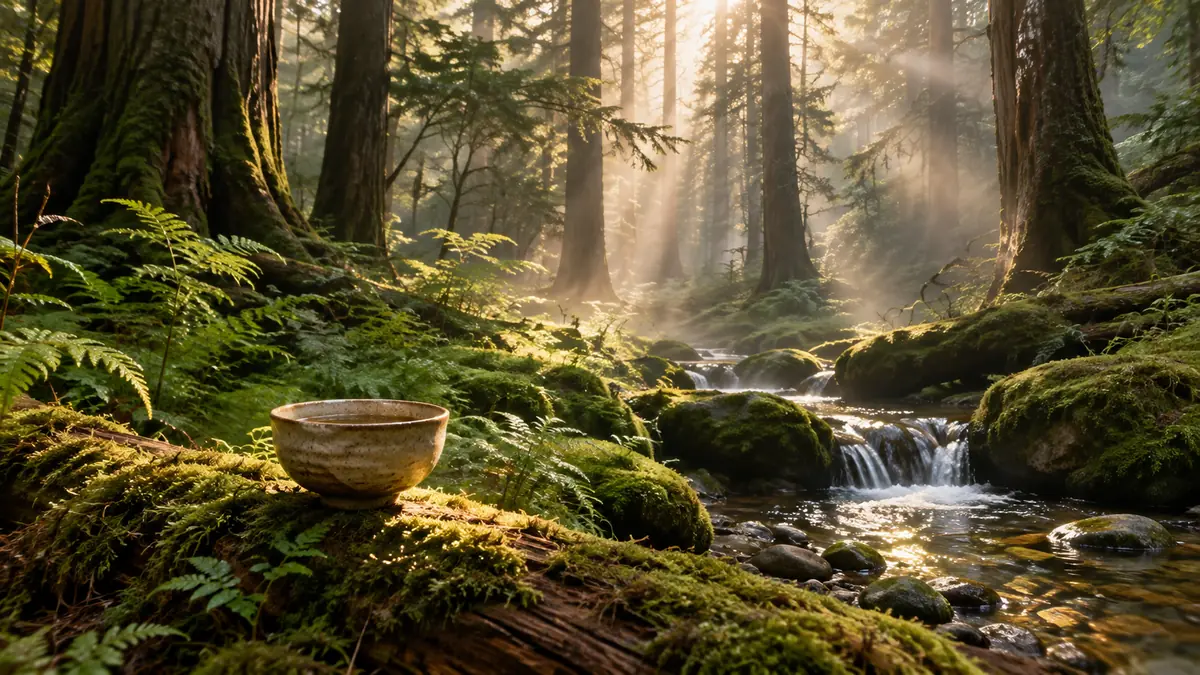
You do not need to fly to the remote cedar mountains of Nagano or Akita to experience the life-giving medicine of Shinrin-Yoku. While ancient primary forests offer the highest concentrations of phytoncides, any mature woodland, botanical garden, or forested regional park possesses the power to recalibrate your nervous system.
When you are ready to venture into the trees, abandon all performance metrics and follow this clinical four-phase protocol:
Phase 1: The Threshold Crossing & Digital Surrender
The most crucial step of forest bathing occurs before your foot ever touches the soil.
- Sever the Digital Leash: Take your smartphone, switch it into full Airplane Mode, and bury it deep inside the bottom of your backpack. If you use your phone to track steps, listen to podcasts, or photograph every picturesque leaf, you remain tethered to the synthetic matrix. You are looking at the forest through a lens rather than bathing in its presence.
- Establish the Threshold: Before stepping into the trees, locate a natural gateway—two mature oaks standing beside the trail, a wooden footbridge over a creek, or where the gravel path gives way to soft dirt. Pause at this boundary. Place your hand on your chest, take three long, slow, audible exhalations, and set a silent intention: “I leave my titles, my inbox, my worries, and my achievements behind. I enter this living sanctuary simply as a living creature returning home.” Step across.
Phase 2: The Unhurried Drift (Flânerie of the Green)
Once across the threshold, discard all concepts of speed, distance, and destination.
- Adopt the Snail’s Cadence: Intentionally reduce your walking speed to roughly one-quarter of your normal urban pace. If you are breathing heavily, you are moving too fast. Walk so slowly that you can feel the subtle shift of your body weight from heel to toe across the uneven loam.
- Follow Intuitive Curiosity: Do not follow a rigid route or trail map. Allow yourself to be pulled by effortless curiosity. If a patch of bright green lichen on an old granite boulder beckons you, wander off the path to inspect it. If a low-hanging pine branch crosses your path, stop and gently cradle its needles in your palm. Much like the surrender of control in Stoic wisdom from The Dichotomy of Control and the acceptance of impermanence in Kyoto in Stillness, surrender the need to steer your journey.
Phase 3: The Five Gateways of the Senses
Shinrin-Yoku is not an intellectual exercise; it is an organic, multi-sensory awakening. Move through the five sensory gateways one by one:
- The Gateway of Sight (Komorebi & Horizons): Soften your gaze. Stop staring with laser focus at single objects. Instead, open your peripheral vision. Look up at the cathedral of branches swaying against the pale sky. Notice the endless permutations of green: chartreuse, sage, olive, moss, jade, and emerald. Watch how sunlight breaks into shimmering motes through the mist.
- The Gateway of Scent (The Phytoncide Breath): Stop and close your eyes. Inhale deeply through your nose down into the pit of your belly. Hold the air for four seconds, and exhale slowly through parted lips. Inhale the damp, peaty aroma of geosmin—the organic compound produced by soil microbes when rain strikes dry earth. Breathe in the resinous, balsamic perfume of pine sap. You are literally inhaling the immune system of the forest.
- The Gateway of Sound (The Natural Acoustic Basin): Stand completely still for two minutes. Filter out any distant mechanical rumbles and tune your ears to the organic symphony. Hear the wind traveling through needles versus broad leaves; hear the sudden rustle of a dry leaf pushed aside by a foraging beetle; listen to the subtle, hollow crack of a falling acorn. These acoustic frequencies speak directly to your primitive amygdala, signaling that there are no predators near and that you are safe to disarm.
- The Gateway of Touch (Tactile Communion): Remove your gloves. Reach out and touch the rough, furrowed bark of a giant hemlock. Feel the icy chill of a mountain stream flowing over your fingertips. Touch the velvety, sponge-like cushion of living moss. If the temperature and terrain allow, kick off your shoes and place the bare soles of your feet onto the soft, cool earth.
- The Gateway of Taste (Atmospheric Moisture): Part your lips and inhale the damp mountain air. Feel the microscopic droplets of humidity condensing on your tongue. If you carry a thermos of pure water or hot green tea, take a slow, reverent sip, savoring how the warmth echoes the tranquility of your surroundings.
Phase 4: Sit-Spot Stillness & Sacred Departure
Conclude your forest bathing session by shifting from movement into pure stillness.
- The Sit-Spot: Locate a welcoming location—a smooth boulder beside a stream, a dry log, or the base of an ancient cedar. Sit down comfortably. Rest your back against the wood or stone. For fifteen to twenty minutes, do nothing at all. Close your eyes, let gravity pull your shoulders down, and simply exist as another silent organism within the grove.
- The Departure Bow: When it is time to leave, stand up slowly. Turn toward the grove of trees that offered you shelter. In traditional Japanese forest therapy, it is customary to offer a slight, reverent bow of the head—a simple gesture of gratitude to the trees for sharing their shade, their medicine, and their enduring peace. Cross back over the threshold, carrying the quiet rhythm of the woods inside your chest.
Bringing the Forest Inward: Micro-Doses of Nature in Daily Life
We must be realistic: most of us cannot live in a cabin tucked beneath ancient Japanese redwoods. We have professions, families, mortgages, and urban responsibilities that anchor us to cities.
Yet, environmental biology reveals that even micro-doses of nature can interrupt the cascade of chronic stress:
- Aerosolize Pure Phytoncides: Purchase pure, high-grade essential oils extracted from Chamaecyparis obtusa (Japanese Hinoki cypress), Siberian fir (Abies sibirica), or Scots pine. Place a few drops in an ultrasonic cool-mist diffuser in your bedroom or home office. Clinical sleep studies confirm that inhaling vaporized Hinoki oil during sleep measurably lowers night-time adrenaline and improves deep REM architecture.
- The 10-Minute Urban Park Sanctuary: Even a small municipal park containing a cluster of mature deciduous or evergreen trees offers significant restorative value. A 10-minute walk through a tree-lined square on your lunch break—with your phone silenced in your pocket—can reset directed attention and lower midday blood pressure spikes.
- Embrace Biophilic Living Spaces: Surround your living and working environments with living greenery—fiddle-leaf figs, snake plants, peace lilies, or cascading pothos. Research indicates that the visual presence of natural foliage in indoor environments reduces subjective fatigue by up to 15%.
- Live by the Seasons of the Trees: Perhaps the greatest lesson the forest imparts is that nothing in nature blooms twelve months a year. A tree spends its autumn gracefully releasing what it no longer needs. It spends its winter in quiet, dormant, unseen stillness deep within its root system. It does not apologize for its winter rest, nor does it rush its spring blossom.
When you feel exhausted, uninspired, or depleted, remember the ancient canopies. Forgive yourself for needing to slow down. Step away from the concrete, find a quiet grove of trees, breathe deeply, and allow the quiet wisdom of the earth to welcome you home.
Frequently Asked Questions About Shinrin-Yoku & Forest Therapy
How long does a forest bathing session need to be to produce clinical health benefits?
Clinical research indicates that the physiological benefits of nature occur along a dose-response curve. As little as 20 minutes of relaxed immersion in an urban green space is sufficient to trigger a statistically significant decline in salivary cortisol levels and systolic blood pressure. For profound immune enhancement—specifically the 50% surge in Natural Killer (NK) cells and anti-cancer proteins discovered by Dr. Qing Li—a sustained immersion of two to three hours in a mature forest environment is recommended.
Can I listen to guided meditations, podcasts, or relaxing music while forest bathing?
While calming music is enjoyable, it fundamentally defeats the primary neurobiological mechanisms of Shinrin-Yoku. Forest bathing relies on multi-sensory attunement. When you place earbuds in your ears, you close down the auditory gateway. You disconnect from the natural acoustic soundscape—wind in the canopies, birdsong, water ripples—which your primitive autonomic nervous system specifically requires to disengage its defensive vigilance. For genuine healing, leave the headphones at home and let the forest be your symphony.
What if I live in a dense metropolis with no access to ancient wilderness?
You do not need untouched old-growth forests to experience nature’s restoration. Studies comparing urban parks to wild forests show that city parks with mature tree canopies provide roughly 70% to 80% of the psychological and cardiovascular benefits of wilderness immersion. Look for pocket parks, botanical arboretums, community gardens, or tree-lined cemetery walkways. The key factor is not geographic isolation, but your internal posture of unhurried presence and sensory openness.