

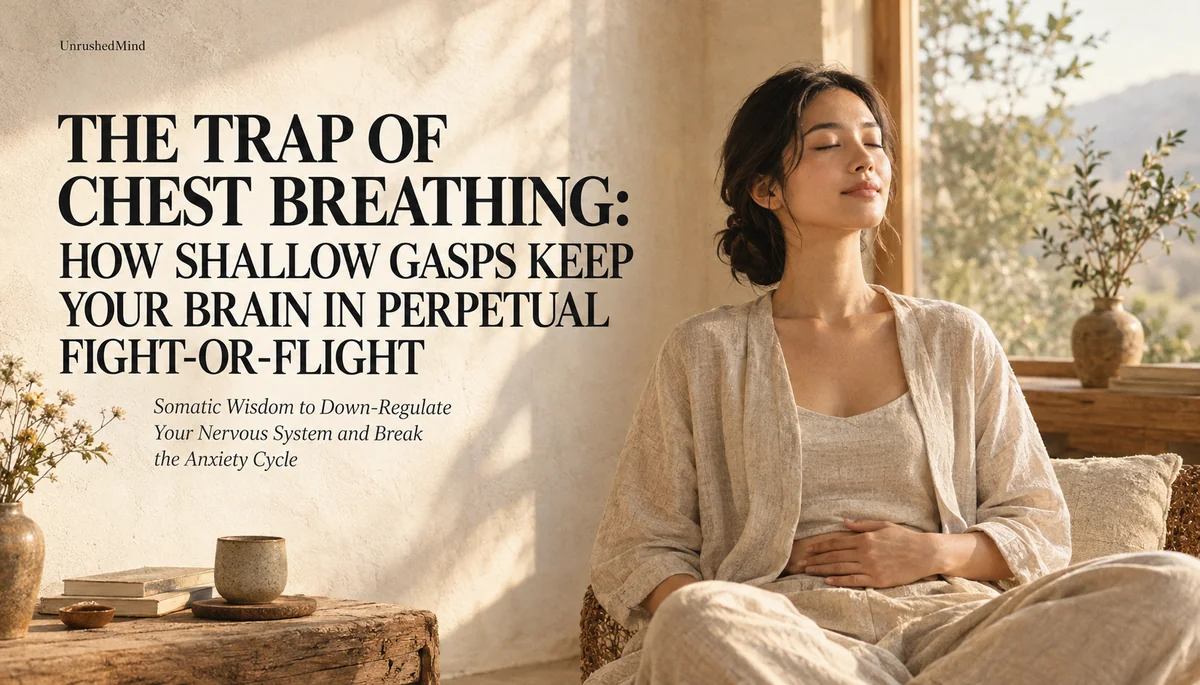
Have you ever caught yourself holding your breath while reading an email, or taking rapid, shallow sips of air into your collarbones? Your shoulders are hunched, your throat feels dry, and an inexplicable urgency tightens around your chest. You are sitting quietly at a desk, yet inside, your biology behaves as if a predator were […]
Have you ever caught yourself holding your breath while reading an email, or taking rapid, shallow sips of air into your collarbones?
Your shoulders are hunched, your throat feels dry, and an inexplicable urgency tightens around your chest.
You are sitting quietly at a desk, yet inside, your biology behaves as if a predator were lurking in the shadows.
Without realizing it, millions of people live in a state of chronic upper-chest hyperventilation.
Every shallow gasp sends an unspoken signal to your brain: danger is near, stay vigilant.
The Biology of Overbreathing: Why Shallow Gasps Signal Danger
In modern physiology, chronic hyperventilation shallow breathing anxiety describes a subtle breathing pattern where rapid sips of air into the upper chest blow off excessive carbon dioxide. This respiratory shift constricts cerebral blood flow and triggers the amygdala, convincing your brain that you are in constant peril.
When you breathe only with your neck and collarbones, you bypass the diaphragm.
The diaphragm is not merely a muscle of respiration; it is the physical anchor of emotional safety.
Running directly through it is the vagus nerve, the primary superhighway of the parasympathetic nervous system.
When you take deep diaphragmatic breaths, the descending movement massages the vagus nerve, signaling the heart to slow its tempo.
Conversely, upper-chest breathing stimulates the sympathetic nerve chain along your thoracic spine.
By breathing shallowly, you mechanically tell your heart to race and your adrenals to produce stress hormones.

The Vicious Somatic Loop: How Body Symptoms Create Mental Panic
Most people assume anxiety begins as psychological worry and then spills into physical tension.
In clinical reality, the conversation flows equally in the opposite direction.
When you breathe too rapidly, you exhale excessive carbon dioxide (CO2).
This induces mild respiratory alkalosis, which causes your blood vessels to constrict.
Paradoxically, shallow gasping delivers less oxygen to your brain tissue—a phenomenon known as the Bohr Effect.
Your brain senses this drop in oxygenation and immediately sounds an internal alarm.
You begin to experience dizziness, tingling fingers, tight chest muscles, and a sudden surge of dread.
The conscious mind then invents a catastrophic narrative to explain the sensations: “Something is wrong with me.”
Consider the contrast between living in chest-bound respiration and resting in diaphragmatic rhythm:
| Dimension of Respiration | Upper-Chest Breathing | Grounded Diaphragmatic Breathing |
|---|---|---|
| Primary Muscle Used | Neck scalenes, trapezius, and upper clavicular muscles. | The broad dome of the diaphragm expanding 360 degrees. |
| Brainstem Signaling | High sympathetic arousal; fight-or-flight vigilance and amygdala activation. | Vagal tone stimulation; down-regulation of cortisol and heart rate deceleration. |
| Subjective Experience | Restlessness, panic vulnerability, brain fog, and chronic urgency. | Spacious mental clarity, calm presence, and physical safety. |
When you recognize this biological feedback loop, you no longer need to fight your thoughts with more thoughts.
Instead, you can simply change the physical signals arriving at your brainstem.
Three Somatic Steps to Anchor Your Breath in the Diaphragm
Retraining your breath is not about forcing huge, dramatic inhales.
Forcing oversized breaths often worsens hyperventilation and amplifies anxiety.
True somatic restoration is quiet, slow, and soft.

1. The Low-Belly Palm Anchor
Place both hands gently over your lower abdomen, just beneath your navel.
Keep your upper chest, collarbones, and shoulders completely heavy and still.
As you inhale quietly through your nose, invite your lower belly to expand gently against your palms.
As you exhale, let your belly soften naturally inward without any forcing.
Allow your upper chest to remain an undisturbed bystander.
2. The Extended 2:1 Exhale
The secret to switching off the fight-or-flight reflex lies in the length of your out-breath.
Inhale softly through your nose for a silent count of three seconds.
Then, exhale through gently parted lips for an unhurried count of six seconds.
This prolonged exhalation stimulates arterial baroreceptors, signaling your heart that it is safe to rest.
Practice this rhythm for just two minutes whenever restlessness begins to rise.
3. Dissolving “Screen Apnea”
Throughout your workday, observe how you breathe when opening new tabs or checking messages.
Notice the unconscious habit of holding your breath and tensing your shoulders.
Whenever you catch yourself freezing, gently part your teeth and exhale a soft, silent sigh.
Remind your nervous system that an unread message is not a physical threat.
Mindful Somatic & Nervous System Note
A Note on Bodily Wisdom: Your shallow breathing was never a personal flaw. It was your nervous system’s loyal effort to keep you alert in stressful environments. Greet your breath with kindness as you gently invite it back home to your belly.
Frequently Asked Questions About Chest Breathing and Anxiety
Why do I feel lightheaded when taking deep breaths during anxiety?
Forcing large, rapid inhales expels too much CO2, temporarily constricting cerebral blood vessels. Focus instead on smaller, softer inhales and prolonged, gentle exhales.
How does shallow breathing directly impact the vagus nerve?
Upper-chest breathing prevents the downward movement of the diaphragm, depriving the vagus nerve of the mechanical stimulation needed to trigger calming reflexes.
How long does it take to retrain chronic chest breathing?
Practicing two to three minutes of belly breathing three times daily can recalibrate your brainstem’s respiratory center within two to three weeks.
Your nervous system does not respond to rational debates; it listens to the rhythm of your diaphragm.
When your breath sinks beneath your ribs, your heart slows, your shoulders drop, and the alarm fades.
Place your hands on your belly, loosen the tension in your throat, and let the ground support you.