
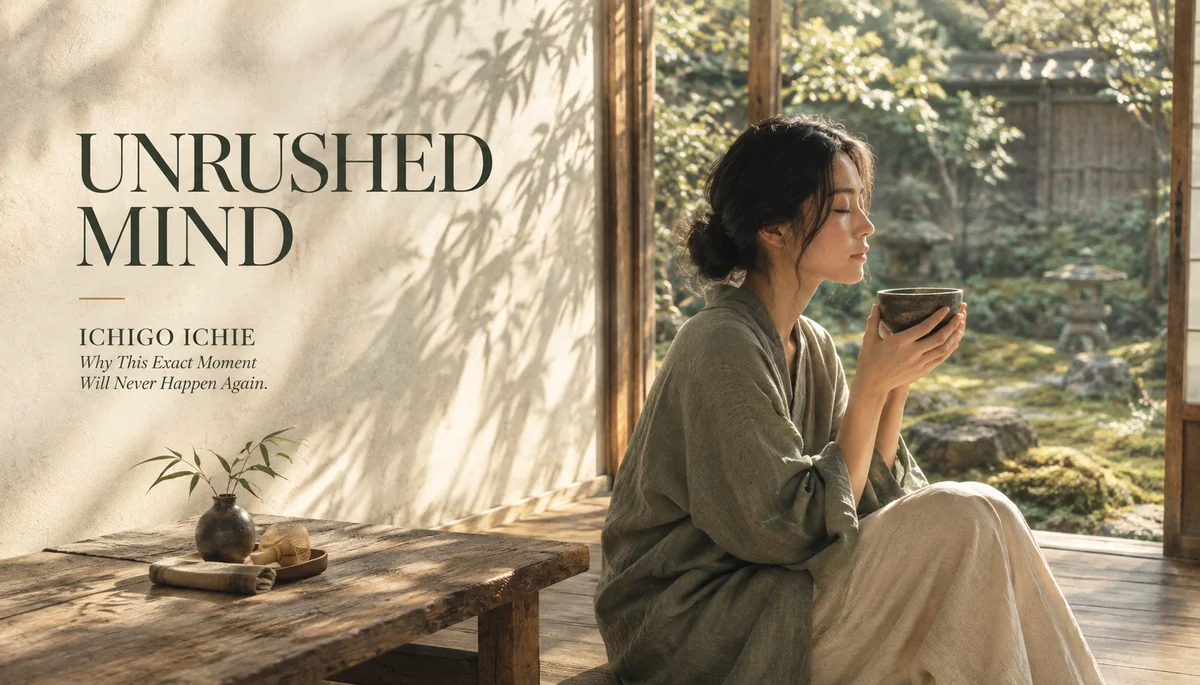
You are sitting across a small wooden table from someone you love. The tea in your cup has cooled slightly, sending up only the faintest ribbons of steam against the morning light. Outside the window, a breeze stirs the leaves of an oak tree, turning their pale undersides toward the sky. The clock on the […]
You are sitting across a small wooden table from someone you love. The tea in your cup has cooled slightly, sending up only the faintest ribbons of steam against the morning light. Outside the window, a breeze stirs the leaves of an oak tree, turning their pale undersides toward the sky. The clock on the wall continues its quiet, indifferent rhythm.
Yet physically, you are only half there.
A corner of your consciousness is reviewing an unanswered email that arrived late yesterday afternoon. Another fragment is already rehearsing a difficult conversation scheduled for tomorrow morning. Your fingers twitch unconsciously toward the phone resting face-down beside your plate, hungry for the quick, numbing hit of a new notification. You hear the voice speaking to you, you nod, you smile in the expected places, but you are not truly inhabiting the room. You are an apparition—a ghostly visitor passing through a moment that you will never get back.
Later, whether in a month, a decade, or on an ordinary Tuesday when circumstances have irrevocably shifted, you will look back at that quiet breakfast with a thumping, hollow ache in your chest. You will realize that the sunlight will never slant across that particular table in quite that way again. The person sitting opposite will never be that exact age, carrying that exact heart, speaking with that exact voice. And you will wonder why it is so heartbreakingly difficult to simply be where your feet are.
This universal modern grief—the sense that our lives are quietly evaporating while our attention is perpetually held hostage elsewhere—was solved centuries ago in the hushed tea pavilions of ancient Japan. The masters called their remedy Ichigo Ichie (一期一会).
Ichigo Ichie is an ancient Japanese philosophical concept originating in Zen tea ceremonies, translating to “once in a lifetime encounter.” It teaches that every single moment, conversation, and breath is unrepeatable. Practicing it frees the mind from chronic hurry, dissolving anxiety by turning ordinary daily encounters into sacred acts of presence.
The Ghost in the Machine: Why We Are Physically Present but Mentally Absent
To understand why we need the medicine of Ichigo Ichie so desperately, we must first confront the quiet tragedy of the modern condition: temporal dislocation. Most of us do not live in the present. We live in an imagined future or an unchangeable past, treating the present merely as an inconvenient waiting room where we pace impatiently until our “real life” begins.
We see this in what can only be called the screenshot illusion. When confronted with breathtaking beauty—a crimson sunset bleeding across the ocean, a child taking her first steps, a musician pouring their soul into a melody—our immediate cultural impulse is not to open our senses and receive it. Our instinct is to raise a glass rectangle between our eyes and the miracle, capturing a digital artifact to prove we were there. But taking a photograph is often a subconscious defense mechanism: it allows us to outsource the demanding emotional labor of presence to a silicon chip. We save the moment for later, only to realize later that we never actually tasted it.
When our minds are perpetually leaning forward, our bodies remain trapped in what psychologists describe as hurry sickness—a constant, underlying agitation that makes stillness feel like a dangerous waste of time. We believe that if we slow down, we will fall behind. We treat our conversations like transactions and our days like checklists to be conquered. But in treating every moment as a means to an end, the end never arrives. We wake up having lived forty or fifty years, only to realize we were merely a passenger in our own skin.
The antidote is not another productivity hack or an aggressive digital detox app. It is a radical, metaphysical shift in how we perceive the texture of time itself.
The Origins of Ichigo Ichie: Wisdom from the Hushed Tea Pavilion
The four kanji characters that comprise Ichigo Ichie (一期一会) carry an immense poetic weight. Ichigo (一期) translates to “from birth until death,” or an entire human lifetime. Ichie (一会) means “a single meeting” or “an unrepeatable gathering.” Put together, the phrase whispered across the straw mats of the tea room meant: “This meeting happens only once in a lifetime.”
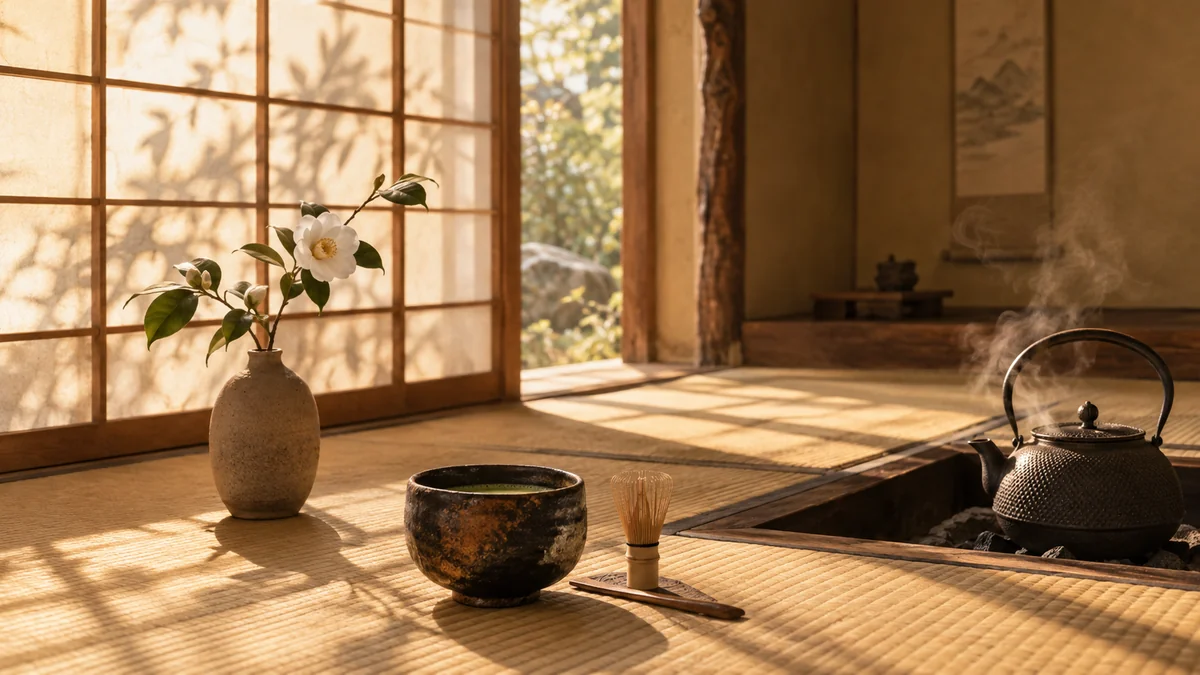
The philosophy was born in the 16th century during Japan’s tumultuous Sengoku (Warring States) period, nurtured by the legendary tea master Sen no Rikyu (1522–1591). Rikyu took the opulent, ostentatious tea parties favored by samurai warlords—who used imported gold bowls to flaunt their wealth—and stripped them down to their bare, sacred essentials. He designed tiny, rustic tea pavilions (*chashitsu*) built of clay, weathered timber, and thatch, nestled deep inside quiet gardens designed to evoke mountain hermitages.
To enter Rikyu’s tea room, every guest—whether a peasant, a wealthy merchant, or the supreme warlord of Japan—had to bend their knees and crawl through a tiny three-foot-square doorway called the nijiriguchi. This physical humility had a profound psychological purpose: a warrior could not enter with his two-foot katana sword strapped to his hip. He was forced to leave his weapons, his status, his military rank, and his imperial ego on the wooden rack outside. Inside the room, all souls were stripped back to equal, fragile mortals sharing a fleeting bowl of green tea.
Centuries later, in the 19th century, the master Ii Naosuke codified this spiritual posture in his seminal work, Chanoyu Ichie Shu:
“Even if the host and the guests meet frequently and know each other well, today’s gathering can never be repeated in the exact same way. The season, the weather, the temperature of the water, the coals burning on the hearth, the quality of the light, and the inner state of those gathered will never align like this again. Therefore, the host must pour their entire soul into serving the tea, and the guests must receive it with unreserved reverence, knowing that this encounter occurs only once in their lives.”
Consider the psychological brilliance of this insight. Rikyu and Naosuke were not talking about rare, exotic encounters with famous strangers in foreign lands. They were speaking about having tea with your spouse, your neighbor, your colleague, or your child. They recognized our human tendency toward familiarity blindness: the moment we expect to see someone tomorrow, we stop seeing them today.
By declaring that even a daily morning routine is an unrepeatable historical event, Ichigo Ichie shatters our complacent boredom. It reminds us that no two cups of water boil with the exact same murmur. No two breezes carry the exact same scent of damp soil. When you embrace this truth, the mundane ceases to be a chore and transforms into a temple of presence, mirroring the contemplative calm found when walking among ancient Zen temples or practicing the art of mindful walking.
The Geometry of Transience: Where Zen Meets Stoic Mortality
To understand the depth of Ichigo Ichie, we must examine the cultural soil from which it grew: the Japanese aesthetic principle of Mono no Aware (物の哀れ), loosely translated as “the pathos of things” or the poignant beauty of impermanence.
In Western thought, permanence is often equated with value. We build monuments out of granite, carve names into marble, and construct empires designed to endure for centuries. But in traditional Japanese philosophy, a thing is not precious because it lasts; it is precious precisely because it vanishes. The Japanese do not celebrate the cherry blossom (*sakura*) because the blossoms are sturdy; they celebrate it because the delicate petals bloom for barely ten days before falling like soft pink snow upon the stones. Its fragility is its majesty.
Here, Japanese Zen forms an extraordinary, resonant bridge with Western Stoicism. Marcus Aurelius, writing in the cold solitude of military camps along the Danube, constantly reminded himself of the exact same reality:
“Time is a river, a violent current of events, glimpsed once and already carried past us, and another follows and is gone.”
Similarly, the Stoic philosopher Seneca warned in On the Shortness of Life that our greatest folly is living as though we possess an infinite reservoir of tomorrows. When we align Ichigo Ichie with the ancient practice of Memento Mori (the remembrance of mortality) and Amor Fati (the radical love of whatever life brings), our perception of daily friction completely dissolves.
Think about the irritation you feel when a train is delayed twenty minutes, or when a child spills milk across the floor, or when an elderly relative tells the same childhood story for the fourteenth time. That irritation exists only because our ego believes we have “better, more important things” to be doing with our supposedly permanent lives. We demand that reality conform to our private schedule.
Now, filter that exact same moment through the lens of Ichigo Ichie. You realize that a spilled glass of milk is not an interruption to your life; it is your life. That child will only be five years old once. One day, you will mop your kitchen floor in absolute, sterile silence, and you would give every possession you own to have that spilled glass of milk and that laughter back again. That elderly parent will not be here forever. This moment of telling a repetitive story is unrepeatable. When you see through the eyes of finitude, impatience feels absurd, and irritation is replaced by an overwhelming wave of tender gratitude.
Why Modern Minds Struggle with Ichigo Ichie: The Brain in Survival Mode
If the wisdom of Ichigo Ichie is so self-evidently liberating, why is it so agonizingly difficult for us to practice? Why do we constantly slide back into rushing, distraction, and numbness?
The answer does not lie in a moral failing or a lack of spiritual discipline. It lies in our evolutionary biology and our overloaded modern nervous system.
From an evolutionary perspective, our brains did not develop to sit under trees and marvel at the transient beauty of floating clouds. Our nervous systems evolved on ancient savannahs where survival required vigilance: scanning the horizon for predators, anticipating famine, remembering past dangers, and constantly calculating future risks. The brain is an anticipation engine. It is hardwired to care about *what comes next* far more than *what is happening now*.
In our hyperconnected modern environment, this evolutionary bias has been weaponized by consumer technology. Digital algorithms are engineered to keep our dopamine systems in a perpetual loop of hungry anticipation: the next email, the next headline, the next metric, the next crisis. This keeps our sympathetic nervous system locked in low-grade overdrive, leaving millions of people feeling like they are perpetually stuck in survival mode.
When the nervous system remains in chronic survival drive for years without respite, it frequently collapses into a state known as a functional freeze. In a functional freeze, you are capable of getting your work done, answering messages, meeting deadlines, and performing your social roles with flawless competence—yet inside, you feel completely numb. You can look at a sunset, but you cannot feel it. You can hug your child, but the warmth does not penetrate the frozen armor around your heart.
True presence requires safety. You cannot open your senses to Ichigo Ichie if your subconscious believes you are currently fleeing an invisible predator. Therefore, practicing Ichigo Ichie is not merely a mental decision; it is a somatic practice of gently reminding your nervous system that you are safe enough to drop your guard, put down your sword, and arrive in the unrepeatable present.
The Master Diagnostic Table: The Hurry Mind vs. The Nostalgic Mind vs. The Ichigo Ichie Mind
To help you recognize where your attention currently resides throughout your daily life, examine the comparative diagnostic matrix below. Notice without judgment which tendencies feel familiar, and observe how a slight recalibration of awareness shifts each ordinary experience into a sanctuary of presence.
| Life Domain | The Hurry Mind (Trapped in Future) | The Nostalgic Mind (Trapped in Past) | The Ichigo Ichie Mind (Anchored in Now) | Practical Micro-Action |
|---|---|---|---|---|
| Daily Meals & Beverages | Swallows food in minutes while typing or scrolling; views eating merely as fuel intake to finish so work can resume. | Compares every dish to a meal eaten years ago; laments that foods “don’t taste as pure as they used to.” | Tastes the warmth, texture, and aroma of each mouthful; treats a simple morning tea as a complete, sacred universe. | Take the first three bites or sips of any meal in absolute silence with zero screens or reading material. |
| Conversational Listening | Nods impatiently while rehearsing an internal rebuttal; checks phone or glance over the speaker’s shoulder. | Filters what the speaker says through past grievances, old arguments, or rigid preconceptions of who they are. | Listens with an empty cup; receives the person before them as if seeing their unrepeatable soul for the first time. | Drop your shoulders and maintain soft, uninterrupted eye contact for 60 seconds without speaking. |
| Delays & Disruptions | Explodes with internal rage at traffic, late trains, or cancelled meetings; views unexpected pauses as life stolen. | Ruminates on how the delay could have been avoided; blames self or others for poor planning and lost momentum. | Receives the disruption as an unscripted gift of silence; steps into the unexpected space as a chance to breathe. | When delayed, take three slow physiological sighs and silently whisper: “This pause will never happen again.” |
| Daily Routines & Chores | Rushes through dishes, sweeping, or folding laundry with clenched jaw, desperately trying to get them “out of the way.” | Feels a heavy, repetitive boredom; mourns the exciting, adventurous days of past freedom and youth. | Inhabits the sensory reality of the chore: the warm soapy water, the scent of cotton, the rhythm of movement. | Commit to doing one daily chore at 50% speed, engaging all five senses in the physical contact of the task. |
| The Passing of Time | Panics over deadlines and aging; constantly measures output against artificial timelines and societal expectations. | Grieves lost opportunities, past decisions, and younger versions of self; wishes the clock could turn back. | Reveres time as a sacred river; recognizes that mortality is what gives each unrepeatable hour its blinding brilliance. | Pause at sunset, take off your shoes, and ground your bare feet on the floor while acknowledging today is complete. |
The 4-Step Ichigo Ichie Presence Protocol: Bringing the Sanctuary Home
You do not need to construct a traditional Japanese tea pavilion or travel halfway across the world to practice Ichigo Ichie. You can build an unhurried sanctuary in your own living room, behind your desk, or on an ordinary walk through your neighborhood. Here is a simple, four-step protocol designed to anchor the spirit of Ichigo Ichie into your daily life.
Step 1: The Sensual Sensory Anchor (Awakening the Five Gates)
The fastest way to rescue your consciousness from chronic mental time travel is to drop out of your conceptual mind and anchor directly into your somatic body. The intellect can travel into next week or three years ago in a fraction of a millisecond; your physical body, however, is fundamentally incapable of existing anywhere except the immediate present.
Whenever you catch your mind racing ahead into anxious anticipation, execute a 30-second sensory audit. Awaken the five gates of perception:
- Touch: Feel the physical weight of your clothing on your shoulders. Feel the solid firmness of the floor supporting your heels. Feel the temperature of the air against the skin of your wrists.
- Sound: Listen past the obvious foreground noises. Can you hear the low hum of the refrigerator, the distant murmur of traffic outside, the wind in the eaves, or the quiet sound of your own inhalation?
- Sight: Notice three colors or textures in your immediate environment that you normally ignore—the grain in the wood, a reflection of light on a porcelain handle, the shadow cast by a chair.
- Scent & Taste: Inhale slowly through your nose. What does the room smell like? What is the lingering taste on your tongue?
This simple act halts the runaway momentum of the sympathetic nervous system and signals to your limbic brain that there is no emergency requiring your immediate flight. You are safe. You have arrived.
Step 2: The Nijiriguchi Threshold (Entering the Low-Demand Room)
Recall the three-foot crawl space (*nijiriguchi*) that forced 16th-century samurai to bow low and strip off their swords before entering Rikyu’s tea room. You can introduce this ancient boundary into your own life by establishing deliberate physical and psychological thresholds.
Before you sit down to dinner with your family, before you open a book to read, or before you engage in a creative task, pause at the physical doorway of the room. Take a conscious, slow breath. Visualize yourself unclipping your metaphorical sword—your smartphone, your professional titles, your lingering frustrations about work, your need to control the conversation—and placing it on a wooden rack outside.
Tell yourself silently: “For the next thirty minutes, I have nothing to defend and nothing to prove. I am entering a low-demand sanctuary where only what is in front of me exists.” When you step over the threshold, you enter the room as an empty vessel, ready to be filled with the unscripted magic of the unrepeatable moment.
Step 3: The “Last Time” Lens (Seeing the Familiar as Rare)
One of the most potent paradoxes of human psychology is that we only truly cherish things when we know they are ending. If you knew you were taking your last breath in Paris, you would savor every drop of espresso. If you knew this was your last summer vacation with your children before they moved across the country, you would not spend the afternoons checking work notifications on the beach.
The sobering, liberating truth of Ichigo Ichie is that for every single experience in your life, there will be an unannounced, final time.
There was a final time your parents picked you up and held you in their arms, and neither you nor they knew it was the last time. There will be a final time you walk down the tree-lined street you currently live on. There will be a final time you brew coffee in your favorite mug before it chips or breaks. There will be a final time you hear a loved one’s specific laugh.
Apply this “Last Time Lens” to your ordinary routines. When a friend calls to chat, listen as if this were the final time you will ever hear their voice on the other end of the line. When you sit with your partner at the end of a long day, look into their eyes and remember: One day, one of us will sit in this room alone, yearning for this exact evening. This is not morbid sentimentality; it is the ultimate alchemy that transforms routine into reverence and clears away petty irritation like morning mist.
Step 4: Radical Acceptance of Wabi-Sabi (Embracing the Flawed Encounter)
Many people fail to practice Ichigo Ichie because they confuse “sacred presence” with “flawless perfection.” They believe that for a moment to be cherished, the atmosphere must be serene, the children must behave angelically, the food must be cooked to perfection, and their thoughts must be as calm as a mountain lake.
When reality inevitably fails to meet these rigid expectations, they become frustrated, declaring the evening “ruined.”
True Ichigo Ichie is inseparable from Wabi-Sabi (侘寂)—the Japanese aesthetic of finding profound beauty in imperfection, asymmetry, and weathered patina. In the traditional tea ceremony, a teacup that has been broken and repaired with gold lacquer (*kintsugi*) is considered infinitely more valuable and spiritually resonant than a smooth, factory-made porcelain cup. The cracks tell the story of its journey.
Your life is not a sterile luxury catalog. An authentic Ichigo Ichie encounter does not require quiet perfection. It embraces the awkward silence, the scorched toast, the sudden downpour of rain on an afternoon walk, and the tearful conversation. Whatever arises in this moment *is* the moment. When you release the need to orchestrate or sanitize reality, you find that the messy, cracked, unpredictable present is the only place where authentic joy can ever take root.
The Sanctuary of the Ordinary: How to Inhabit the Only Life You Have
There is an old Zen story of an earnest student who traveled across mountains to seek out a renowned master. The student bowed deeply and asked: “Master, how can I attain complete enlightenment and enter the sacred realm of the Buddha?”
The master looked up from the wooden bench where he was sitting and asked quietly: “Have you eaten your morning rice porridge?”
“Yes, master, I have,” replied the student, confused by the mundane question.
“Then,” said the master, “go wash your bowl.”
The lesson of that story is the very heartbeat of Ichigo Ichie: the sacred is not hiding in some exotic, distant realm; the sacred is concealed within the ordinary tasks you are currently rushing through in order to get somewhere else.
True spiritual freedom and genuine mental tranquility are not discovered by escaping into an ashram on a Himalayan peak, nor are they earned after you achieve a certain net worth or retire. Peace is discovered in the deliberate washing of the bowl. It is discovered in the unhurried sip of warm water. It is discovered in setting down your phone, looking up, and seeing the light filtering through the window right now.
As you finish reading these words, take a deep, slow breath. Notice where you are sitting. Feel the weight of your body, the pulse in your wrists, the miraculous air entering your lungs. You will never be this exact age again. The universe will never assemble this exact combination of light, thought, and breath in all of eternity.
Close your screen gently. Step across your doorway. And greet this unrepeatable moment of your life with both hands wide open.
Những Băn Khoăn Thường Gặp Về Triết Lý Ichigo Ichie