

You remember the exact moment the fracture occurred. Perhaps it was a phone call in the middle of a mundane Tuesday afternoon that shattered a relationship you believed was built of solid granite. Perhaps it was a slow, agonizing unraveling—years of silent compromises, relentless overwork, and self-neglect that culminated in a catastrophic crash of chronic […]
You remember the exact moment the fracture occurred. Perhaps it was a phone call in the middle of a mundane Tuesday afternoon that shattered a relationship you believed was built of solid granite. Perhaps it was a slow, agonizing unraveling—years of silent compromises, relentless overwork, and self-neglect that culminated in a catastrophic crash of chronic burnout, leaving your body depleted and your mind trembling in dark exhaustion. Or perhaps it was a sudden, unforeseen failure: a business venture that collapsed, a creative dream that withered, or a profound loss that carved a gaping chasm through the landscape of your life.
In the aftermath of such devastation, the modern world gives you very clear, unspoken instructions: Hide the damage. Clean up the mess as quickly as possible. Put on an unshakeable face, smile for the camera, and pretend that the surface was never broken.
We live in a culture aggressively obsessed with the frictionless, the polished, and the pristine. From algorithmic feeds showcasing curated perfection to corporate environments that celebrate robotic invulnerability, we are conditioned to believe that our worth is inextricably tied to our seamlessness. To be broken, we are told, is to be defective. To carry scars is to announce to the world that you are damaged goods, compromised in value, and undeserving of deep reverence.
And so, we spend enormous reserves of our life force attempting to sweep our shattered pieces into the shadows. We purchase industrial-strength emotional glue, frantically taping our fractured self-esteem back together in the dark. We wear heavy, suffocating masks of hyper-competence, terrified that if anyone looks closely enough, they will see the fault lines running across our chest. We judge our past mistakes with ruthless cruelty, viewing our periods of collapse not as chapters of living history, but as shameful defects that must be eradicated from our personal biography.
Yet, late at night, when the house is quiet and the performance ceases, that desperate effort to appear unbroken leaves us hollowed out. The cracks do not disappear simply because we refuse to acknowledge them; they merely ache in the dark.
More than five centuries ago, in the quiet Zen tea rooms and artisan workshops of ancient Japan, a radically compassionate philosophy arose to challenge this tyranny of perfection. It is the ancient art of Kintsugi (金継ぎ – “golden joinery”). When a beloved ceramic tea bowl slips from trembling hands and shatters against the tatami floor, the Japanese master craftsman does not discard the shards into the dustbin. Nor do they search for an invisible, transparent adhesive to disguise the rupture.
Instead, the artisan gathers every fragmented piece with reverent tenderness. Using natural tree lacquer dusted with genuine, luminous 24-karat gold powder, they painstakingly mend the fractures. When the process is complete, the vessel is not merely repaired—it is transformed. The fault lines gleam with radiant gold. The bowl is stronger, more resilient, and infinitely more valuable than it was before it fell.
Kintsugi offers an arresting, healing mirror for the exhausted modern soul: Your fractures do not disqualify you from beauty. Your suffering does not diminish your worth. The scars you carry are not shameful secrets to be hidden—they are the sacred, golden seams where your deepest wisdom, compassion, and resilience reside.
What Is Kintsugi? The Ancient Japanese Art of Mending with Pure Gold
Quick Answer: Kintsugi (also known as kintsukuroi) is the traditional Japanese craft of repairing fractured ceramics using natural urushi tree lacquer dusted with powdered gold, silver, or platinum. Rather than disguising damage, kintsugi illuminates the fracture, celebrating history, resilience, and transformation as essential elements of enduring beauty.
To truly understand Kintsugi as a living philosophy rather than a mere decorative novelty, one must travel back to late 15th-century Japan, during the Muromachi period. Legend holds that the eighth Shogun, Ashikaga Yoshimasa, accidentally broke his favorite Chinese celadon tea bowl (chawan). Deeply grieved by the loss of this irreplaceable heirloom, Yoshimasa sent the shattered pieces across the sea back to China, requesting that the imperial craftsmen restore it.
Months later, the bowl returned to Kyoto. To the Shogun’s dismay, the Chinese artisans had repaired it using the prevailing technique of the era: drilling holes into the porcelain and binding the fragments together with crude, unsightly metal staples (a method known as kasugai). The vessel held liquid once more, but its aesthetic soul was ruined; it looked like a wounded prisoner held together by iron wire.
Determined to find a more noble and poetic solution, Japanese lacquer craftsmen in Kyoto began experimenting. They turned to Urushi (漆)—the sap of the indigenous lacquer tree, a natural resin that has been harvested in Japan for over nine millennia. Urushi is a remarkable substance: when applied in delicate, patient layers and allowed to cure slowly in a humid, darkened room, it forms a waterproof, chemical-resistant polymer bond stronger than the surrounding ceramic.
The artisans took this bonding medium and performed an act of aesthetic alchemy: while the final layer of lacquer was still tacky, they dusted the visible seams with fine powder of pure gold (kin), silver (gin), or platinum. When buffed with the tooth of a sea bream or a polished agate stone, the fracture lines caught the morning sunlight, glowing with breathtaking brilliance.
The Shogun was stunned. The bowl had not merely been rescued; it had been elevated into an entirely new realm of aesthetic majesty. The lines of fracture had become a landscape of golden rivers (nagare), charting the unique narrative of the vessel’s existence. The bowl had become an unrepeatable masterpiece—not despite having fallen, but precisely because it had shattered and been lovingly mended.
Linguistically, the philosophy is encoded into the very syllables of the craft. Kin (金) means gold, and Tsugi (継ぎ) translates to joinery, connection, or the passing on of a legacy across generations. It is also affectionately called Kintsukuroi (金繕い), where tsukuroi carries the tender connotation of mending, caring for, or gently setting things right. It is an art born from radical care—an insistence that what has suffered trauma deserves not rejection, but golden reverence.
The Tyranny of the Flawless Façade: Why Hiding Your Scars Exhausts the Modern Soul
If Kintsugi is so intuitively moving to our collective subconscious, why do we find it so agonizingly difficult to apply to our own lives? Why do we instinctively run toward concealment when our emotional, professional, or physical vessels shatter?
The answer lies in what sociologists and psychologists identify as the tyranny of the flawless façade. From early childhood, we are indoctrinated into an industrial myth: that value is synonymous with standardization, utility, and absence of defect. A smartphone with a hairline crack across the retina display is instantly depreciated in value. A car with a dented fender is deemed compromised. A factory product with an irregular seam is tossed onto the scrap heap.
Unconsciously, we transfer this industrial logic onto our fragile human souls:
- If a marriage dissolves, we internalize it as a shameful failure rather than the painful, complex conclusion of two human trajectories.
- If we fall victim to chronic exhaustion—a somatic state we explored in our examination of the functional freeze and dorsal vagal shutdown—we berate ourselves for lacking “mental toughness.”
- If an investment or business enterprise fails, plunging us into the spiral of money dysmorphia and financial anxiety, we convince ourselves that our economic misstep is an indictment of our core intelligence.
- If we struggle to ask for support, choosing instead the suffocating armor of hyper-independence and extreme self-reliance, we do so because we believe that acknowledging a crack is equivalent to handing someone a weapon to destroy us.
This relentless drive to appear unbroken creates an unbearable internal tension known in clinical psychology as defensive perfectionism. As celebrated vulnerability researcher Dr. Brené Brown notes, perfectionism is not the healthy pursuit of excellence; it is a twenty-ton shield that we haul around, believing that if we look perfect, live perfect, and perform perfect, we can protect ourselves from the stinging pain of judgment, blame, and shame.
Yet perfectionism does not protect us; it suffocates us. The psychic energy required to maintain the illusion of an unblemished life is astronomical. Every waking hour is spent policing our words, hiding our vulnerabilities, and agonizing over the possibility of exposure. We experience the paralyzing dread of productivity dysmorphia, feeling that no matter how much we achieve, our hidden cracks render us permanently insufficient.
Furthermore, hiding our cracks robs us of genuine human intimacy. When you present an immaculate, polished marble statue to the world, people can admire you, but they can never truly love you. We cannot connect with another person’s perfection; we can only connect with their humanity. It is through the permeable, honest fissures of our shared suffering that empathy enters the room. As the legendary poet Leonard Cohen so famously sang in Anthem:
“Ring the bells that still can ring / Forget your perfect offering / There is a crack, a crack in everything / That’s how the light gets in.”
Kintsugi whispers that you do not need to wait until you are “fixed” to be worthy of belonging. You do not need to hide your past in the cellar. The moment you stop treating your wounds as crimes and begin treating them as sacred materials for transformation, the crushing weight of perfectionism begins to dissolve.
The Sacred Triad of Japanese Aesthetic Philosophy: Wabi-Sabi, Mono no Aware, and Mushin
Kintsugi does not exist in an intellectual vacuum. It is the tangible, tactile embodiment of a profound, interwoven tapestry of Japanese aesthetic and spiritual thought. To appreciate its healing power, we must examine the three philosophical pillars that give golden joinery its sacred gravity.
| Philosophical Pillar | Literal Translation | Core Spiritual Essence | Manifestation in Kintsugi |
|---|---|---|---|
| Wabi-Sabi (侘寂) | Flawed simplicity & the patina of time | Finding quiet reverence in the imperfect, impermanent, and incomplete nature of all things. | Rejecting industrial symmetry; celebrating the asymmetrical, jagged fractures as the true locus of beauty. |
| Mono no Aware (物の哀れ) | The pathos of things / bittersweet sensitivity | A gentle, empathetic awareness of the fleeting, transient beauty of existence and the inevitability of change. | Honoring the reality that all vessels eventually break; greeting the fall not with anger, but with poignant tenderness. |
| Mushin (無心) | No-mind / clear presence | The Zen state of non-attachment; letting go of rigid expectations and adapting fluidly to circumstances. | Refusing to grieve the original form; allowing the mended bowl to emerge into its new destiny without clinging to the past. |
1. Wabi-Sabi: The Sanctuary of Imperfection
As we detailed in our foundational exploration of Wabi-Sabi and the art of imperfect living, this aesthetic worldview teaches that true elegance arises not from sterile precision, but from natural weathering and honest simplicity. Wabi connotes the quiet serenity found in modesty and solitude; Sabi refers to the beauty of things that display the noble wear and tear of time—the rust on an iron kettle, the moss on a stone lantern, the worn edges of an ancient wooden table.
Kintsugi is Wabi-Sabi made visceral. When a teacup is mended with gold, it embodies the ultimate reconciliation with imperfection. The gold does not hide the chip; it announces that the chip is an integral part of the universe’s unfolding story. It mirrors the timeless wisdom of the Roman Stoics, particularly Marcus Aurelius’s reflections on Amor Fati: the art of loving one’s fate—not merely enduring life’s ruptures, but cherishing them as the very fuel of character.
2. Mono no Aware: The Tenderness of Transience
Coined by 18th-century scholar Motoori Norinaga, Mono no Aware describes that bittersweet pang in your chest when you watch cherry blossoms drift onto the pavement or watch the golden light of autumn fade into twilight. It is the realization that things are precious precisely because they do not last forever.
A ceramic cup that is guaranteed never to shatter would lack emotional resonance; it would be nothing more than an indestructible plastic tumbler. It is the fragility of porcelain—its susceptibility to gravity and human error—that makes holding it in both hands an act of mindful presence. In this way, Kintsugi shares a deep spiritual kinship with Ichigo Ichie: the art of cherishing unrepeatable moments. When we accept that our bodies, our careers, and our relationships are vulnerable to breaking, we begin to treat every ordinary morning with immense gentleness.
3. Mushin: The Freedom of Non-Attachment
In Zen philosophy, Mushin (short for mushin no shin, “mind without mind”) is a state of open, fluid awareness unburdened by rigid preconceptions. When an ordinary person drops a porcelain bowl, the mind is immediately consumed by distress: “How could I be so clumsy? That bowl was expensive! Why did this happen to me?” This is attachment—fighting against reality.
The practitioner of Mushin observes the falling bowl with equanimity. The bowl was whole; now it is in fragments. Gravity did what gravity does. The past cannot be rewritten. Instead of cursing the floor, the artisan steps forward with curiosity: “What does this vessel wish to become now?” By relinquishing attachment to the original vessel, Kintsugi opens the doorway to a future that could never have been imagined in the pristine state.
The Psychology of Antifragility and Post-Traumatic Growth: How Fractures Become Resilient
While Kintsugi was born from poetic craftsmanship, modern neuroscience and behavioral psychology have arrived at the exact same conclusion: human beings possess the extraordinary biological capacity not merely to survive psychological earthquakes, but to be fundamentally expanded by them.
For decades, conventional psychology viewed trauma through a purely deficit-based lens: trauma occurred, an individual suffered damage, and the best possible outcome was “bouncing back” to the baseline state of functioning—a metric referred to as resilience.
However, in the mid-1990s, clinical psychologists Dr. Richard Tedeschi and Dr. Lawrence Calhoun at the University of North Carolina pioneered a revolutionary paradigm: Post-Traumatic Growth (PTG). Their extensive empirical research revealed that a significant majority of individuals who endure profound existential crises—grief, severe illness, life-altering divorce, or professional destruction—do not merely return to their previous baseline. Instead, the seismic struggle to rebuild their shattered worldview catalyzes positive psychological changes that were completely inaccessible prior to the crisis.
Tedeschi and Calhoun identified five core domains where Post-Traumatic Growth consistently manifests:
- Greater Appreciation for Life: A radical recalibration of daily priorities. Trivial annoyances lose their sting, while simple pleasures—a cup of hot tea, bird song at dawn, an unhurried walk through the woods—evoke profound gratitude.
- Deeper, More Authentic Relationships: The shedding of superficial acquaintances and the courage to show up with radical emotional honesty, fostering deep, mutual bonds where vulnerability is welcomed.
- Recognition of New Possibilities: The realization that the destruction of “Plan A” does not mean the end of life; it liberates the soul to explore entirely new paths of creativity, vocation, and contribution.
- Enhanced Personal Strength: The bone-deep, quiet realization: “If I survived that dark night of the soul, I can handle whatever tomorrow brings.”
- Spiritual and Existential Deepening: A move away from dogmatic certainty toward a broader, more compassionate understanding of human suffering, mystery, and grace.
This psychological metamorphosis is the exact definition of what statistician and author Nassim Nicholas Taleb terms Antifragility. Taleb points out that while the fragile breaks when exposed to stress (like an ordinary teacup dropped on concrete), and the robust simply resists stress without changing (like an iron anvil), the antifragile actually grows stronger, more capable, and more sophisticated as a direct result of volatility and shock.
A Kintsugi tea bowl is the physical embodiment of antifragility. The tensile strength of cured urushi lacquer combined with gold creates a structural matrix along the fracture lines that is frequently less prone to chipping than the original fired clay. But more importantly, its value transcends the ceramic medium. The gold in Kintsugi is the somatic metaphor for Post-Traumatic Growth: it is the hard-won wisdom, the deepened self-compassion, and the fierce grace that only those who have visited the bottom of the canyon and climbed back out can ever possess.
Master Diagnostic Table: The 4 Archetypes of Brokenness
When life inevitably delivers a fracture, how does your psyche respond? Are you exhausted from trying to look unbroken, or have you allowed your wounds to transform into wisdom? The following diagnostic matrix outlines the four distinct relational postures we adopt toward our scars:
| Dimension | The Flawless Perfectionist | The Broken Defeatist | The Positivity Pretender | The Kintsugi Sanctuary Mind |
|---|---|---|---|---|
| Reaction to Rupture | Intense panic and shame; desperate attempts to hide or glue the pieces before anyone notices. | Total resignation; concludes that because the bowl broke, life is fundamentally ruined forever. | Immediate bypass; proclaims “everything happens for a reason” while repressing all grief and tears. | Grieves the loss honestly, breathes deeply, and pauses to gather the fragments with reverence. |
| Relationship to Scars | Views scars as hideous defects; avoids speaking of the past at all costs. | Identifies completely with the scar; defines self permanently as a helpless victim of fate. | Paints over the scar with toxic positivity; denies that any real damage ever occurred. | Illuminates the scar with gold; honors the fracture as living history and sacred character. |
| View of Vulnerability | Mortal danger; equates needing help or admitting failure with weakness. | Weaponized helplessness; uses past trauma as an excuse to never try again. | Performative optimism; only shares “inspirational victories,” never raw struggles. | Sacred courage; recognizes that shared vulnerability is the only true bridge of intimacy. |
| Pacing of Healing | Demands instant results; rushes to resume high output to avoid feeling the void. | Stagnant; frozen in the moment of rupture, refusing the slow labor of repair. | Superficial sprint; consumes self-help hacks seeking an overnight transformation. | Unhurried patience; allows the lacquer of healing to cure slowly in the quiet dark. |
| Ultimate Soul State | Exhausted, isolated, brittle, living under perpetual threat of exposure. | Bitter, numb, disempowered, trapped in cyclical sorrow. | Fragmented, anxious, disconnected from authentic emotional reality. | Serene, grounded, antifragile, radiating quiet majesty and deep self-reverence. |
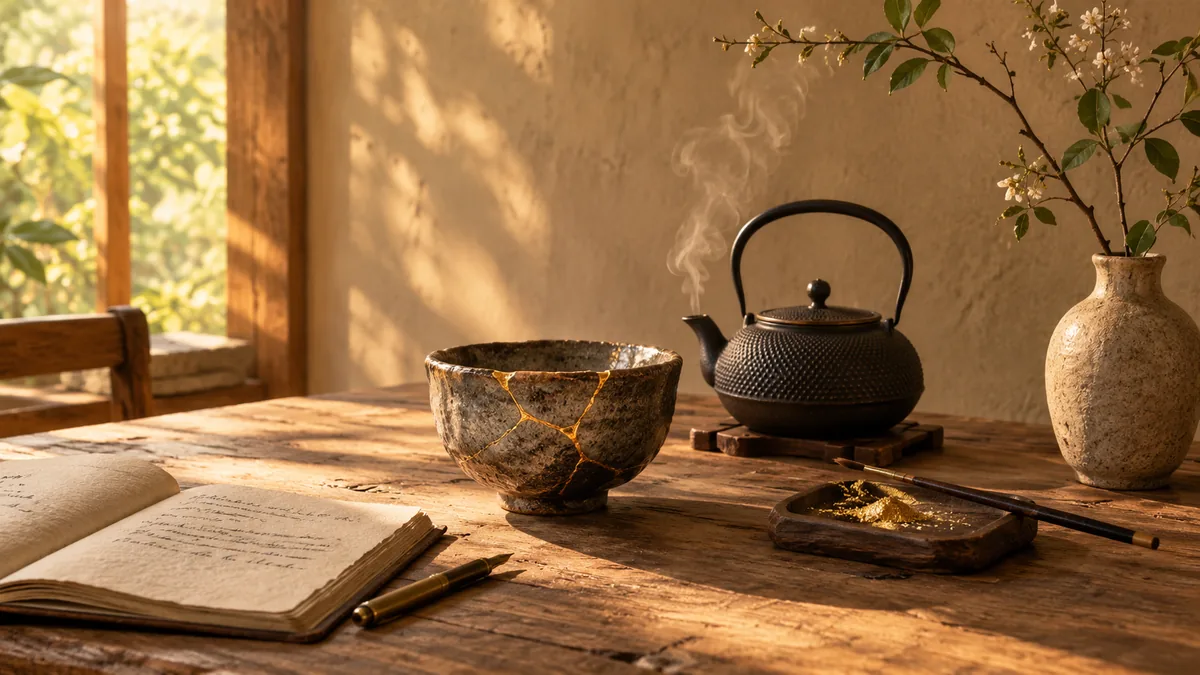
The sacred breathing room of Kintsugi: An authentic hand-formed ceramic vessel illuminated by golden joinery, resting in quiet contemplation where fractures become the source of enduring light.
The Sanctuary Golden Mending Protocol: 4 Steps to Honor Your Scars and Reclaim Wholeness
How do we translate this 500-year-old Japanese ceramic ritual into a concrete, somatic, and emotional methodology for healing our everyday lives? The Sanctuary Golden Mending Protocol is a four-stage process designed to guide your nervous system from the shock of rupture into the luminous grace of golden repair.
Step 1: Gathering the Shards Without Shame (The Cessation of Judgment)
When an internal or external vessel breaks, the most critical initial intervention is to stop the secondary bleeding: the self-condemnation that screams, “You fool, how could you let this happen?”
In traditional Kintsugi, an artisan does not curse the dropped tea bowl, nor do they kick the shards under the rug in frustration. They kneel down, turn on a soft lamp, and gently pick up every fragment—even the tiny, dust-like splinters. They inspect each piece with neutral, respectful curiosity.
In your personal life, this means carving out an intentional sanctuary of solitude. Sit down with your journal or sit in quiet contemplation beside an open window. Name the pieces of your crisis without euphemisms and without catastrophic judgment:
- “This piece is my grief over the ending of this partnership.”
- “This piece is the financial stress that keeps my stomach clenched at night.”
- “This piece is the bitter disappointment of failing to achieve that dream.”
- “This piece is the physical fatigue my body has accumulated after years of running on adrenaline.”
Place your hand over your heart—activating the soothing parasympathetic circuit we detailed in our guide on the vagus nerve reset and vagal tone restoration—and speak a simple, unconditional truth: “The break has occurred. I am hurting, and that is entirely human. I do not need to hide these pieces. I am going to hold them until we are ready to begin.”
Step 2: The Urushi Foundation: Slow Emotional Curing (Honoring the Timeline of Grief)
One of the most astonishing aspects of authentic Kintsugi is its refusal to be rushed. Urushi lacquer does not dry through evaporation like modern synthetic glue. Rather, it cures through an enzymatic oxidation process that requires very specific conditions: darkness, high humidity (75–85%), and moderate warmth (20–25°C). If an artisan tries to speed up the process by using a heat gun or placing the bowl in direct sunlight, the lacquer blisters, weakens, and cracks. The joinery fails.
A master Kintsugi project takes anywhere from two to six months to complete. Each microscopic layer of lacquer must be painted on, placed in the furo (curing chamber), left undisturbed for days or weeks, and then gently sanded with charcoal before the next layer is applied.
In our hyper-accelerated culture, we expect our emotional wounds to heal like microwave meals. We read three personal growth books, attend two therapy sessions, and demand of ourselves: “Why am I still sad? Why am I not over this yet?”
You must grant your heart its own furo—a protected, low-stimulation sanctuary of patient recovery, akin to the somatic reset we explored in healing from sensory overload. Healing is an organic, enzymatic process. It requires the darkness of quiet rest, the warmth of self-compassion, and the humidity of honest tears. Give yourself permission to be an unfinished piece resting in the cupboard. Do not demand that your lacquer dry before its natural season.
Step 3: Dusting the Cracks with Pure Gold (Extracting Meaning and Radical Compassion)
Once the urushi lacquer has fully bonded the vessel and the seams have been smoothed to perfection, the artisan prepares for the sacred climax: the application of the gold powder (kinputsu). Using a delicate bamboo quill or a fine badger-hair brush, they gently dust the exposed seam with pure, powdered gold. As the excess dust is brushed away, the jagged wound is suddenly transformed into an arc of breathtaking radiance.
What is the gold in human emotional repair? The gold is meaning, wisdom, and boundless self-compassion.
To dust your scars with gold does not mean pretending that the trauma was pleasant. It does not mean participating in toxic spiritual bypassing or proclaiming that your heartbreak was “a blessing in disguise.” Suffering is painful, unfair, and deeply grieved.
Rather, the gold is the conscious decision to ask: “Now that this fracture has occurred, what precious truth will I allow it to illuminate within me?”
- Did your battle with burnout teach you the sacred art of setting boundaries, inspiring you to embrace the grace of saying ‘no’ without guilt?
- Did a devastating betrayal strip away your people-pleasing instincts, releasing you from the fawn response and the urge to placate others to feel safe?
- Did your financial missteps dismantle your obsession with external status, leading you into the deep peace of the mind of enough?
- Did your own profound sorrow teach you to look into the eyes of another suffering human being with reverence, finally understanding the quiet art of holding space?
When you synthesize wisdom and compassion from your darkest seasons, you are literally dusting your fractures with 24-karat gold. You are declaring that your pain will not be wasted; it will be consecrated into character.
Step 4: Holding the Mended Self in Stillness (Walking into the World Without Apology)
The final step of the craft is burnishing. The artisan takes a polished stone and gently rubs the gold seams until they reflect the ambient light of the room. The bowl is washed with pure spring water, dried with an organic linen cloth, and placed upon the tea master’s table—ready to be filled with steaming green matcha and passed between the hands of cherished guests.
Notice what the artisan does not do: they do not wrap the mended bowl in bubble wrap and hide it in an attic vault, whispering that it is too broken to ever be used again. The bowl returns to daily service. It holds warm tea. It participates in the warmth of community. It fulfills its sacred destiny with immense quiet dignity.
This is your invitation to re-enter your life: unapologetic, authentic, and whole.
You do not need to walk into rooms hoping that people will not notice you have a past. You do not need to apologize for having loved deeply and lost, for having taken brave risks that collapsed, or for having spent months recovering your mental health. When someone interacts with you, let them sense the golden seams running beneath your calm demeanor. Let them feel the grounded solidity of someone who has stared into the abyss, survived the fracture, and emerged with a heart of pure, unbreakable gold.
The Geography of Stillness: Pilgrimage to the Kintsugi Studios of Kyoto and Kanazawa
For those drawn to the tangible, geographic roots of this philosophy, there is no more transformative pilgrimage than stepping into the living workshops of Japan where Kintsugi has been continuously practiced for half a millennium.
In the historic cultural capitals of Kyoto and Kanazawa, Kintsugi is not an academic concept; it is an atmospheric way of life. Kanazawa, nestled along the rugged coast of the Sea of Japan, is the uncontested heart of Japanese gold leaf production, crafting over 99% of the nation’s kinpaku (gold leaf). Here, in the preserved geisha and artisan district of Higashi Chaya, ancient wooden tea houses with dark wooden latticework (kimusuko) lean gently toward cobblestone alleyways, their eaves dripping with soft rainwater.
Stepping off the crowded tourist trail into a quiet lacquer atelier in Kyoto—tucked behind the willow trees bordering the Kamo River—the atmosphere shifts into absolute stillness. The air smells rich and earthy, fragrant with aged cedar shavings, natural pine turpentine, and the distinctive sweet, resinous scent of raw urushi sap. There are no fluorescent lights, no blaring televisions, and no hurry.
The craftsman sits cross-legged on a woven tatami mat beside a small wooden workbench, illuminated only by the natural, diffused light filtering through rice-paper shoji screens. With magnifying glasses perched upon their nose, their fingers move with the microscopic, hypnotic precision of a Zen monk practicing calligraphy. A tiny stroke of red lacquer. A delicate breath. A whisper of gold dust sifted from a hollow bamboo tube. Hours dissolve like morning mist.
To watch an artisan spend four months restoring a single, humble clay rice bowl—a vessel that originally cost no more than twenty dollars—is a profound spiritual reckoning. It forces you to ask: If this craftsman can bestow such infinite patience, love, and golden honor upon a handful of broken clay, why have I been so stingy, impatient, and cruel with the broken pieces of my own soul?
Whether you embark on a slow, contemplative walking journey through the ancient stone pathways of Kyoto—an experience we explored in our travel sanctuary essay on Kyoto in stillness and Zen temple gardens—or practice your own quiet contemplation at home, the pilgrimage of Kintsugi begins the moment you decide to look at your wounds through the lens of reverence rather than shame.
Frequently Asked Questions About Kintsugi Philosophy and Emotional Healing
Does Kintsugi mean romanticizing pain or believing that trauma is “good”?
No. Kintsugi does not glorify trauma, nor does it suggest that suffering should be sought out or celebrated. The breaking of the ceramic vessel is an unfortunate, painful accident. In human terms, emotional abuse, systemic injustice, grief, and debilitating illness are not “good” things; they are agonizing realities of our mortal condition. Kintsugi does not say that the break was good; it says that the break does not have the final word. Kintsugi is not about loving the destruction; it is about honoring the courageous, creative human capacity to resurrect life, beauty, and meaning from the ashes of destruction.
What is Yobitsugi, and how does it apply when some pieces of my life are permanently missing?
In traditional ceramic restoration, there is a fascinating, advanced branch of Kintsugi known as Yobitsugi (呼び継ぎ – “calling together to join”). This occurs when an antique bowl shatters, but one or two critical ceramic shards are lost forever. Instead of declaring the bowl unsalvageable, the artisan seeks out a fragment from an entirely different, unrelated broken vessel—perhaps a piece of blue-and-white porcelain from another century—and meticulously cuts it to fit the missing gap, joining it with gold.
In life, when catastrophic losses occur—the death of a parent, the irreversible loss of a physical ability, or the permanent severing of an estranged bond—those pieces cannot be glued back together because they no longer exist. Yobitsugi reminds us that you do not need all your original pieces to become whole again. You can invite new materials—new friendships, new hobbies, chosen family, creative passions, and spiritual practices—to fill the empty spaces. The resulting patchwork is eclectic, fascinating, and deeply sacred.
How long does the emotional Kintsugi process typically take?
There is no standardized stopwatch for healing the human psyche. Just as the curing time of urushi lacquer varies depending on atmospheric humidity, temperature, and the porosity of the clay, the timeline of emotional recovery depends on the depth of the rupture, your biological wiring, and the safety of your environment. For some wounds, the gold settles within a year; for deep, generational or developmental wounds, the burnishing may continue over a lifetime. The essential teaching of Kintsugi is to abandon the clock. As the ancient Stoic sage Seneca observed, “Time heals what reason cannot.” Trust the quiet work happening beneath the surface, even when progress feels invisible.
What is the subtle difference between Wabi-Sabi and Kintsugi?
While the two philosophies are deeply intertwined, their focus operates on different planes. Wabi-Sabi is a broad, overarching worldview and aesthetic philosophy that perceives beauty in the modest, weathered, and impermanent characteristics of all natural things (e.g., an unpainted wooden fence turning silver in the rain). Kintsugi, by contrast, is a specific, active practice within the Wabi-Sabi tradition. It focuses specifically on the moment of catastrophic fracture and the intentional, conscious decision to rebuild that fracture with gold. If Wabi-Sabi is the quiet philosophy of accepting life’s imperfections, Kintsugi is the active, golden art of mending what was broken.
You Were Never Broken: You Are Being Golden-Mended
Take a long, unhurried breath. Drop your shoulders away from your ears. Unclench your jaw, and let your hands rest gently upon your lap, palms facing upward in a gesture of open surrender.
Look back across the landscape of your years. See the places where you stumbled. See the projects that fell flat. See the relationships that ended in tears. See the seasons where your mental health collapsed and you wondered how you could possibly face the dawn. See the mistakes you swore you would never forgive yourself for making.
Notice how you have carried those memories: tucked away like shameful, chipped porcelain in a locked cupboard, shrouded in secrecy, coated in the dust of self-reproach.
Today, you are invited to take those vessels out of the dark. Set them down upon the warm oak table of your consciousness. Look at the jagged, irregular cracks running across your heart.
You do not need to hide them anymore. You do not need to apologize for being human.
Those fractures are not proof that you are defective; they are proof that you have dared to enter the arena of life. They are proof that you have loved, that you have risked, that you have dared to feel the full, untamed weight of existence. And beneath the patient care of your own rising self-compassion, those fault lines are not growing wider—they are filling with the luminous, quiet, enduring gold of your sovereign soul.
You were never ruined. You were never discarded. You are simply a vessel in the sacred, unhurried hands of the master craftsman—becoming, with every passing season, more resilient, more whole, and infinitely more beautiful than you were before the fall.
Philosophical & Reflective Wellbeing Disclaimer: The reflections, historical philosophies, and self-compassion frameworks presented in this essay are offered for educational, contemplation, and personal enrichment purposes only. They do not constitute formal psychotherapeutic diagnosis, clinical trauma treatment, or medical advice. If you are experiencing acute trauma, severe depression, or overwhelming psychological distress, please connect with a qualified mental health clinician, trauma therapist, or healthcare professional who can offer safe, personalized clinical care.