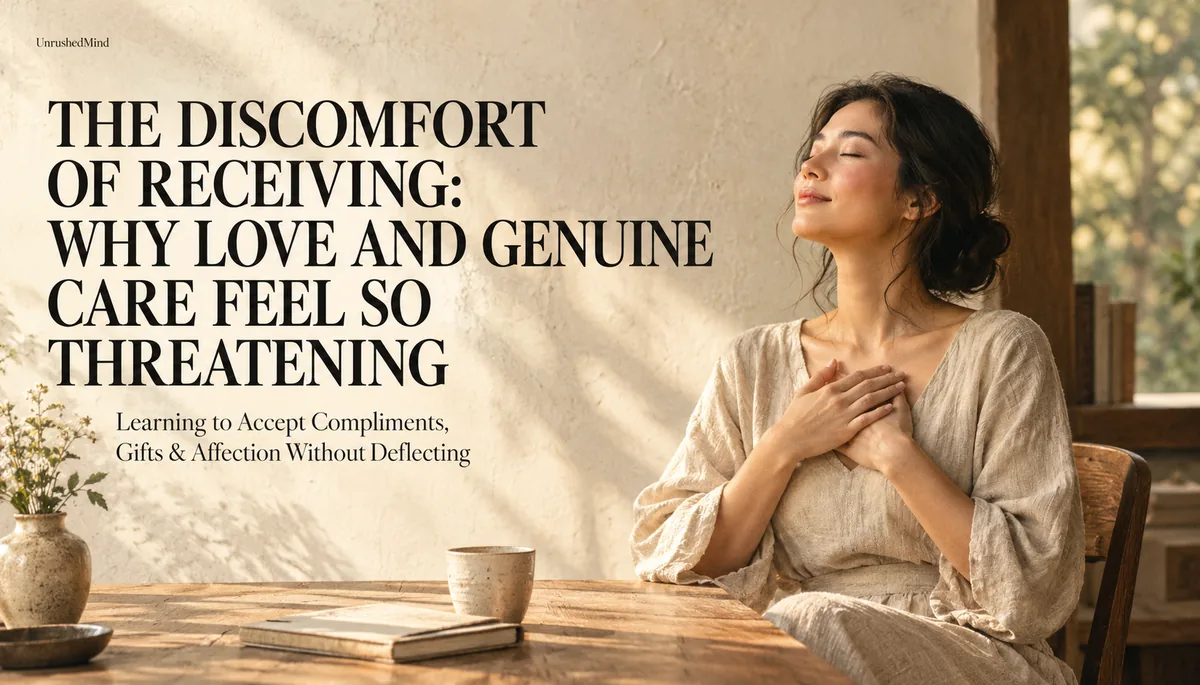
Someone looks you in the eyes and offers a sincere, glowing compliment about your spirit or work. Instead of feeling warmed, a sudden wave of tension grips your throat and chest. Almost involuntarily, you stammer an excuse, make a self-deprecating joke, or point out a flaw. When a dear friend buys you dinner or brings […]
Someone looks you in the eyes and offers a sincere, glowing compliment about your spirit or work.
Instead of feeling warmed, a sudden wave of tension grips your throat and chest.
Almost involuntarily, you stammer an excuse, make a self-deprecating joke, or point out a flaw.
When a dear friend buys you dinner or brings an unexpected gift, your mind does not sink into gratitude.
Instead, an invisible alarm rings, and you mentally calculate how quickly you can return the favor to erase the debt.
To onlookers, this reaction looks like sweet modesty or polite etiquette.
Yet beneath the quiet smile lies a subtle, exhausting physical panic.
The discomfort of receiving is rarely about modesty; it is a learned survival defense against vulnerability.
When receiving love feels dangerous, your nervous system is treating genuine affection as a hidden emotional trap.
The Trap of Deflection: Why Being Cherished Triggers a Threat Response
Deflecting love and compliments occurs when your subconscious associates care with an impending invoice or unspoken strings attached.
If early experiences taught you that kindness is used to control or guilt-trip you, accepting unconditional warmth registers as an existential risk.
Your instinct to minimize praise is an armor built to protect your sovereignty.
You assume that accepting kindness places you in a vulnerable position of owing someone else.
In psychological terms, this is often called the emotional ledger wound.
You were conditioned to view relationships as transactional ledgers where receiving kindness incurs an unbearable obligation.
Every compliment feels like a spotlight shining on an imposter who might be exposed at any moment.
Every thoughtful gift feels like a golden shackle waiting to tighten around your wrist.
By refusing to let love land, you ensure you can never be blindsided by a future demand.

Hyper-Independence and the Armor of the Eternal Giver
Many people who panic when receiving are magnificent at pouring out boundless love to others.
You are the first to remember birthdays, offer comfort, and insist on picking up the bill.
Playing the role of the perpetual giver feels supremely safe, capable, and noble.
When you are always the one giving, you retain control and never have to risk being let down.
You dictate the emotional climate while keeping your soft interior shielded behind a wall of generosity.
This pattern is rooted in hyper-independence, a protective coping mechanism born from neglected childhood needs.
If no one reliably cared for you when you were small, you formed a fierce vow: I will never need anyone.
To allow someone to look after you now feels like surrendering your only shield.
You secretly fear that if you show up empty-handed, no one will find a reason to love you.
So you give until you are depleted, while deflecting every cup of water offered in return.
The Armor of Deflection vs. The Sanctuary of Receptivity: A Direct Contrast
Recognizing how your nervous system behaves when care is offered reveals the deep journey from guarded fear to open grace:
| State of Receiving | Subconscious Belief | Nervous System Reality |
|---|---|---|
| Deflective Armor | “If I accept this praise, they will soon discover I am a disappointment.” | Sympathetic spike, shallow breath, throat tightness, and rapid verbal deflection. |
| Transactional Debt | “This gift comes with invisible terms; I must settle the score immediately.” | Low-grade panic, compulsive urge to reciprocate, and mental exhaustion. |
| Sanctuary Receptivity | “I am allowed to receive care simply because I exist, without earning it.” | Parasympathetic softening, warm chest expansion, and unhurried gratitude. |
Three Gentle Micro-Rituals to Practice Receiving Without Panic
Expanding your capacity to receive love is like stretching a stiff muscle after years of disuse.
It does not require forceful willpower, but small, tender acts of daily permission:
- The Three-Second Breath and the Clean “Thank You”: When praised, notice the urge to deflect. Inhale softly and say only two words: “Thank you.” Let the sentence end without an excuse or self-mockery.
- The Heart-Hand Anchor: If receiving care makes your chest tighten, place one hand gently over your sternum. This somatic touch signals physiological safety to your vagus nerve, reminding your body that love is not an ambush.
- The Twenty-Four-Hour Debt Delay: When given a gift, deliberately forbid yourself from reciprocating for twenty-four hours. Sit with the sensation of being cared for, and allow the kindness to steep into your spirit.

Mindful Connection & Emotional Grace Note
When you push away kindness, you believe you are simply being modest or self-sufficient.
Yet to the giver, deflection feels like having a warm offering turned away at the door.
To offer love is a vulnerable act; the giver is showing you their affection and whispering, You matter to me.
When you receive someone’s gift with an open, softened heart, you give them the sacred joy of loving you.
Receiving is not passive weakness; it is the ultimate expression of trust and emotional generosity.
You do not need to perform or exhaust yourself to earn your place beneath the sun.
You are worthy of being cherished simply because you are here.
Frequently Asked Questions