
You lie down on the floor, close your eyes, and tell yourself it is finally time to relax. Yet within thirty seconds, your jaw remains tightly clamped, your shoulders refuse to sink, and your chest feels constricted. Your mind begins an anxious interrogation: Why am I still so tense, and why can’t I just calm […]
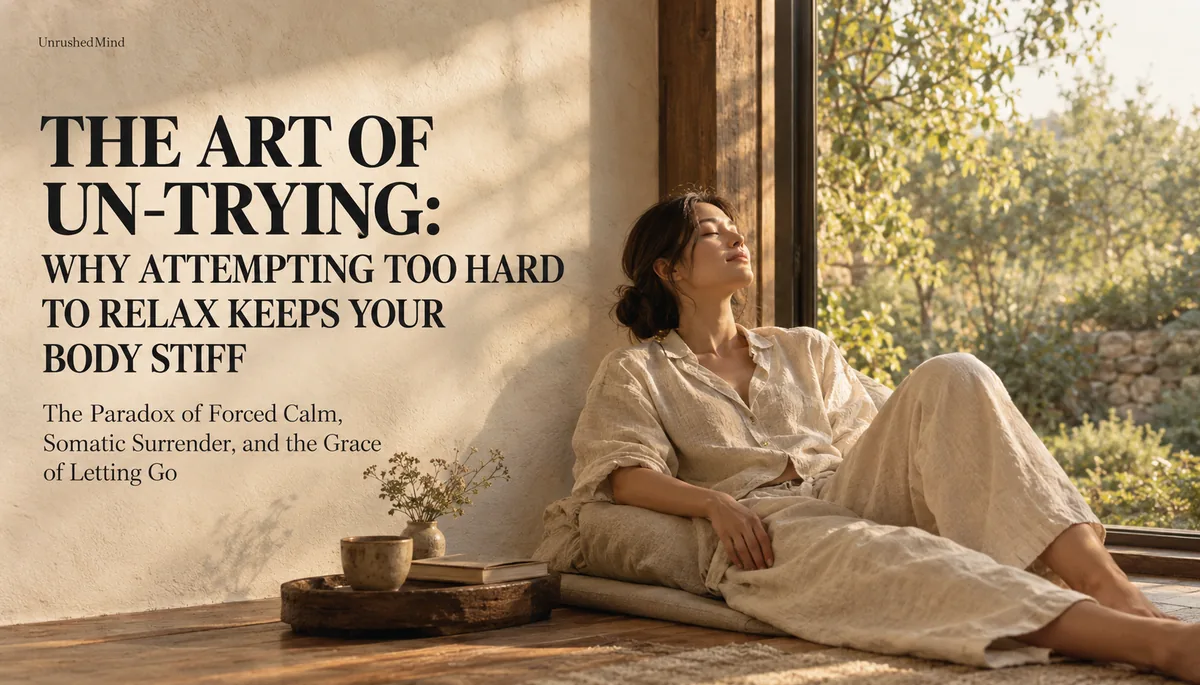
You lie down on the floor, close your eyes, and tell yourself it is finally time to relax.
Yet within thirty seconds, your jaw remains tightly clamped, your shoulders refuse to sink, and your chest feels constricted.
Your mind begins an anxious interrogation: Why am I still so tense, and why can’t I just calm down?
If you have ever felt more agitated while trying to meditate or rest, you are not failing at self-care.
You are simply caught in the biological trap of hyper-efforting.
Quick Answer: Trying too hard to relax makes you tense because willpower acts as a subtle threat signal to your nervous system. Forcing calm turns rest into another performance metric, triggering sympathetic vigilance instead of natural, restorative parasympathetic surrender.
The Relaxation Paradox: When Willpower Becomes Chronic Tension
In modern life, we are trained to solve every difficulty through exertion, discipline, and willpower.
When work becomes demanding, we push harder. When a project stalls, we apply focus.
Naturally, when chronic exhaustion sets in, we try to apply that same aggressive determination to our own bodies.
We download meditation apps, count our inhales, and aggressively command our muscles to soften.
Here lies the paradox: your autonomic nervous system cannot be commanded by willpower.
In neuroscience and clinical psychology, this phenomenon is recognized as relaxation-induced anxiety.
The moment your conscious mind demands that you relax, it sends an underlying message of urgency: the current state is wrong and must be fixed immediately.
Your sympathetic nervous system interprets that subtle panic as a sign of danger.
Instead of softening, your body deploys its instinctual defense armor, keeping your neck rigid and your breath shallow.
The Hidden Vigilance of the “Striving Mind”
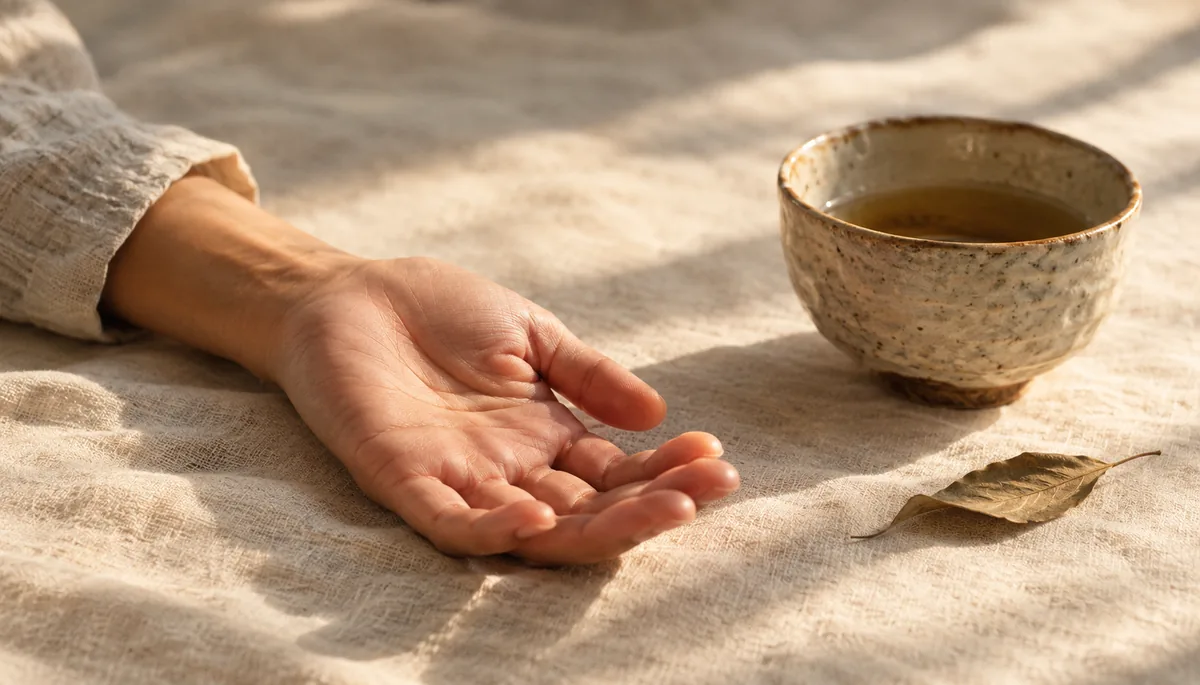
True rest is not a task you accomplish through strict obedience.
True rest is an act of biological surrender.
When you strive to relax, you are not actually resting; you are merely working at relaxing.
You turn your inner landscape into an audition where your heart rate and muscle tone are constantly judged.
Consider how your daily approach to rest compares to genuine somatic surrender:
| Dimension | The Striving Relaxer | The Somatic Controller | The Un-trying Soul |
|---|---|---|---|
| Core Attitude | Demands immediate stillness as an achievement. | Micro-manages breathing intervals and posture. | Welcomes the body’s fatigue without judgment. |
| Physical Sensation | Clenched jaw, raised shoulders, shallow chest breathing. | Forced deep diaphragmatic breaths that feel suffocating. | A heavy, sinking release into whatever surface supports you. |
| Inner Voice | “Why can’t I stop my racing thoughts?” | “I must hold my breath for precisely seven seconds.” | “It is completely safe to be tired right now.” |
The 4 Somatic Movements of Un-trying
If willpower cannot force relaxation, how does an overstimulated body actually return to peace?
The answer lies in the ancient art of un-trying—releasing the need to control your physiology.
Here are four gentle somatic shifts to transition from forced calm to genuine biological ease:
1. Recognize Effort Itself as a Form of Tension
Notice the subtle muscular striving behind your desire to be calm.
When you furrow your brow to focus on your breath, you are still bracing.
Simply noticing this striving with kindness allows the first layer of resistance to dissolve.
2. Stop Treating Tightness as a Malfunction
Your tight shoulders and racing heart are not enemies to be eliminated.
They are loyal sentinels of an exhausted nervous system that has been working overtime to protect you.
Instead of trying to forcefully soften a tight muscle, whisper inward: I see how hard you have been working. You do not have to defend me right now.
3. Yield Your Weight to Gravity
Relaxation is not something you actively produce; it is something you yield into.
You do not have to hold yourself together on the chair or the floor.
Feel the tangible pull of the earth beneath your pelvis, your shoulder blades, and your heels.
The earth has been carrying massive mountains for millions of years; it can easily carry your tired bones without any assistance from you.
4. Let the Body Breathe Itself
Drop all breathing techniques, counting patterns, and respiratory rules.
Your body knows perfectly well how to breathe when you are asleep.
Take a step back into the role of a gentle observer, allowing your lungs to take whatever shallow or uneven breaths they desire.
When you stop trying to steer the breath, your parasympathetic vagus nerve naturally down-regulates your system.
Frequently Asked Questions About Somatic Release
Why do I feel restless or panicky when I try to sit still?
When chronic stress has been your baseline, sudden stillness can feel unfamiliar to a hyper-vigilant nervous system. Your brain interprets the sudden drop in stimulation as vulnerability. If sitting still triggers agitation, practice gentle movement, such as walking slowly or swaying, before attempting passive rest.
How do I know if my body has entered authentic relaxation?
Authentic somatic release rarely arrives with dramatic fanfares. It appears in subtle biological signals: a spontaneous involuntary sigh, a sudden pooling of saliva in the mouth, a warm heaviness in the limbs, or gentle gurgling sounds in the stomach as digestion restarts.
Is deep diaphragmatic breathing harmful?
Deep breathing is beneficial when practiced gently, but forcing exaggerated inhales while your chest is tight can trigger hyperventilation and elevate cortisol. Natural, unforced exhalations with prolonged pauses are far more effective for soothing an overstimulated nervous system.
An Unrushed Parting Thought
You do not need to earn your right to rest through perfect technique.
You do not need to master meditation, perfect your breathwork, or silence your mind to deserve a quiet sanctuary.
Peace is not a prize waiting at the end of rigorous spiritual labor.
Peace is what remains when you finally stop trying to fix, improve, or manage yourself.
Lay your burdens down, release the reins of control, and allow the quiet ground beneath you to do the holding.