We spend our best decades building an intricate defense against uncertainty. We measure our worth by numbers glowing faintly on digital screens, accumulating assets like shields against mortal vulnerability. Yet when you sit quietly beside someone who has reached eighty, the conversation never turns to portfolios or square footage. At eighty, the artificial hierarchies of […]
We spend our best decades building an intricate defense against uncertainty.
We measure our worth by numbers glowing faintly on digital screens, accumulating assets like shields against mortal vulnerability.
Yet when you sit quietly beside someone who has reached eighty, the conversation never turns to portfolios or square footage.
At eighty, the artificial hierarchies of corporate striving dissolve into sheer irrelevance.
What remains is a far simpler question: Did you actually live the years you were given, or were you merely preparing to live?
The Balance Sheet Illusion: Why Accumulation Fails the Final Test
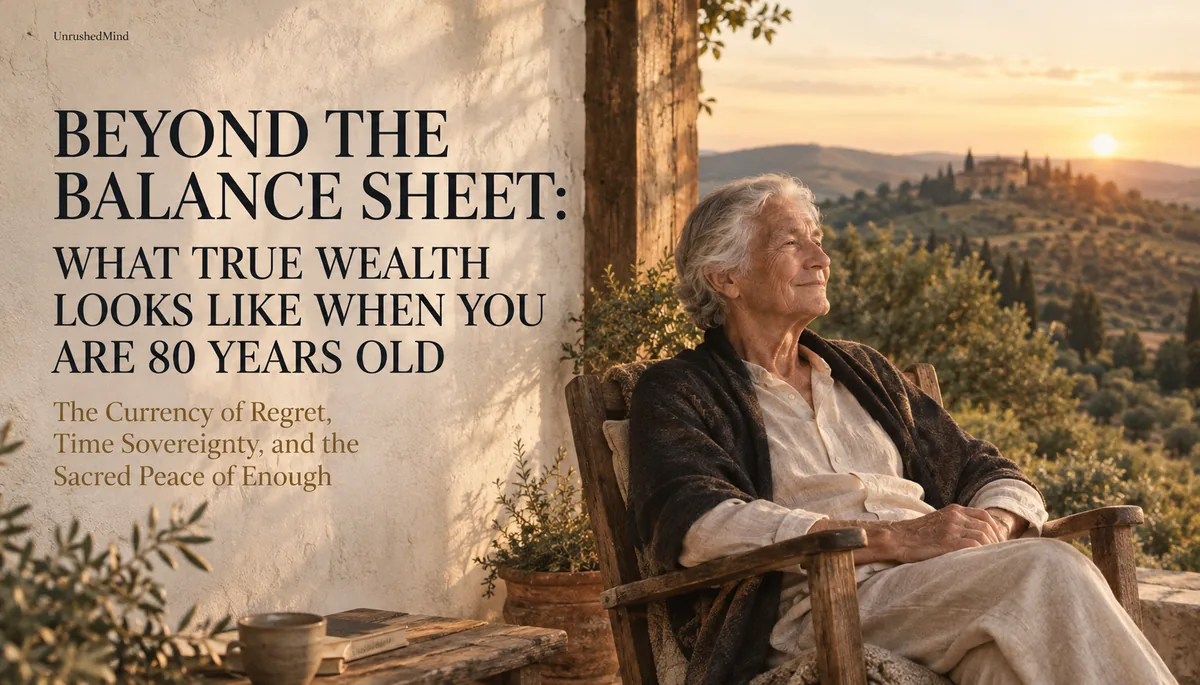
At eighty years old, what true wealth looks like at 80 is never found in a ledger of financial assets. True wealth is somatic dignity, an unhurried mind, rich memories of connection, and the sacred realization that you possessed enough time to live your life.
Modern culture convinces us that more is always better, equating exhaustion with virtue.
We tell ourselves that we will slow down after the next milestone, promotion, or savings target.
Yet the goalposts of ambition possess an insidious habit of retreating every time we draw near.
When palliative care worker Bronnie Ware recorded the regrets of people facing their final days, she observed a striking pattern.
Not a single person wished they had spent more hours in an office or accumulated extra status symbols.
Instead, the most universal lament was agonizingly simple: “I wish I hadn’t worked so hard.”
The balance sheet creates an illusion of security that trades irreplaceable present vitality for theoretical future safety.
By the time that future arrives, the body is often too depleted to enjoy the freedom it worked a lifetime to secure.

The Four Non-Financial Currencies of an 80-Year-Old Soul
When financial abundance is stripped of cultural status, true prosperity reveals itself as four non-financial assets.
These currencies cannot be bought on an exchange or transferred through legal wills.
1. Somatic Dignity and Physical Ease
A body unravaged by frantic striving is among the rarest luxuries in old age.
Chronic overwork floods the nervous system with elevated cortisol, wearing down joints and constricting the breath.
True wealth is waking up at eighty with a spine that moves gently, shoulders free of tension, and lungs that draw deep, restorative air.
2. Time Sovereignty
True wealth is owning your mornings without the violent intrusion of an alarm.
It is the luxury of watching steam rise from a ceramic cup of tea for twenty unbroken minutes without checking a screen.
At eighty, you realize that time was never money; time was life itself.
3. Relational Resonance
The true inheritance of a well-lived life lives in the eyes of people who look at you with warmth rather than obligation.
Did your children know you as an unhurried, listening presence, or only as a preoccupied provider hurrying between obligations?
At the end of life, the only enduring asset is the depth of trust and safety you cultivated in the hearts of those you loved.
4. The Sacred Peace of “Enough”
Perhaps the greatest spiritual triumph of old age is the permanent cessation of comparison.
It is the quiet state of looking around at an ordinary room and an ordinary afternoon, feeling completely whole.
The person who needs nothing more is infinitely wealthier than the tycoon still tormented by the hunger for expansion.
Comparing the Paths to Late-Life Prosperity
To understand how daily choices shape our later years, it helps to examine three distinct attitudes toward capital:
| Dimension | The Ledger Accumulator | The Anxious Inheritor | The Slow Wealth Elder |
|---|---|---|---|
| Primary Metric | Net worth, liquid assets, titles | Preservation of family expectations | Hours spent in sovereign peace and ease |
| Nervous System State | Chronic sympathetic vigilance | Lingering fear of scarcity and loss | Ventral vagal safety and somatic ease |
| View of Daily Time | A resource to be monetized | An obligation to be managed | A sacred sanctuary to be savored |
| Relationship to Things | Possessions define personal worth | Possessions are guarded with anxiety | Light attachment to simple, functional beauty |
| Legacy Passed Down | Complex financial trusts | Generational guilt and expectation | A living blueprint of calm and inner peace |

The Inheritance of Peace: What You Actually Leave Behind
When you pass away, legal systems will distribute your accounts and property.
Yet the energy that lingers in the homes of your descendants is the emotional climate of your presence.
If you lived in chronic hurry, you bequeath an invisible legacy of urgency, teaching your family that human worth requires endless production.
If you chose to cultivate the mind of enough and protected empty white space on your calendar, you grant them permission to rest.
You demonstrate that life is not an emergency, and that an unhurried life is both honorable and attainable.
Practicing slow wealth does not require financial abandonment; rather, it demands that you deliberately cap your desires.
It means deciding what constitutes “enough” so you can convert excess earnings into unmeasured hours of rest, craftsmanship, and quiet companionship.
Questions on Slow Wealth and Aging with Dignity
The Final Verdict on a Life Well Lived
When you stand at eighty looking back across your decades, you will not judge yourself by your peak earning years.
You will measure your life by the warmth of your kitchen table, the quietude of your conscience, and the gentleness with which you moved through this earth.
The ledger will close, and the accounts will settle into dust.
Give yourself permission today to invest in the quiet, priceless wealth that time can never devalue.