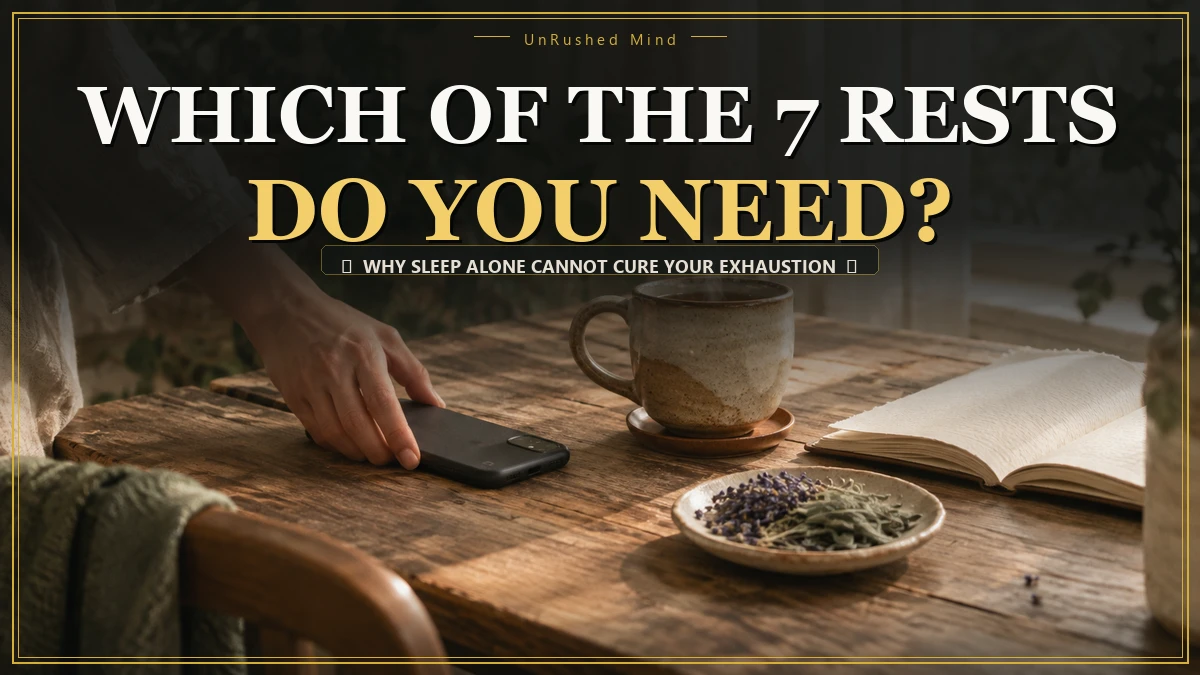
Sleeping eight hours only addresses physical tiredness. Take this 8-question clinical assessment based on Dr. Saundra Dalton-Smith's framework to uncover whether you are starving for Mental, Sensory, Emotional, Social, or Creative Rest.
Have you ever slept for eight or nine hours on a weekend, only to wake up feeling as though your bones and brain are still weighted with lead?
Pause for one unhurried breath and answer these eight diagnostic reflections below to pinpoint which hidden rest deficit—Mental, Sensory, Emotional, Social, or Creative—is quietly draining your vitality.
The 7 Types of Rest Diagnostic: Why Are You Still Exhausted After a Full Night’s Sleep?
Sleeping eight hours only addresses physical fatigue. Take a slow breath and answer these 8 diagnostic reflections to uncover which of the 7 biological and psychological rest channels—Mental, Sensory, Emotional, Social, Creative, or Physical—is secretly running on empty.
This self-assessment is designed for educational and personal reflection purposes regarding mental restoration, burnout symptoms, and stress levels. It does not replace professional clinical diagnosis, psychiatric care, or licensed medical therapy.
Understanding the Seven Architecture Channels of True Rest
Internal medicine physician Dr. Saundra Dalton-Smith uncovered a vital clinical distinction: sleep and rest are fundamentally different biological processes. Sleep repairs the physical body, but leaves six other human energy reserves—Mental, Sensory, Emotional, Social, Creative, and Spiritual—potentially running on empty.
When you transition directly from a work computer to smartphone scrolling, your sensory cortex never experiences quiet. True restoration requires matching your specific deficit with its sovereign remedy.
Architectural Profile Decodings & Restoration Guidance
Every intuitive choice or score threshold mirrors an underlying autonomic state. Below are the comprehensive psychological and neurobiological decodings for each result profile:
🟢 Balanced Rest Architecture: Mild Ultradian & Physical Load (0 – 7 Points)
✦ Autonomic State: Your rest ecosystem is relatively well-integrated. Unlike most modern adults who confuse sleep with total recovery, you have maintained healthy boundaries around your sensory, emotional, and social bandwidth.
✦ Mechanism: When fatigue does appear for you, it is primarily natural physical tiredness or the 90-minute ultradian dip—a biological signal to pause briefly rather than a sign of deep existential or autonomic depletion.
✦ Gentle Micro-action: 1. Honor the 90-Minute Ultradian Pulse: Step away from focal screens for 5–10 minutes after every 90 minutes of deep work before cognitive fatigue accumulates. 2. Protect Low-Stimulation Evenings: Keep dimming overhead lights to warm 2700K amber tones an hour before sleep. 3. Nourish Creative Awe: Continue making weekly space for unhurried walks in nature or quiet contemplation.
🌿 Read Your Guide: The 90-Minute Brain Rhythm & Cognitive Rest ➔
🟡 Deep Cognitive & Sensory Rest Deficit: The Overstimulated Brain (8 – 15 Points)
✦ Autonomic State: Here is the exact reason eight hours of sleep has not cured your exhaustion: your physical body is resting in bed, but your sensory cortex and default mode network are still severely over-saturated.
✦ Mechanism: When you transition from a work monitor directly to a smartphone screen, your optic nerves and decision-making centers never experience true quiet. You are not lazy or broken—you are experiencing acute Mental and Sensory Rest starvation.
✦ Gentle Micro-action: 1. Practice Deliberate Sensory Blackouts: Close your eyes and sit in complete silence (no podcasts, no music, no screens) for 5 minutes mid-afternoon. 2. Externalize Open Mental Loops: Keep an analog notebook beside your bed to write down every unfinished task before sleep so your working memory stops rehearsing them at 2:00 AM. 3. Swap Scrolling for Soft Fascination: During breaks, rest your gaze on natural fractals—tree branches, clouds, or distant horizons—which calm brainwaves within 60 seconds.
🔴 Severe Emotional, Social & Creative Depletion: The Exhausted Caregiver (16 – 24 Points)
✦ Autonomic State: Your exhaustion runs far deeper than muscles or sleep cycles—it lives in the invisible emotional labor you carry every day. You have been functioning as the strong, dependable anchor for others while quietly starving for Emotional, Social, and Creative Rest.
✦ Mechanism: When you must constantly self-monitor, mask your own tiredness, and absorb other people’s expectations, even a week of sleep cannot replenish you until you are granted permission to stop performing.
✦ Gentle Micro-action: 1. Claim Zero-Expectation Solitude: Schedule at least two hours this week where no one needs your reply, your smile, or your caregiving. 2. Drop the Performative Mask: Practice telling one safe person—or your own journal—the unvarnished truth: ‘I am at capacity today and need quiet.’ 3. Receive Beauty Without Producing: Spend time near water, trees, or gentle instrumental music without trying to be productive, helpful, or self-improving.
🌿 Read Your Solution: Healing the Drained Social & Emotional Battery ➔
📚 Academic & Clinical Foundation: The 7 Types of Rest Clinical Framework (Dr. Saundra Dalton-Smith, MD), Ultradian Rhythm Neuroscience, and Sensory Processing Research
🌿 Mindful Reflection Notice: This self-assessment is designed solely for educational, self-inquiry, and personal reflection purposes. It does not constitute medical, psychiatric, or clinical psychological advice, diagnosis, or treatment. If you are experiencing acute emotional distress, severe burnout, or chronic physical symptoms, please consult a qualified healthcare professional.