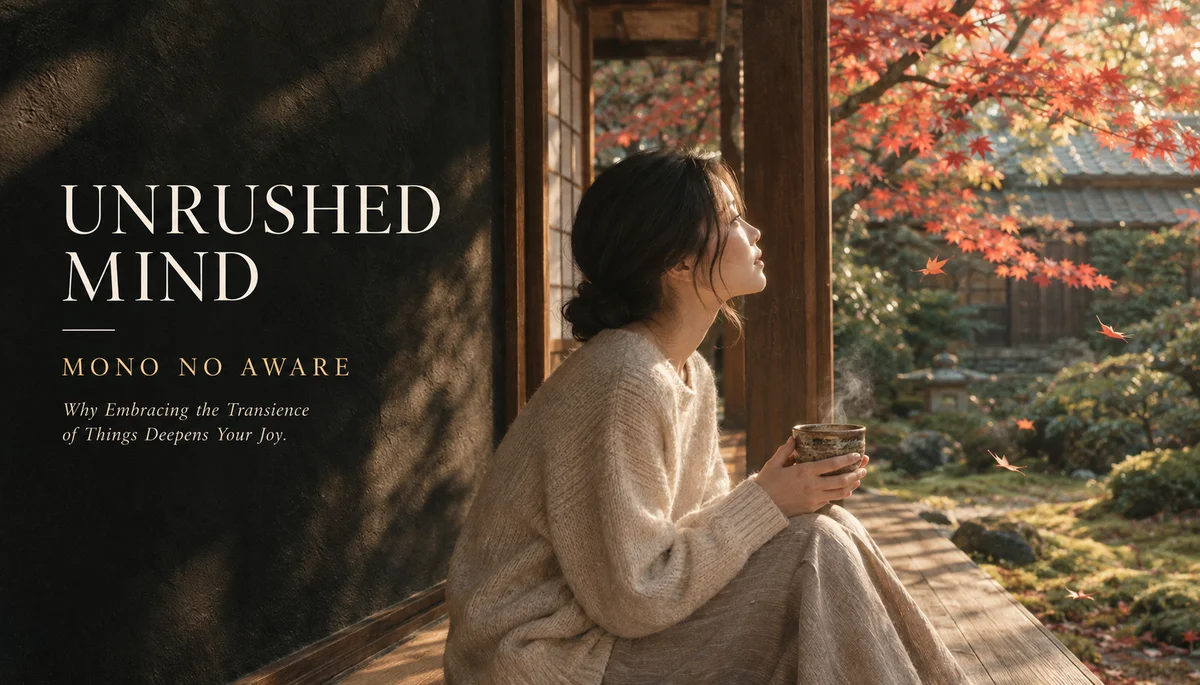
Have you ever stood beneath an autumn maple tree in the quiet courtyards of Kyoto as the evening light softened to amber, watching a single crimson leaf detach from its branch and drift toward the moss below? Or perhaps you have sat on a weathered wooden porch in late August, listening to the cicadas fade […]
Have you ever stood beneath an autumn maple tree in the quiet courtyards of Kyoto as the evening light softened to amber, watching a single crimson leaf detach from its branch and drift toward the moss below? Or perhaps you have sat on a weathered wooden porch in late August, listening to the cicadas fade into the dusk, feeling a sudden, inexplicable ache tighten around your chest?
It is not a bitter grief, nor is it clinical depression or despair. It is something far more delicate: a sweet, tender sadness—a quiet ache born from the sudden, piercing realization that this exact moment is slipping through your fingers even as you live it. You are simultaneously breathless with wonder at how magnificent the world is, and acutely aware that this beauty cannot stay.
Mono no Aware (物の哀れ) is an ancient Japanese aesthetic philosophy translated as “the pathos of things” or “a tender empathy toward impermanence.” It describes the gentle, bittersweet ache felt when witnessing the transient beauty of life—recognizing that things are precious precisely because they cannot last.
In our modern culture, we are rarely taught how to sit with this bittersweet feeling. We live in an era obsessed with permanence, relentless accumulation, and the desperate illusion of control. We fight the natural seasons of life, falling victim to hurry sickness and the toxic myth of falling behind. We freeze moments through glowing camera lenses instead of taking them into our lungs. We construct artificial lives designed to deny aging, death, endings, and autumn—often exhausting our minds until we find ourselves caught in revenge bedtime procrastination, stealing hours from the night just to feel a fleeting sense of ownership over our time. When a pleasant sensation arises, our immediate reflex is to cling, hoard, and demand that it stay forever. And when sadness brushes against our shoulder, we immediately label it a pathology or try to numb it with distraction.
Yet, this refusal to let things end poisons our capacity for genuine joy. When you demand that a flower never wilt, you cease to see the flower in front of you. Cultivating the mind of enough requires that we first make peace with the truth that everything in this world is in transit.
Mono no Aware offers an entirely different sanctuary: a profound reconciliation with time. It teaches us that impermanence is not the enemy of joy, but its sacred birthplace.
The Heartbeat of Japanese Aesthetics: From Murasaki Shikibu to Motoori Norinaga
To understand Mono no Aware, one must understand how classical Japanese thought perceived the relationship between human consciousness and the natural world—a worldview shared with Shinrin-yoku (forest bathing) and the quiet contemplation found in ancient Zen temples of Kyoto.
The term itself is composed of three elements:
- Mono (物): “Things,” encompassing not merely physical objects, but events, encounters, landscapes, human relationships, and the vast tapestry of living existence.
- No (の): The possessive particle, denoting connection and belonging (“of”).
- Aware (哀れ): Originally an ancient spontaneous exclamation of deep emotional resonance—an audible breath or sigh, “Ah!”—uttered when the human heart is struck by profound wonder, tender awe, or beauty. Over centuries, this exclamation matured into a nuanced aesthetic feeling: a bittersweet, compassionate sensitivity toward the ephemeral nature of all phenomena.
The philosophy took root during the Heian period (794–1185 CE), finding its supreme literary expression in Murasaki Shikibu’s The Tale of Genji (Genji Monogatari). In this sprawling masterwork of courtly life, human triumphs and heartbreaks are constantly framed against the backdrop of shifting seasons—the rustle of autumn grasses, the fading scent of plum blossoms, the chill of winter moonlight on silk screens. The characters do not weep out of hopelessness; they weep because their hearts are sufficiently awake to register the heartbreaking majesty of a world in perpetual transition.
Centuries later, in the 18th century, the revered literary scholar and philosopher Motoori Norinaga (1730–1801) distilled Mono no Aware into the defining spiritual sensibility of Japan. Norinaga asserted that to possess Mono no Aware is simply to have a heart that knows how to feel (kokoro wo shiru). A person who understands Mono no Aware is not stone-faced or rigidly detached, nor are they overwhelmed by hysteria. Rather, they are someone whose spirit resonates like a finely tuned bell whenever the breeze of reality brushes against it.
As Norinaga observed, if cherry blossoms (sakura) bloomed continuously all year round, like artificial plastic flowers in a shopping mall, we would walk beneath them without looking up. It is their fragile, fleeting scatter (chiru)—lasting barely a week before falling as delicate pink snow across temple stones—that breaks our hearts open to wonder. Their beauty is indivisible from their mortality.
The Modern Fear of Ending: The Pathology of Grasping
Why is this wisdom so urgently needed today?
Because modern civilization suffers from what philosophers call a crisis of temporal grasping. We have created a society grounded in permanence: perpetual economic growth, round-the-clock connectivity, air-conditioned isolation from the changing seasons, and an obsession with staying forever young. We want summer without winter; we want beginnings without goodbyes; we want achievement without the quiet plateau that follows—a mindset closely tied to the arrival fallacy and modern status anxiety.
This conditioning creates three widespread psychological traps:
1. Anticipatory Grief and the Inability to Inhabit the Present
When an ungrounded mind encounters something radiant—a deep conversation with a friend, the innocent laughter of a child, a blissful holiday morning—it immediately falls into preemptive panic: “What if this ends? What will I do when this person is gone? How fast can I capture this on my phone so I never lose it?” This resembles the deep abandonment terror seen in those lacking emotional permanence, where the absence of reassurance feels like a total void. The desperate effort to preserve the moment destroys our ability to actually inhabit it.
2. The Trap of Toxic Positivity
Modern culture insists that only cheerfulness is acceptable. We are commanded to “stay positive,” “manifest good vibes,” and banish all sadness from our vocabulary. But grief, bittersweet longing, and wistfulness are not defects; they are essential dimensions of human emotional depth. By exiling the gentle ache of impermanence, we end up emotionally shallow, terrified of depth, and vulnerable to sudden collapse when life inevitably shatters our illusions of permanence.
3. The Clinging Hoarder Complex
When we treat endings as personal failures, we hold onto dead relationships, obsolete career identities, and cluttered living spaces far past their natural season. We forget the quiet art of walking away with dignity and peace. We become like someone trying to trap the wind inside a jar, wondering why the air inside quickly turns stale and suffocating.
The Neuroscience of the Bittersweet: Why Melancholy Heals
For decades, Western psychology treated sadness as a negative valence emotion to be avoided or cured. However, groundbreaking neuroscience and research into mixed emotions—popularized by author Susan Cain in her seminal work Bittersweet—reveals a very different biological reality.
When human beings experience bittersweet emotion—the simultaneous presence of sorrow and wonder characteristic of Mono no Aware—our bodies do not undergo the toxic stress response of acute grief or anxiety.
Instead, mixed affect stimulates the parasympathetic branch of our autonomic system through the vagus nerve, restoring vagal tone and providing the nervous system with one of the most restorative forms of emotional rest. Our heart rate slows, our breathing deepens, and our brains release oxytocin—the neurochemical of bonding, trust, and deep compassion.
Witnessing the fleeting nature of life softens the ego. It dissolves the illusion of self-importance and reminds us of our shared vulnerability with every other creature on this earth. When you realize that the person sitting across from you will not be here forever, your petty grievances, irritations, and defensive barriers melt away. Tender melancholy is the bridge that connects loneliness to communion, leading toward the profound stillness of Ataraxia.
The Triad of Japanese Stillness: Mono no Aware, Wabi-Sabi, and Ichigo Ichie
To fully integrate this philosophy into daily life, it helps to understand how Mono no Aware forms a sacred philosophical triad with its sister concepts:
1. Wabi-Sabi (The Aesthetic of Form)
While Wabi-Sabi focuses on the external world of objects and spaces—honoring the beauty of things that are imperfect, weathered, unpolished, and cracked by time—it provides the physical sanctuary in which still contemplation can take place.
2. Ichigo Ichie (The Wisdom of Presence)
Ichigo Ichie (“one time, one meeting”) addresses the realm of action and direct attention. It reminds us that this exact gathering, this exact conversation, and this exact sip of tea will happen precisely once in the history of the universe and will never repeat itself in identical form.
3. Mono no Aware (The Emotional Resonance of the Soul)
If Wabi-Sabi is the vessel and Ichigo Ichie is the encounter, Mono no Aware is the tender emotional music that plays inside the heart when witnessing them. It is the poignant recognition of transience that transforms simple presence into sacred reverence.
Together with the philosophy of Kintsugi—which mends broken shards with gold lacquer rather than concealing fractures—these Japanese principles form a complete roadmap for healing from burnout, grief, and the frantic modern hurry to achieve eternal certainty.
Master Diagnostic: How Do You Relate to Impermanence?
Every person navigates the reality of change differently. Review the four paradigms below to observe where your mind naturally retreats when confronted with transience:
| Dimension | The Clinging Hoarder | The Numb Nihilist | The Toxic Positivity Evader | The Mono no Aware Mind |
|---|---|---|---|---|
| Core Relationship to Time | Fights time; hoards memories and objects; terrified of aging and endings. | Dismisses time; claims “nothing matters” to avoid the risk of grief. | Denies time; forces artificial cheerfulness and ignores seasonal transitions. | Befriends time; honors the seasons; welcomes both the arrival and departure of beauty. |
| Emotional Reaction to Beauty | Anxious attachment; frantic phone photography; unable to enjoy the present. | Cynical detachment; refuses to be moved because “it will all turn to dust.” | Shallow excitement; consumes experiences rapidly without reflective depth. | Tender awe; a bittersweet tear of gratitude; deeply present in the sensory moment. |
| Handling of Loss & Endings | Catastrophizing; bitter resistance; feeling betrayed by life’s changes. | Cold indifference; emotional shutdown; withdrawal into isolation. | Spiritual bypassing; immediate rationalization (“everything happens for a reason”). | Sacred reverence; gentle mourning; understanding that endings make space for rebirth. |
| Ultimate State of Being | Chronic exhaustion and nervous system hypervigilance. | Functional freeze; emotional numbness; dry cynicism. | Manic fatigue; hidden anxiety; disconnection from raw truth. | Profound stillness; tender heart; deep peace and unhurried grace. |
The Sanctuary Mono no Aware Protocol: 4 Steps to Befriend Impermanence
How do we move from theoretical appreciation to daily, lived experience? The following four-step contemplative practice helps you gently cultivate the spirit of Mono no Aware in the middle of a noisy, high-pressure world:
Step 1: Honoring the Ache (Do Not Rush to Fix the Sadness)
The next time you feel that gentle, poignant ache—watching the final golden rays of sunset fade into dusk, watching your child fall asleep knowing they are growing up so fast, or finishing the final page of a beloved book—pause.
Resist the urge to pick up your phone, turn on a podcast, or distract yourself. Place a gentle hand over the center of your chest. Take one slow, deliberate breath, and quietly acknowledge the ache: “This is Aware. This is the heartbeat of life passing through me. My sadness proves that I am awake enough to love.”
Allow the feeling to sit beside you for two full minutes without judging it as negative.
Step 2: Holding with Open Palms (From Ownership to Stewardship)
Notice where in your life you are gripping with closed, white-knuckled fists:
- Are you trying to freeze a relationship in its initial honeymoon phase?
- Are you terrified of losing your current professional title or status?
- Are you fighting the natural shifts in your physical body?
Practice the somatic posture of the Open Palm. When you love something—a person, a home, a moment of triumph, an afternoon of peace—hold it as you would hold a wild sparrow resting on your open hand. You do not own the bird. If you close your fist to keep it forever, you crush its life. Love it intensely, nurture it with reverence, but keep your hand flat and open so it remains free to take flight when its season concludes.
Step 3: Slow Sensory Reverence (Daily Seasonal Attunement)
Reclaim your biological connection to natural cycles. Modern offices and digital screens maintain an eternal, sterile 72°F artificial light. Step outside once each day to actively seek out transience:
- Notice the specific angle of sunlight this week compared to last month.
- Observe the scent of the evening air as autumn transitions toward frost.
- Brew a cup of hot tea and deliberately watch the delicate steam curl into the air and dissipate into nothingness before taking your first sip.
By witnessing miniature cycles of evaporation, melting, and fading every day, your nervous system learns that dissolution is not a crisis, but the natural rhythm of the cosmos.
Step 4: Surrendering to the River of Becoming
Reflect on the Stoic wisdom of Epictetus and Marcus Aurelius, who shared an uncanny convergence with ancient Japanese thought: Time is a river, a violent current of events, glimpsed once and then swept away.
Endings are not punishments; they are the fertile soil from which new beginnings emerge. If autumn did not strip the trees bare, spring could never burst forth with fresh emerald buds. If our lives were endless, nothing would be precious, no conversation would carry weight, and no hug would hold sacred gravity.
Surrendering to the river means saying to life: “I will cherish you while you are here, and I will bless you with gratitude when you depart.”
Mindful Pilgrimage: Finding Mono no Aware in the Sanctuaries of Kyoto
Nowhere is the tangible atmosphere of Mono no Aware more palpable than in the ancient temple districts of Kyoto, Japan.
If you ever walk across the Tsutenkyo Bridge at Tofuku-ji Temple in late November, you will gaze down upon the Sengokukan ravine—a sea of thousands of Japanese maples transformed into brilliant shades of crimson, burnt amber, and gold. As you stand in the unhurried morning silence, a gentle breeze rustles through the valley, sending a cascade of leaves spiraling downward to carpet the stones below.
The dozens of travelers and monks standing beside you do not cry out in panic. They stand in hushed, reverent stillness. Some gently bow. They understand that they are witnessing a masterclass in letting go: the trees releasing their most magnificent adornment without resistance, surrendering to the quiet slumber of winter.
Further north, nestled against the foothills of Sagano in Arashiyama, lies the secluded hermitage of Gio-ji Temple. Here, beneath a canopy of swaying green bamboo and tall maples, lies a world of velvety moss. In late autumn, fallen camellia petals and golden maple leaves rest scattered across the deep green emerald moss. There are no manicured lawnmowers or artificial cleaners sweeping away the fallen foliage. The temple caretakers allow the leaves to decay naturally into the earth.
To visit Kyoto through the lens of Mono no Aware is not merely a sightseeing holiday; it is a profound nervous system reset. It reminds the weary traveler that to live well is not to conquer time, but to walk alongside it with reverence and grace.
Master FAQ: Frequently Asked Questions
1. Is Mono no Aware just romanticized sadness or clinical depression?
No. There is a fundamental neurobiological and psychological distinction between the two. Clinical depression is characterized by emotional numbness, despair, hopelessness, anhedonia (the inability to feel pleasure), and a contraction of the self into agonizing isolation.
Mono no Aware, by contrast, is an expansive, tender, and deeply vitalizing state of awareness. It produces a feeling of sweet connection, gratitude, and wonder. It does not pull you into a dark abyss; it breaks your heart open to the unbearable beauty of living, leaving you more compassionate toward yourself and others.
2. How can I practice Mono no Aware if I live in a crowded modern city?
You do not need an ancient Zen temple to experience Mono no Aware. Transience is omnipresent:
- Watch the morning steam rise from your coffee mug and fade into the kitchen air.
- Notice the afternoon light shifting across the brick wall of an adjacent building.
- Acknowledge the passing of a simple conversation on the subway or a quiet walk home from work.
- Celebrate the end of each workweek not merely as an escape, but as a completed chapter of life that will never return.
Mono no Aware is not a geographic location; it is an internal posture of gentle attentiveness.
3. Does accepting impermanence make someone cold or detached in relationships?
Paradoxically, it produces the exact opposite effect. When you believe someone will always be there, you take them for granted. You look at your phone during dinner, you let small resentments fester, and you postpone deep intimacy.
When you embody Mono no Aware, you realize with startling clarity that every conversation could be your last with that person. This does not foster cold detachment; it infuses your interactions with fierce tenderness, radical patience, and profound kindness. You listen closer, forgive faster, and hold your loved ones with unreserved devotion.
4. How does Mono no Aware differ from the Buddhist concept of Anicca?
While both acknowledge the universal truth of impermanence (Anicca in Pali / Mujo in Japanese), their emotional texture differs. Classical Buddhist philosophy often approaches Anicca from an analytical and ascetic perspective, using the recognition of transience to sever clinging, dissolve desire, and extinguish suffering (dukkha).
Mono no Aware, rooted in indigenous Japanese Shinto sensibilities and poetic tradition, does not seek to detach from the world. Instead, it invites us to lean into the emotional beauty of transience. It does not ask you to stop loving what passes away; it asks you to love it with an ache of deep reverence, celebrating the bittersweet dance between presence and disappearance.
Philosophical & Reflective Wellbeing Disclaimer
This essay is written as a philosophical and aesthetic contemplation on mindfulness, Japanese literature, and emotional wellbeing. It is designed to offer a gentle reflective framework for navigating life transitions, grief, and the stress of modern pace. It does not constitute medical, psychological, or psychiatric advice. If you are experiencing persistent clinical depression, debilitating grief, or severe mood disturbances, please consult a qualified mental health healthcare professional.
The Sacred Gift of Letting Go
When you close your eyes at night, let the day that just passed dissolve without regret.
Do not try to drag yesterday’s accomplishments into tomorrow’s morning, and do not torture yourself trying to keep every leaf on the branch. Life is not a stone fortress to be defended against the elements; it is a melody that exists only because each note willingly surrenders itself to silence so the next note may sound.
Open your hands. Breathe into the sweet, quiet ache of being alive. Bow gently to the passing season, and thank the moment for gracing you with its presence before it softly drifts away.