






Table of Contents Hide 0.1 The Montado Cadence: Nature’s Nine-Year Lesson in Sacred Patience 0.2 The Whitewashed Silence: Architecture That Shelters the Senses 0.3 The Somatic Contrast: Speed vs. Stillness 0.4 ✦ The 60-Second Somatic Anchor: Grounding in the Rhythm of Ancient Bark 0.5 Three Gentle Micro-Actions for Cultivating Alentejo Slowness 0.6 Frequently Asked Questions […]
We live in a culture that treats speed as the ultimate virtue.
From dawn until dusk, our minds are bombarded by algorithmic demands and artificial clocks.
Yet deep within our overstimulated nervous systems, an unvoiced exhaustion quietly accumulates.
We long for an unhurried horizon where time ceases to be an aggressive creditor.
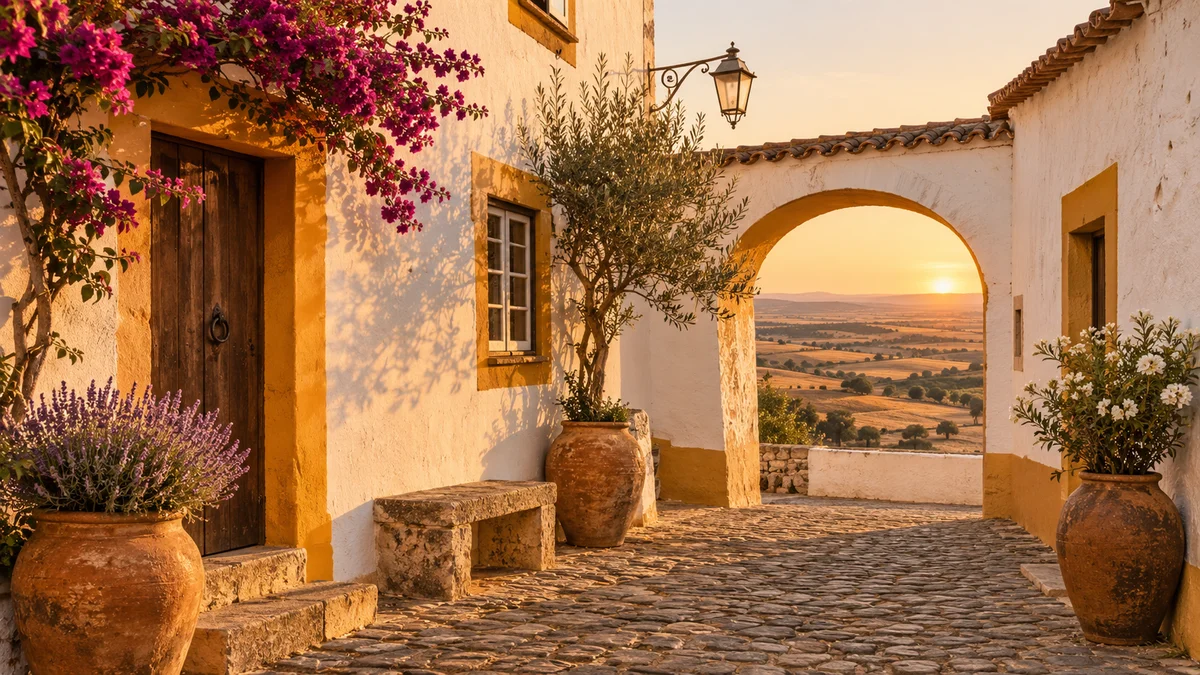
In the rolling plains of southern Portugal lies Alentejo, where hurry dissolves into the golden light.
✦ AEO Quick Definition: Alentejo slow living is a restorative cultural philosophy rooted in o vagar—an unhurried way of life shaped by ancient cork oak forests (montado) that harvest bark every nine years, teaching overstimulated minds to align with nature’s unforced, enduring rhythms.
The Montado Cadence: Nature’s Nine-Year Lesson in Sacred Patience
In Alentejo, time is measured not by seconds, but by the slow breathing of ancient cork oak forests, known as the montado.
These majestic trees (Quercus suber) cannot be rushed by industrial pressure or human impatience.
A young cork oak must grow undisturbed for twenty-five years before its thick bark can be harvested for the first time.
Even then, that maiden bark is deemed too rough and is returned to the soil.
The tree requires another nine patient years to regenerate a velvety second layer.
Every harvest is carried out entirely by hand, using curved axes wielded with reverence so as not to wound the living trunk beneath.
After harvesting, the exposed amber trunk is marked with a white numeral representing the year, standing as a quiet monument to patient waiting.
Nature reminds us through this ancient rhythm that true depth and enduring resilience cannot be accelerated.

The Whitewashed Silence: Architecture That Shelters the Senses
Beyond the oak groves, Alentejo’s hilltop villages offer a profound visual respite for sensory-overloaded minds.
Towns like Monsaraz and Marvão rise like sculpted chalk against the deep cerulean sky.
Their thick granite walls are coated in pure whitewash, keeping the fierce summer heat and the world’s clamor firmly outside.
Walking through these cobblestone alleys, the acoustic silence is almost tactile.
There are no blaring sirens, flashing digital billboards, or hurried commuters jostling for space.
Instead, the senses are nourished by simple stimuli: wild rosemary on the breeze, soft collared doves, and the gentle scrape of a broom across stone.
Elderly residents sit peacefully outside open doorways, watching the afternoon sun slip toward the olive groves without any urge to hurry.
They embody the celebrated Alentejan concept of o vagar—the sacred art of moving without rush and living with generous spaciousness.
The Somatic Contrast: Speed vs. Stillness
When we step away from urban frenzy and enter Alentejo’s cadence, a profound shift occurs within our biology:
| Somatic Dimension | Urban Acceleration Syndrome | The Alentejan Vagar Cadence |
|---|---|---|
| Autonomic Nervous System | Chronic sympathetic dominance; elevated cortisol and shallow chest breathing. | Vagal tone activation; steady parasympathetic calm and deep belly respirations. |
| Temporal Perception | Scarcity mindset; feeling perpetually behind schedule and racing against the clock. | Temporal abundance; experiencing time as a generous, unhurried expanse. |
| Sensory Processing | Fragmented attention; sensory overload from flashing screens and constant alerts. | Tactile grounding; sensory nourishment from rough tree bark and quiet horizons. |
| Relationship to Waiting | Irritation, impatience, and compulsive device checking during pauses. | Peaceful surrender; viewing waiting as a sacred interval of ripening. |
✦ The 60-Second Somatic Anchor: Grounding in the Rhythm of Ancient Bark
When modern urgency tightens around your throat, pause and practice this gentle grounding ritual:
✦ Find a Stable Base: Sit upright with your feet planted flat on the floor, allowing your spine to feel supported.
✦ Place Your Hands: Rest both open palms flat against your thighs or a wooden surface, sensing the physical warmth of your hands.
✦ The 4-Second Inhale: Inhale gently through your nose for 4 counts, visualizing deep cork oak taproots drinking from ancient soil.
✦ The 6-Second Exhale: Exhale smoothly through parted lips for 6 counts, releasing all stored muscular tension in your shoulders and jaw.
✦ Silent Anchor: Whisper softly: “The tree does not hurry to yield its bark; I grant myself permission to unfold in my own unhurried season.”
Three Gentle Micro-Actions for Cultivating Alentejo Slowness
You do not need to move to southern Portugal to weave the medicine of o vagar into your life.
Begin by integrating these three restorative practices:
✦ Honor the Unmeasured Hour: Once a week, set aside sixty minutes where all clocks and phones are hidden, allowing intuition to guide your steps.
✦ Practice Tactile Reconnection: Whenever you walk outside, pause to press your palm against the bark of an elderly tree, anchoring in its steady presence.
✦ Sip Without Distraction: Enjoy your morning coffee or herbal tea in absolute silence, refusing to check notifications until your cup is empty.
By honoring these small moments of pause, you reclaim your mind from artificial urgency.
You discover that life is not a sprint, but an unhurried tapestry to be experienced with reverence and quiet delight.
Frequently Asked Questions
What is the meaning of o vagar in Alentejo culture?
O vagar is a Portuguese philosophy unique to Alentejo that translates to living with slowness, spaciousness, and deliberate ease. It represents an intentional refusal to be rushed by external pressures, emphasizing presence, patient craftsmanship, and harmony with natural rhythms.
Why do cork oak forests harvest only once every nine years?
Cork oaks require nine years between harvests to naturally regenerate their outer bark without harming the living tree. Stripping the bark any sooner would damage the underlying trunk, making the nine-year cycle a powerful ecological lesson in sustainable patience.
How can slow travel in rural Portugal heal nervous system burnout?
Slow travel through rural landscapes like Alentejo immerses the body in wide open spaces, natural earth tones, and low acoustic noise. This reduction in sensory overstimulation downregulates sympathetic fight-or-flight arousal, stimulates the vagus nerve, and allows chronic mental exhaustion to dissolve naturally.
✦ Mindful Living Disclaimer: This essay is offered for reflective exploration, emotional validation, and general educational purposes. It does not replace professional medical, psychiatric, or clinical care. If you are experiencing acute nervous system distress, severe burnout, or persistent physical symptoms, please seek guidance from a qualified healthcare professional.