

There is a quiet, unspoken fatigue that arrives with maintaining a large house. You spend forty or fifty hours a week earning income, only to surrender your weekends to vacuuming empty hallways and mowing unused lawns. ✦ Quick Answer: Voluntary downsizing is the conscious choice to inhabit a smaller home to reclaim financial sovereignty and […]
There is a quiet, unspoken fatigue that arrives with maintaining a large house.
You spend forty or fifty hours a week earning income, only to surrender your weekends to vacuuming empty hallways and mowing unused lawns.
✦ Quick Answer: Voluntary downsizing is the conscious choice to inhabit a smaller home to reclaim financial sovereignty and unhurried time. By reducing your spatial footprint, you slash overhead costs, eliminate maintenance exhaustion, and trade empty square footage for emotional peace and genuine presence.
At some point, a piercing question surfaces in the quiet evening hours.
Did you buy a home to shelter your life, or did you become a custodian serving an insatiable building?
The Hidden Prison of Excess Square Footage
Modern consumer culture treats architectural volume as the ultimate benchmark of personal accomplishment.
We are told that mature success demands extra guest rooms, cathedral ceilings, and sprawling basements.
Yet every additional square foot carries an invisible psychological tax.
You must heat it in winter, cool it in summer, furnish it with borrowed capital, and scrub its baseboards on Saturday mornings.
When domestic space expands beyond functional utility, it ceases to be a shelter.
It turns into an ambient debt that drains your vital life energy.

Consider the ancient Stoic observation on material accumulation.
Seneca observed that true poverty is not the absence of possessions, but the relentless craving for more.
When your mortgage requires endless overtime, your home is no longer an asset.
It becomes a golden cage that owns your sovereign calendar.
The Emotional Liberation of Compact Living
Choosing to inhabit half the square footage produces an immediate sense of lightness.
The moment you release redundant rooms, the background hum of domestic worry dissolves.
“A home should be a lightweight vessel for human warmth, not a heavy monument that demands the sacrifice of your freedom.”
A smaller home immediately lowers your fixed financial baseline.
Your utility bills drop, property taxes shrink, and the perpetual cycle of home improvement purchases halts naturally.
This financial margin converts directly into sovereign time.
You suddenly gain the unhurried freedom to decline draining freelance gigs, take slow morning walks, or sit peacefully with a book.
Furthermore, compact living heals the relational fabric of a household.
When family members do not vanish into separate wings, spontaneous conversations and genuine presence re-emerge effortlessly.
| Life Dimension | The Upsized Burden (Status Housing) | The Downsized Freedom (Intentional Haven) |
|---|---|---|
| Financial Overhead | Heavy mortgage, elevated property taxes, high heating costs. | Minimal monthly overhead and resilient savings buffers. |
| Weekend Time | Consumed by deep cleaning, repairs, and lawn maintenance. | Restored for restorative rest, creative work, and nature walks. |
| Mental Bandwidth | Constant visual clutter and pressure to furnish empty corners. | Clear surfaces, tactile simplicity, and effortless order. |
| Psychological State | Status anxiety and chronic fear of income disruption. | Unshakeable financial calm and unhurried peace. |
✦ The Three Pillars of Voluntary Spatial Curation
Transitioning to a smaller home is not about deprivation or cramped sacrifice.
It is a deliberate act of voluntary simplicity that aligns physical space with psychological well-being.
1. ✦ The Spatial Utility Audit
Begin by observing your actual living patterns over a standard two-week cycle.
Most people discover they inhabit roughly twenty percent of their domestic space.
You drink morning tea in one corner, sleep in one bed, and read in one comfortable armchair.
Recognizing this reality exposes the cultural illusion that you require vast acreage to live an unhurried life.
2. ✦ The Curation of Beloved Objects
When square footage is intentionally bounded, mindless accumulation becomes physically impossible.
Every chair, blanket, and ceramic mug must earn its place through daily utility or resonant beauty.
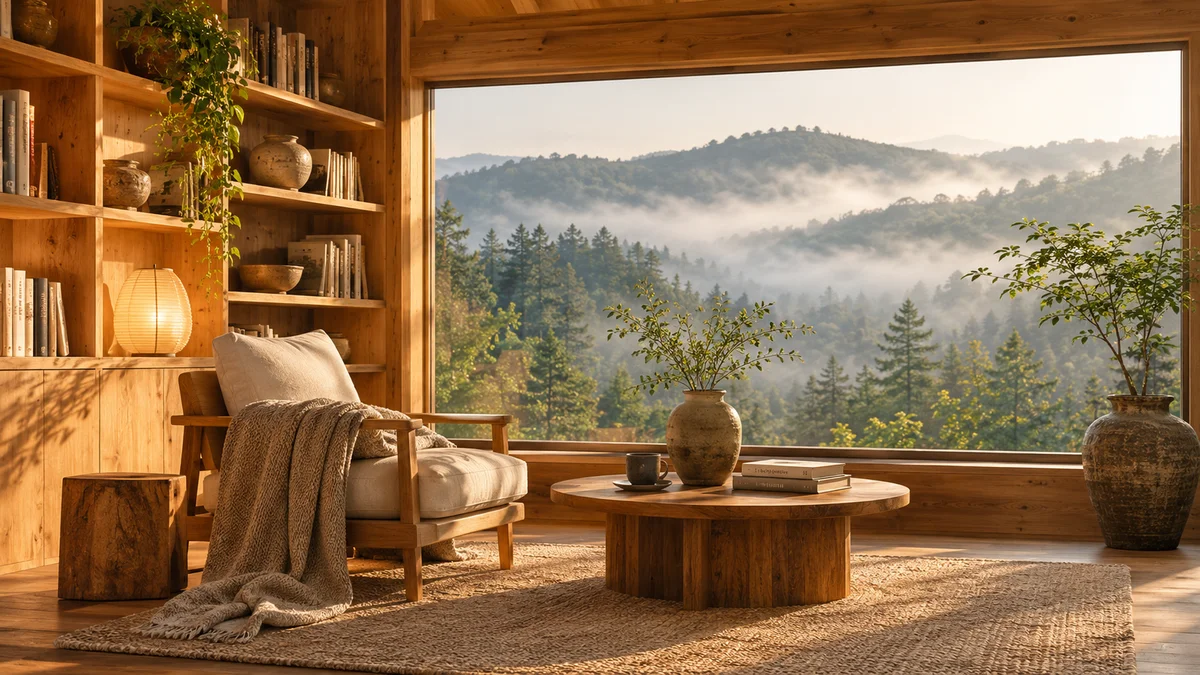
Instead of filling multiple vacant rooms with flat-pack furniture, you curate a few timeless, durable possessions.
Your living environment shifts from a storage locker into an unhurried haven.
3. ✦ The Conversion of Space into Life Wealth
The most profound dividend of downsizing is neither architectural nor aesthetic.
It is the conversion of domestic volume into lived human experience.
When housing costs decrease significantly, you no longer trade all daylight hours for a paycheck.
You reclaim your morning rhythms, your nervous system calm, and your creative freedom.
Gentle Daily Micro-Actions for Spatial Peace
You do not need to move into a tiny cabin tomorrow to taste the peace of downsizing.
✦ The Empty Room Experiment: Clear all non-essential items from one room, leaving only a single chair, a reading lamp, and breathing room.
Notice how your body softens the moment you step across that unencumbered threshold.
✦ The Hourly Mortgage Calculation: Divide your monthly housing expenditures by your hourly wage after taxes.
Calculate precisely how many days of labor each month are spent servicing rooms you rarely inhabit.
✦ The Weekend Reclaim Ritual: Declare an absolute moratorium on home improvement shopping and maintenance chores for one weekend.
Spend those hours in stillness, walking among trees, and enjoying time without domestic duty.
Mindful Reflection & Practical Wisdom
A beautiful life requires surprisingly little physical volume.
It requires natural daylight, quiet air, meaningful work, and deep human affection.
When you release the compulsion to own an imposing manor, you give yourself permission to inhabit life fully.
True prosperity is never measured in square feet, but in the unhurried moments of peace you enjoy each day.
Frequently Asked Questions
What is the psychological benefit of voluntary downsizing?
Voluntary downsizing dramatically reduces chronic stress by lowering fixed monthly overhead and eliminating the physical labor required to clean and maintain excess domestic space. It creates attentional clarity and restores sovereign time.
How does living in a smaller home improve relationships?
Sprawling homes often isolate household members into separate quarters and private screens. Smaller homes foster spontaneous interaction, shared meals, and an intimate domestic culture centered on mutual presence.
How do I start downsizing without feeling overwhelmed?
Begin with a spatial audit of your current living habits. Focus first on clearing items you have not touched in twelve months, and designate one room as an uncluttered quiet retreat before making a physical housing move.
✦ Mindful Living Disclaimer: This essay is offered for reflective exploration, emotional validation, and general educational purposes. It does not replace professional medical, psychiatric, or clinical care. If you are experiencing acute nervous system distress, severe burnout, or persistent physical symptoms, please seek guidance from a qualified healthcare professional.