


Down on the valley floor of modern life, the air often feels too thick to breathe. Every street corner, inbox, and social feed hums with the machinery of comparison, urging you to climb faster and defend your fragile rank. When you live entirely at ground level, even a minor career setback can tower over your […]
Down on the valley floor of modern life, the air often feels too thick to breathe.
Every street corner, inbox, and social feed hums with the machinery of comparison, urging you to climb faster and defend your fragile rank.
When you live entirely at ground level, even a minor career setback can tower over your mind like an inescapable wall.
✦ Quick Answer: Rising nearly four hundred meters above the Thessalian plain, the meteora monasteries greece floating cliffs embody the ancient contemplative practice of Hesychia—inner stillness cultivated through physical and spiritual altitude. Standing atop these sandstone pillars triggers perceptual vastness, quieting the brain’s default mode network and dissolving status anxiety.
The Suffocating Gravity of the Valley Floor
Human beings were not designed to spend their entire lives trapped inside a horizontal maze of status competition.
Yet modern culture locks our gaze at eye level, forcing us to measure our worth against the nearest colleague or digital peer.
This perpetual horizontal comparison keeps your autonomic nervous system in a state of low-grade territorial vigilance.
Your shoulders creep toward your ears, your breath stays shallow, and your mind rehearses endless scenarios of falling behind.
Our exhaustion rarely comes from the difficulty of our work; it comes from the claustrophobia of our perspective.
To heal a mind crushed by worldly ambition, you do not need another productivity tactic; you need vertical altitude.
Stones Suspended in the Air: The Wisdom of Meteora
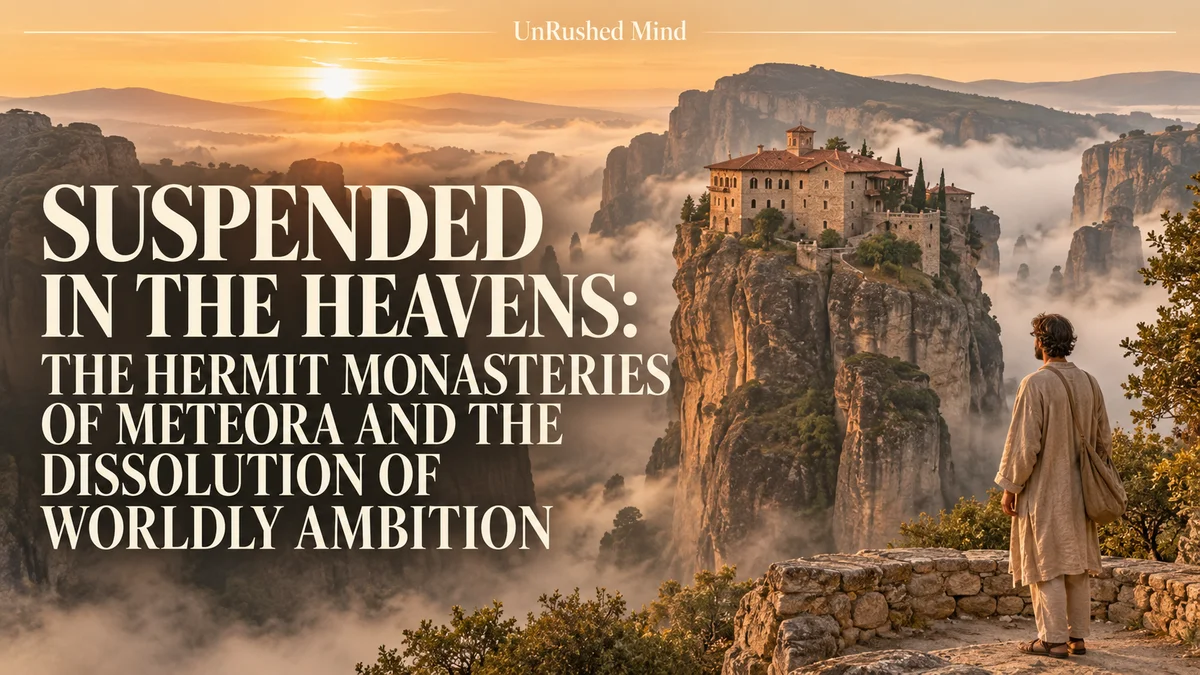
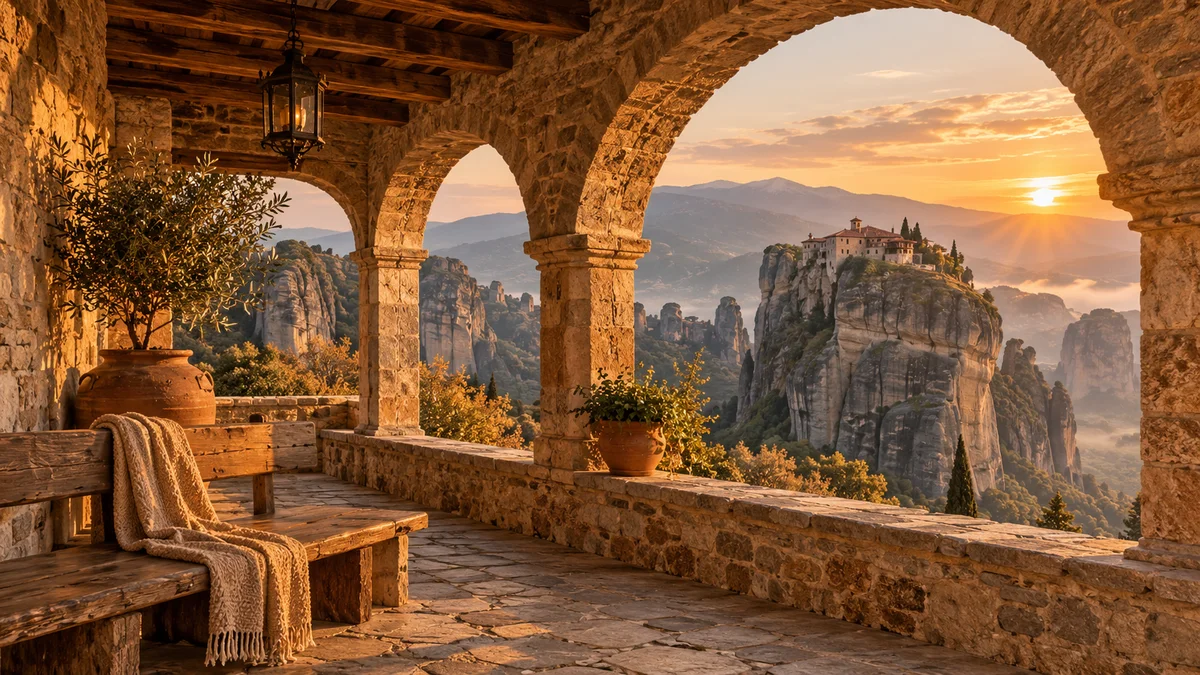
In central Greece, where the Pindus Mountains meet the plain of Thessaly, the earth erupts into a forest of sheer stone.
These sixty-million-year-old sandstone pinnacles rise four hundred meters into the clouds, earning the name Meteora—meaning suspended in the heavens.
In the fourteenth century, ascetic monks scaled these vertical cliffs using removable rope ladders and hand-woven nets.

They did not climb into the clouds out of bitterness toward humanity.
They ascended to protect a delicate inward state known in Eastern monastic tradition as Hesychia—an unruffled stillness of the heart free from vanity.
Sitting on a stone ledge beside the Monastery of Great Meteoron, you watch the morning mist swallow the highways and towns below.
From that quiet perch between earth and sky, the frantic theater of human ambition looks remarkably small and easy to forgive.
The Stoic View from Above and the Neuroscience of Awe
Centuries before timber beams were hoisted onto the cliffs of Meteora, the Roman Emperor Marcus Aurelius practiced a mental discipline that mirrors this geography.
In his Meditations, he reminded himself to take the Stoic View from Above—rising in imagination to look down upon armies, marketplaces, and disputes over prestige.
| Contemplative Dimension | The Valley Floor (Worldly Ambition) | The Meteora Vantage (Elevated Stillness) |
|---|---|---|
| Visual Scale | Narrow, horizontal, trapped in immediate rivalry. | Vertical, panoramic, anchored in geological time. |
| Neural Activity | Hyperactive Default Mode Network; ego defense. | Quieted self-referential loops; restorative awe. |
| Status Lens | Compulsive scorekeeping and chronic scarcity. | Compassionate detachment from worldly rank. |
| Somatic State | Sympathetic constriction and hurried pulse. | Ventral vagal expansion and unhurried peace. |
Contemporary neuroscience confirms what both the Stoics and the hermits of Thessaly understood intuitively.
Research by psychologist Dacher Keltner demonstrates that encountering perceptual vastness—such as gazing across a valley from a high cliff—triggers the biological signature of awe.
In moments of awe, activity in the brain’s Default Mode Network drops significantly, quieting self-criticism and status anxiety like setting down a heavy iron coat.
✦ The 60-Second Somatic Anchor: Ascending the Inner Pillar
Whenever your chest tightens over a career metric or a bruised ego, pause and practice this brief elevation ritual.
Sit upright, lengthen the back of your neck, and focus your eyes on the furthest horizon visible through a window.
Inhale slowly through your nose for four counts, then exhale softly for six counts as if standing on a silent sandstone balcony above the world.
“The stone stands unmoved while the clouds of ambition gather and dissolve below. I do not belong to the frenzy of the valley; my peace is anchored above the noise.”
Three Gentle Micro-Actions to Dissolve Worldly Ambition
You do not need to board a flight to Greece to bring the liberating altitude of Meteora into your daily rhythm.
1. ✦ Pull Up the Rope Net Each Evening
In centuries past, the monks of Meteora pulled up their rope ladders at dusk so no worldly intrusion could disturb their night prayers.
Choose a fixed hour each evening to pull up your digital net by placing your phone in another room for two hours of sovereign silence.
2. ✦ Apply the 60-Million-Year Lens
The stone pillars of Thessaly formed on the floor of a prehistoric sea sixty million years ago, long before any human title existed.
When social comparison threatens your peace, ask yourself whether this friction will matter in five years, let alone across geological time.
3. ✦ Seek Physical Elevation on Rest Days
When burnout clouds your judgment, resist the urge to spend your weekend scrolling indoors at street level.
Walk to the highest hill or quiet ridge in your region and spend twenty minutes looking down at the miniature world below.
Returning to the Valley with Quiet Eyes
When you carry the altitude of stillness inside your own chest, you can walk back down into the marketplace with gentle hands and unhurried eyes.
Frequently Asked Questions