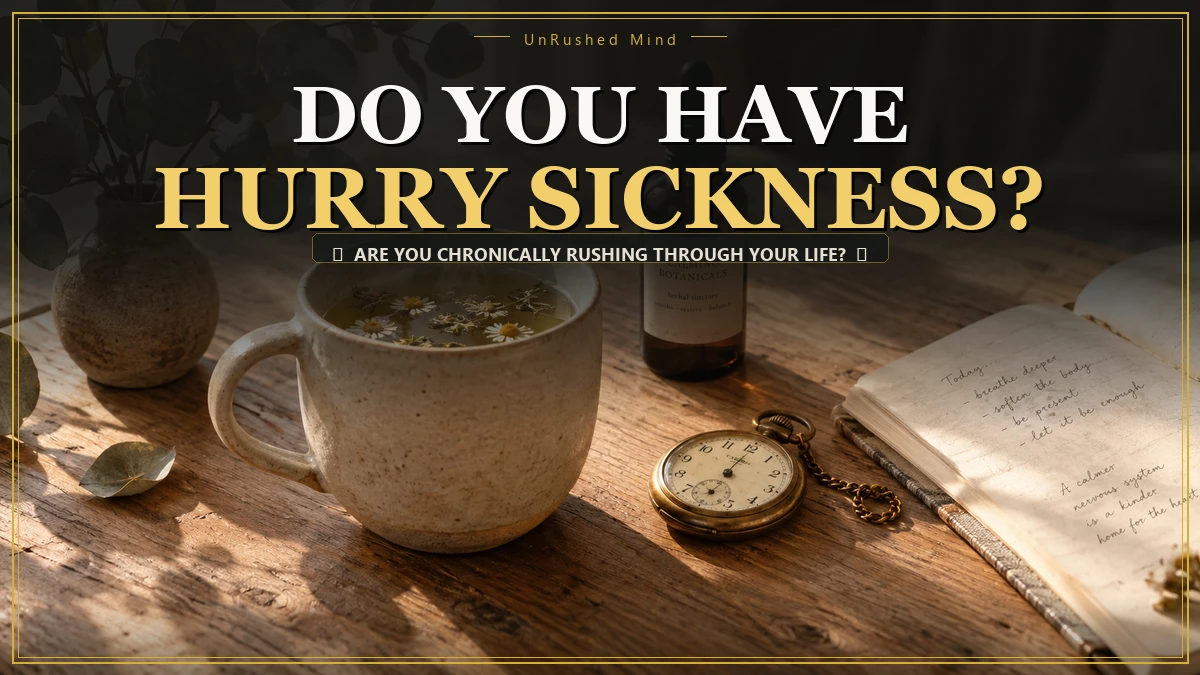
Do you press elevator buttons repeatedly, listen to audio at 2x speed, or feel immediate guilt when sitting still? Take this 8-question cardiology-inspired assessment to measure your internal clock speed.
Do you press elevator buttons repeatedly, listen to audio at 2x speed, or feel immediate guilt whenever you sit down to rest?
Measure your internal clock speed and evaluate your relationship with time scarcity through the 8-question cardiology assessment below.
The Hurry Sickness & Time Scarcity Index: Are You Chronically Rushing Through Your Own Life?
Cardiologists Meyer Friedman and Ray Rosenman coined the term 'Hurry Sickness' to describe a continuous struggle and unremitting attempt to accomplish more and more things in less and less time. Answer these 8 behavioral reflections to see if your internal clock is trapped in artificial urgency.
This self-assessment is designed for educational and personal reflection purposes regarding mental restoration, burnout symptoms, and stress levels. It does not replace professional clinical diagnosis, psychiatric care, or licensed medical therapy.
Cardiology Research & The Addiction to Velocity
Cardiologists Meyer Friedman and Ray Rosenman coined the term ‘Hurry Sickness’ after observing that cardiac patients wore down the front edges of waiting room chairs—unable to sit back comfortably even with nothing urgent to do.
When chronic rushing becomes normalized, we stop inhabiting our present moments and treat life as an emergency to be endured. Unhooking from hurry sickness restores autonomic equilibrium.
Architectural Profile Decodings & Restoration Guidance
Every intuitive choice or score threshold mirrors an underlying autonomic state. Below are the comprehensive psychological and neurobiological decodings for each result profile:
🟢 Sovereign Unhurried Tempo: The Art of Dolce Far Niente (0 – 7 Points)
✦ Autonomic State: You have accomplished something remarkably rare in the twenty-first century: you have unhooked your self-worth from the speed of the industrial clock.
✦ Mechanism: Instead of treating your life as a race to be optimized, you inhabit *Kairos*—qualitative, lived time. Your heart rate, digestion, and attention remain anchored where your feet actually stand.
✦ Gentle Micro-action: 1. Protect Your Unmediated Mornings: Continue savoring your first cup of tea or coffee without screens or schedules. 2. Be a Mindful Haven of Slowness: In a frantic world, your unhurried cadence gives everyone around you subconscious permission to exhale. 3. Deepen Seasonal Living: Keep aligning your workload with natural cycles of effort and quiet restoration.
🌿 Read Mindful Guide: Il Dolce Far Niente & The Art of Doing Nothing ➔
🟡 Accelerated Internal Clock: Moderate Hurry Sickness (8 – 15 Points)
✦ Autonomic State: Your mind and body have absorbed the artificial urgency of modern culture. Even when no actual emergency exists, your sympathetic nervous system stays slightly revved—causing you to walk faster than necessary, rush through meals, and mentally leap into the next hour before the current one has finished.
✦ Mechanism: You are not truly short on time; rather, chronic speed has compressed your capacity to feel present inside the time you have.
✦ Gentle Micro-action: 1. Deliberately Choose the Longer Line: Once this week at a café or grocery store, pick the slightly longer queue and practice dropping your shoulders while waiting. 2. Return Audio to 1x Speed: Listen to conversations and podcasts at natural human cadence to retrain your nervous system out of hyper-vigilance. 3. The Single-Task Meal: Eat one meal a day without a phone, book, or screen—noticing texture, warmth, and breath.
🌿 Read Your Solution: Unhooking Your Mind from Hurry Sickness ➔
🔴 Severe Hurry Sickness & Productivity Dysmorphia Alert (16 – 24 Points)
✦ Autonomic State: Your responses reflect an acute state of Hurry Sickness and Productivity Guilt. Somewhere along the way, your nervous system learned to equate stillness with danger or laziness, and constant motion with safety and worth.
✦ Mechanism: Because your internal stopwatch never stops ticking, even accomplishments bring no lasting relief—and rest itself feels stressful because your mind scolds you for ‘wasting time.’ Left unchecked, this chronic adrenaline loop drains both cardiovascular health and the joy of being alive.
✦ Gentle Micro-action: 1. Name the Guilt Without Obeying It: When sitting still triggers a wave of guilt, say gently: ‘This is old conditioning, not an emergency. I am safe to pause.’ 2. Walk at 70% Speed: Today, intentionally reduce your walking pace by 30% for ten minutes—sending a bottom-up somatic signal to your brain that there is no predator chasing you. 3. Practice 10 Minutes of Unproductive Stillness: Sit by a window with a warm drink and do nothing useful at all; reclaim your right to exist without producing.
🌿 Read Your Solution: Unlearning the Guilt of Doing Nothing ➔
📚 Academic & Clinical Foundation: Friedman & Rosenman Cardiology Research (Type A Time Urgency), Harvard Business School Time Famine Studies, and Slow Living Philosophy
🌿 Mindful Reflection Notice: This self-assessment is designed solely for educational, self-inquiry, and personal reflection purposes. It does not constitute medical, psychiatric, or clinical psychological advice, diagnosis, or treatment. If you are experiencing acute emotional distress, severe burnout, or chronic physical symptoms, please consult a qualified healthcare professional.