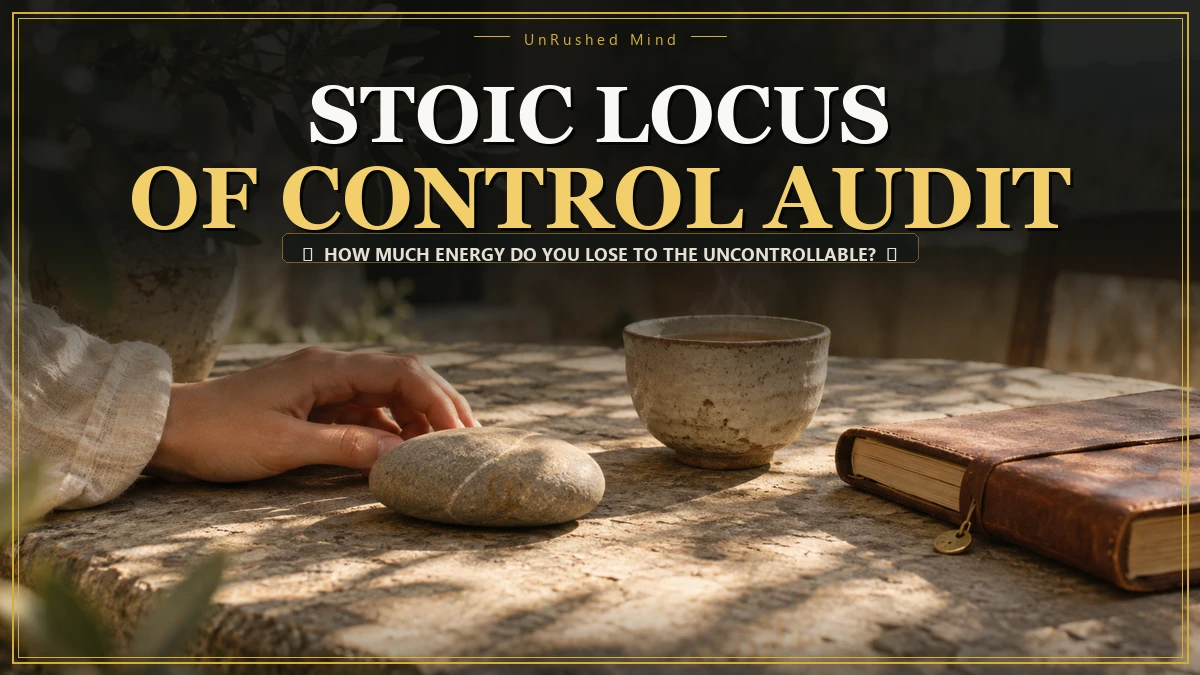
Measure where your mental perimeter is leaking peace. Based on Epictetus's Dichotomy of Control and cognitive rumination science, this 8-question audit reveals how much lifeblood you spend on imaginary battles and external outcomes.
Two thousand years ago, the Stoic philosopher Epictetus opened his handbook with a single liberating division: some things are up to us, and some things are not up to us.
Measure where your mental perimeter is leaking peace and how effectively you separate sovereign action from imaginary suffering in the audit below.
The Stoic Locus of Control & Overthinking Audit: How Much Energy Do You Lose to the Uncontrollable?
Two thousand years ago, Epictetus observed that human suffering stems not from events themselves, but from investing our soul's energy into things outside our volition. Answer these 8 cognitive reflections to measure where your mental perimeter is leaking peace.
This self-assessment is designed for educational and personal reflection purposes regarding mental restoration, burnout symptoms, and stress levels. It does not replace professional clinical diagnosis, psychiatric care, or licensed medical therapy.
The Inner Citadel & Cognitive Behavioral Rumination
Modern cognitive psychology calls Epictetus’s division the Locus of Control. When we invest our emotional wellbeing into external variables—other people’s opinions, past mistakes, or uncertain futures—we fall into chronic rumination.
As Seneca noted, ‘We suffer more often in imagination than in reality.’ Withdrawing mental energy from external outcomes immediately restores your present calm.
Architectural Profile Decodings & Restoration Guidance
Every intuitive choice or score threshold mirrors an underlying autonomic state. Below are the comprehensive psychological and neurobiological decodings for each result profile:
🟢 Sovereign Inner Citadel: Strong Internal Locus of Control (0 – 7 Points)
✦ Autonomic State: You embody the core wisdom of Epictetus and Marcus Aurelius. You have trained your mind to distinguish clearly between *Ta Eph’ Hemin* (what is up to us: our character, breath, intentions, and responses) and *Ta Ouk Eph’ Hemin* (what is not up to us: other people’s opinions, the past, and external outcomes).
✦ Mechanism: Because you refuse to pour lifeblood into the uncontrollable, your nervous system conserves vast reserves of quiet strength and clarity.
✦ Gentle Micro-action: 1. Deepen Ataraxia: Continue practicing a morning or evening reflection to keep your inner citadel uncluttered. 2. Model Grounded Calm: Your unhurried presence naturally co-regulates anxious people around you without requiring you to carry their burdens. 3. Contemplate Amor Fati: Move from merely accepting uncontrollable events to actively welcoming them as fuel for wisdom.
🌿 Read Deep Dive: The Ancient State of Ataraxia & Imperturbable Calm ➔
🟡 Porous Mental Perimeter: Anticipatory Anxiety & Imaginary Rehearsals (8 – 15 Points)
✦ Autonomic State: As Seneca famously wrote in *Letters from a Stoic*: ‘We suffer more often in imagination than in reality.’ You understand logically that you cannot control everything, yet in moments of uncertainty or social friction, your mind attempts to buy safety by over-rehearsing the future or replaying the past.
✦ Mechanism: Roughly 40% to 50% of your daily mental fatigue is coming not from the work you are doing, but from hypothetical scenarios your brain is simulating in the background.
✦ Gentle Micro-action: 1. The Two-Column Stoic Audit: Whenever anxiety spikes, draw a line down a page—write ‘In My Control’ on the left, ‘Outside My Control’ on the right, and physically cross out the right column. 2. Interrupt Imaginary Courtrooms: When you catch yourself arguing with someone in your head, place a hand on your chest and say softly: ‘They are not in this room right now.’ 3. Set a ‘Worry Containment’ Window: Give yourself 10 minutes at 4:00 PM to write down uncertainties, freeing the rest of your evening for presence.
🌿 Read Your Solution: The Dichotomy of Control Antidote to Overthinking ➔
🔴 External Locus Captivity & Chronic Rumination Loop (16 – 24 Points)
✦ Autonomic State: Your inner peace has been accidentally handed over to external hostages—other people’s moods, unchangeable past regrets, and the demand for 100% certainty before you can relax.
✦ Mechanism: In cognitive psychology, this is known as hyper-vigilant rumination: your brain mistakenly believes that if you worry hard enough, you can prevent pain or control how the world perceives you. Instead, it leaves your body exhausted while the external world remains just as unpredictable.
✦ Gentle Micro-action: 1. Practice Epictetus’s First Question: Before engaging with any stressful thought today, ask: ‘Is this within my direct volition right now?’ If the answer is no, drop your shoulders and exhale. 2. Apply the Memento Mori Lens: Ask yourself whether this current worry will matter in five years—let mortality strip away trivial social anxieties. 3. Return to Somatic Reality: Rumination only survives in abstract thought; interrupt the loop by feeling your feet on the floor and naming 3 physical objects in the room.
🌿 Read Your Solution: Memento Mori & Breaking the Overthinking Loop ➔
📚 Academic & Clinical Foundation: Epictetus’s Dichotomy of Control (Enchiridion), Julian Rotter’s Locus of Control Scale (1966), and Cognitive Behavioral Rumination Research
🌿 Mindful Reflection Notice: This self-assessment is designed solely for educational, self-inquiry, and personal reflection purposes. It does not constitute medical, psychiatric, or clinical psychological advice, diagnosis, or treatment. If you are experiencing acute emotional distress, severe burnout, or chronic physical symptoms, please consult a qualified healthcare professional.