


You can spend months trapped inside glowing glass rectangles before realizing the world has lost its color. The days blur together into an unyielding stream of notifications, meetings, and urgent deadlines. Beneath the steady rhythm of your productivity, an unspoken emotional drought quietly settles into your chest. You look at a sunset and feel only […]
You can spend months trapped inside glowing glass rectangles before realizing the world has lost its color.
The days blur together into an unyielding stream of notifications, meetings, and urgent deadlines.
Beneath the steady rhythm of your productivity, an unspoken emotional drought quietly settles into your chest.
You look at a sunset and feel only detached recognition, rather than the sudden catch in your breath that once accompanied beauty.
Psychologists describe this dull interior twilight as emotional blunting, a somatic shutdown triggered by chronic cognitive overload.
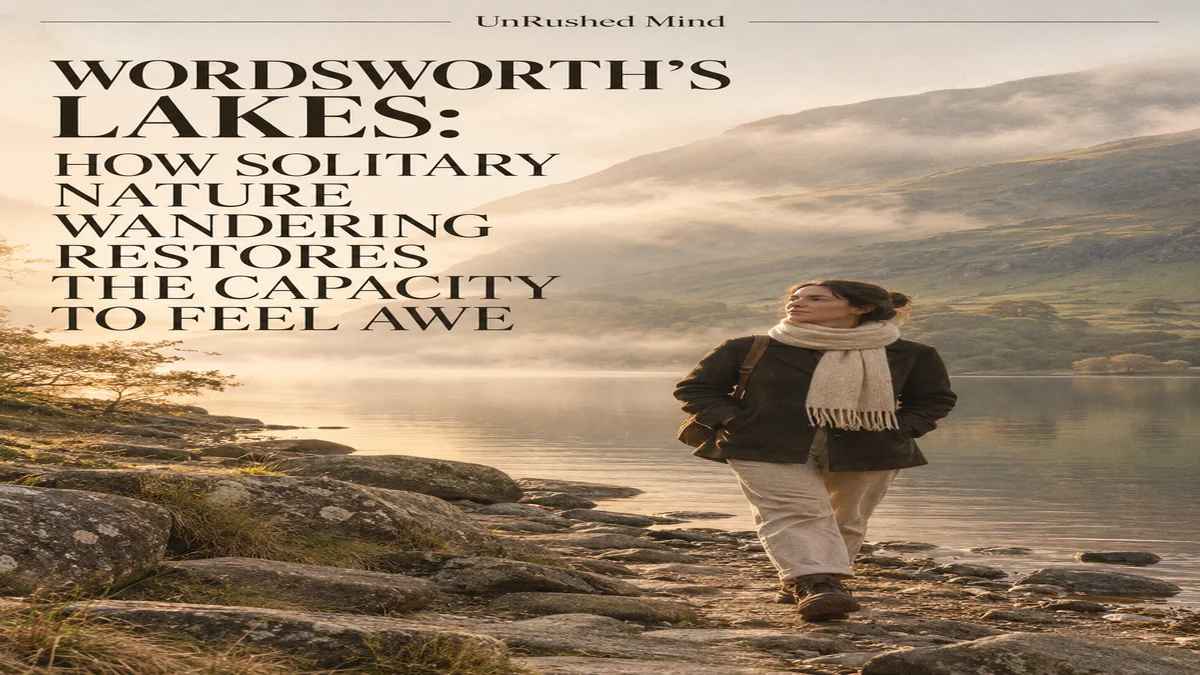
✦ Quick Insight: Solitary wandering through wild natural landscapes, such as the English Lake District, activates Attention Restoration Theory and the soothing neurobiology of awe. Walking silently beside still mountain waters quietens the hyperactive default mode network, shifting the nervous system from chronic depletion back into spontaneous wonder.

The Claustrophobic Mind: The Cost of Screen Living
Modern life confines human perception to a focal distance of roughly eighteen inches.
Your eyes remain locked in a perpetual, narrow stare, straining against artificial blue light while processing fragmented emergencies.
Neurobiologists note that this intense focus forces the brain into continuous directed attention, a finite resource that burns out rapidly.
When directed attention collapses, empathy erodes, patience thins, and your capacity to feel wonder quietly evaporates.
We mistake this spiritual fatigue for ordinary tiredness, seeking refuge in passive scrolling that only accelerates neural exhaustion.
What the depleted spirit truly hungers for is not mindless distraction, but the medicine of vast physical space.
To recover your capacity to feel, you must take your nervous system somewhere wide enough to exhale.
The Lake Poets: Walking As Sacred Medicine
In the winter of 1799, the poet William Wordsworth arrived with his sister Dorothy at Dove Cottage in Grasmere.
Surrounded by steep fells and glistening waters, they turned away from the noisy machinery of the Industrial Revolution.
Wordsworth dedicated his days to deliberate solitary walking, covering over one hundred and eighty thousand miles across Cumbria.
He did not walk for speed, physical fitness, or quantitative metrics.
He walked to surrender himself to what he famously termed a wise passiveness.
By walking alone without destination, the rhythm of his footsteps untied the heavy knots of mental worry.
The immense scale of mist rolling across Ullswater dissolved the self-absorbed prison of his ego.
| Dimension | The Screen-Bound Mind | The Lake Reverie |
|---|---|---|
| Visual Field | Fixed focal depth of eighteen inches | Expansive horizons and mirrored mountain waters |
| Attention Mode | Directed, fatiguing focus on notifications | Soft fascination that effortlessly restores neural bandwidth |
| Sense of Ego | Anxiously inflated and urgently defensive | Humbled, serene, and harmoniously connected |
| Emotional State | Flat affect and persistent numbness | Spontaneous awe and gentle sensory gratitude |
| Autonomic Tone | Sympathetic hyper-arousal and cortisol spikes | Restful parasympathetic engagement and vagal calm |

“Come forth into the light of things, let Nature be your teacher.”
The Science of Awe: Dissolving the Heavy Ego
Modern cognitive science confirms what the Romantic poets discovered through deep intuition.
Researchers studying the emotion of awe find that vast natural landscapes produce immediate physiological resets.
When you look across a mirror-calm lake framed by ancient fells, your brain’s default mode network quietens dramatically.
This neural circuit is responsible for chronic self-rumination, regret, and the mental rehearsal of future crises.
In the presence of timeless beauty, your personal problems shrink down to a healthy, manageable perspective.
Psychologists call this the small-self experience, a tranquil state where the ego unclasps its frantic grip.
Awe stimulates vagal tone, lowers inflammatory markers, and restores your capacity for heartfelt tenderness.
The numbness that felt so permanent in your apartment begins to dissolve in the morning mountain air.
Three Grounded Protocols to Awaken Wonder
You do not need to live in Cumbria to welcome Wordsworth’s quiet medicine into your life.
These three mindful rituals will help you invite restorative wonder back into your daily routine.
✦ The Unplugged Footpath: Walk for thirty minutes each week in a quiet park or waterside trail without headphones or smart devices, allowing raw acoustic silence to settle your nervous system.
✦ The Horizon Soft-Focus: Whenever you reach an open view, pause and soften your gaze toward the farthest visible ridge line for three full minutes, releasing chronic ocular strain.
✦ The Evening Reverie Journal: Before sleeping, write down one fleeting natural image that made you pause, cultivating the habit of quiet astonishment.
Reclaiming Your Haven of Reverie
The numbness you feel is not a character flaw or an irreversible consequence of aging.
It is simply your nervous system begging you to step away from the machine and return to the living earth.
When you allow yourself to wander without purpose, you give your soul permission to marvel once again.
The still waters are waiting, ready to remind you that you are alive.
Frequently Asked Questions