

When November freezes the northern hemisphere, an instinctive urge whispers to retreat indoors, seal every window, and huddle beside artificial radiators. Yet within those overheated, airless living rooms, an unspoken heaviness often begins to settle over the human spirit. Core Insight: Norwegian friluftsliv represents an unhurried return to the raw elements rather than an athletic […]
When November freezes the northern hemisphere, an instinctive urge whispers to retreat indoors, seal every window, and huddle beside artificial radiators.
Yet within those overheated, airless living rooms, an unspoken heaviness often begins to settle over the human spirit.
Core Insight: Norwegian friluftsliv represents an unhurried return to the raw elements rather than an athletic conquer of wilderness. Stepping into sub-zero winds abruptly halts ruminative thought loops, stimulates vagal tone, and reconnects your nervous system with ancient sensory vitality.
The lethargy of late winter is rarely physical exhaustion.
Instead, it is often sensory claustrophobia born from breathing stale recycled heat and staring at glowing rectangular screens.
The Claustrophobic Cocoon: Why Indoor Comfort Slowly Stifles Vitality
Modern architecture treats cold air as a lethal enemy from which we must be protected at all costs.
We seal ourselves inside tightly insulated chambers, keeping our ambient temperature unnaturally static throughout every waking hour.
While physical warmth ensures biological survival, prolonged isolation from the seasons leaves our ancient sensory biology numb and disoriented.
The brain interprets endless indoor stillness as a state of dull entrapment, draining our spontaneous creativity and emotional spark.
In Scandinavia, generations of northern dwellers learned to view the biting wind through a radically different lens.
Their cultural ethos is captured in a timeless maxim: “There is no bad weather, only inadequate clothing“ (Det finnes ikke dårlig vær, bare dårlige klær).
Instead of hiding behind double-glazed glass until April, they deliberately step into the teeth of the Arctic frost.
Diagnostic Comparison: Domestic Paralysis vs. Sovereign Arctic Friluftsliv
To understand why venturing into bitter winter elements restores mental equilibrium, compare the physiological patterns of indoor retreat with intentional open-air immersion:
| Dimension | Domestic Confinement Paralysis | Sovereign Arctic Friluftsliv |
|---|---|---|
| Sensory Atmosphere | Stale radiator heat, dry air, flat artificial lighting | Crisp sub-zero air, arctic pine scent, vast twilight hues |
| Nervous System State | Sluggish, stagnant dorsal vagal lethargy and mild fog | Alert, grounded, and invigorated parasympathetic resilience |
| Cognitive Focus | Looping screen distractions and endless digital rumination | Absolute tactile presence anchored in physical breath |
| Relationship to Winter | Bitter resentment and protective avoidance behind glass | Reverent partnership and seasonal acceptance of cycles |
| Core Inner Emotion | Drained restlessness and lingering seasonal malaise | Deep stillness, ancient wonder, and somatic clarity |

The Somatic Shockwave: What Arctic Wind Does to the Tired Brain
The Norwegian concept of friluftsliv—literally translated as “free air life”—carries no competitive agenda.
You do not march into a frozen landscape to conquer mountain peaks, monitor heart rates, or document athletic milestones for strangers.
You simply go outside to exist inside the vastness of the unbuilt world.
When Arctic air touches bare cheekbones, an immediate neurobiological shift cascades through your body.
✦ The Mammalian Dive Reflex: Sub-zero air meeting facial thermal receptors prompts an immediate down-regulation of rapid heart rates, silencing the chatter of the amygdala.
✦ Radical Sensory Presence: In freezing temperatures, abstract anxieties about work deadlines evaporate because your physical awareness snaps entirely to the present step.
✦ The Awakening of Primal Senses: The distinct crunch of hard-packed snow under heavy boots acts as a rhythmic anchor, grounding an overstimulated mind in physical reality.
The sheer scale of a frozen fjord reminds the human ego of its gentle, humble place in the cosmos.
You are no longer a frantic manager solving manufactured crises; you are simply an organism breathing under winter skies.
“When you surrender your skin to the winter wind, the fragile illusions of artificial urgency fall away. Nature asks nothing of you except the simple humility to breathe.”
The Sacred Contrast: Why the Hearth Requires the Frost
Joy is rarely found in endless, uninterrupted comfort.
If you sit beside a crackling peat fire all day without moving, the warmth feels suffocating and dull.
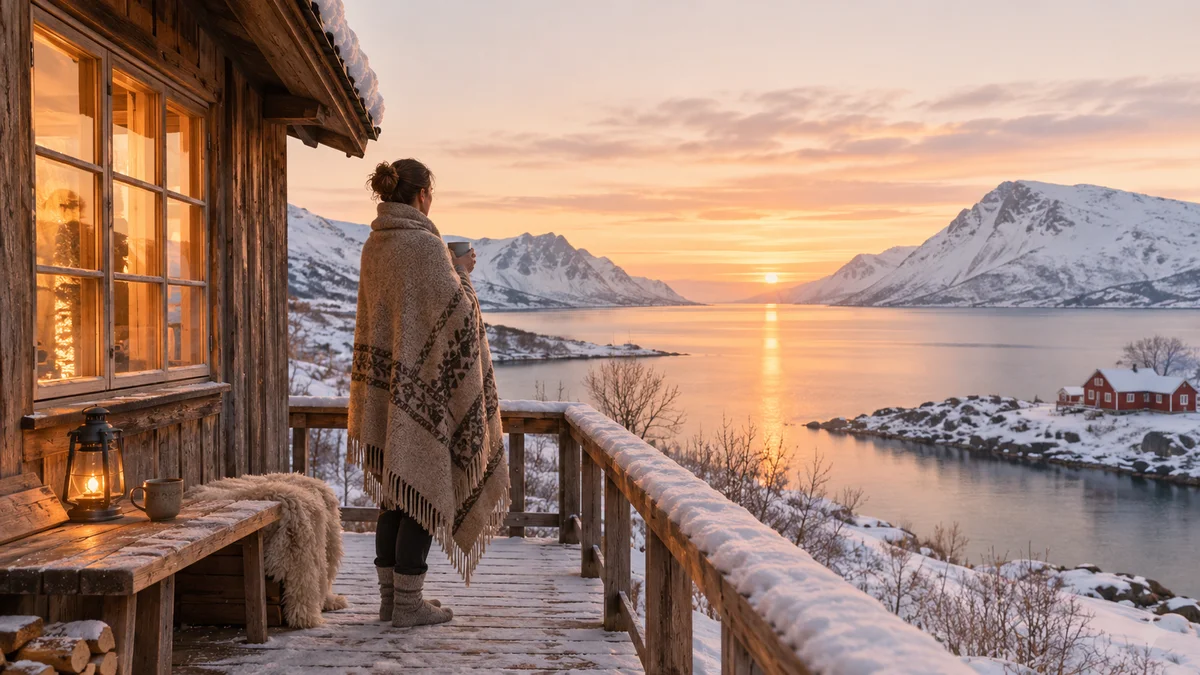
But when you walk through three miles of biting Arctic wind until your fingers tingle and your cheeks glow red, returning to the cabin becomes a spiritual experience.
✦ The Gratitude of Thawing: Slipping off heavy wool gloves to cup a steaming mug of hot tea sends a wave of profound somatic relief through every muscle fiber.
✦ Unrushed Sensory Contrast: True comfort is not the absence of cold, but the sweet and tender contrast between cold wind and loving shelter.
✦ Deep Restorative Slumber: After hours of breathing pure, oxygen-dense winter air, the body sinks into uninterrupted, restorative sleep without chemical aids.
This rhythm of braving the elements and returning to a quiet refuge has sustained human communities across high latitudes for millennia.
It teaches us that winter is not a season to endure in dread, but a sacred quiet haven to be explored with open lungs.
❄️ Decoding Takeaway: The Architecture of Open-Air Peace
• Inner State: Trapped in seasonal brain fog, indoor restlessness, and sensory stagnation.
• Neurobiological Mechanism: Cold air stimulation activates the parasympathetic nerve pathways, slowing pulse and clearing metabolic lethargy.
• Gentle Micro-Action: Dress in warm wool layers, step outside into crisp air for twenty mindful minutes daily, and let the wind touch your face without hurrying back.
Mindful Reflection Notice: Friluftsliv honors physical safety through meticulous preparation. Always wear thermal wool base layers, windproof outerwear, and insulated footwear suited to local winter conditions before venturing into freezing environments.
Mindful Reflections: Frequently Asked Questions
What is the philosophical difference between modern outdoor sports and Norwegian friluftsliv?
Modern outdoor sports often emphasize athletic performance, equipment status, and measurable mileage. In contrast, traditional friluftsliv is deeply non-competitive and philosophical. Its single aim is finding unhurried kinship with the living earth, valuing quiet presence and seasonal observation over physical conquest or speed.
How does crisp winter cold alleviate mental fatigue and seasonal depression?
Cold air stimulation awakens the trigeminal nerve and enhances dopamine production in response to environmental novelty. Exposure to natural sub-zero air clears the stagnant lethargy of heated indoor rooms, sharpens cognitive oxygenation, and resets an overstimulated nervous system through primal sensory contrast.
How can city dwellers practice the principles of friluftsliv without traveling to the Arctic?
You do not need an Arctic tundra to practice open-air living. Any urban park, forested footpath, or quiet lakeshore provides an authentic space for friluftsliv. Dress warmly in natural wool fibers, leave digital devices behind, and spend thirty unhurried minutes walking amidst winter winds to reclaim your internal stillness.