


You travel thousands of miles across oceans to touch an iconic wonder, hoping to feel the breath of timeless beauty against your skin. Yet upon arriving in midsummer, you find yourself trapped in a slow-moving queue of selfie sticks, jostled under scorching sun, and hurrying to capture proof that you were there. When every viewpoint […]
You travel thousands of miles across oceans to touch an iconic wonder, hoping to feel the breath of timeless beauty against your skin.
Yet upon arriving in midsummer, you find yourself trapped in a slow-moving queue of selfie sticks, jostled under scorching sun, and hurrying to capture proof that you were there.
When every viewpoint is crowded with cameras and transactional noise, travel ceases to be an act of discovery. It becomes another grueling performance on your mental ledger.
We return from these high-stakes vacations feeling strangely depleted, secretly needing a second holiday to recover from the exhaustion of our leisure.
Quick Answer: Visiting Santorini during the quiet winter off-season eliminates sensory overload and performative tourism. In the absence of summer crowds, the nervous system shifts from hyper-vigilance to deep restorative awe, allowing genuine connection with the volcanic landscape and unhurried personal reflection to emerge naturally.
The Mirage of Peak-Season Wonder
We live in a culture that treats leisure as an efficiency sport. We book flights during identical summer holidays and assemble identical photo collections to validate our escape.
Yet true restoration requires spaciousness. The human nervous system cannot decompress when every cobblestone alley requires sensory negotiation and crowd avoidance.
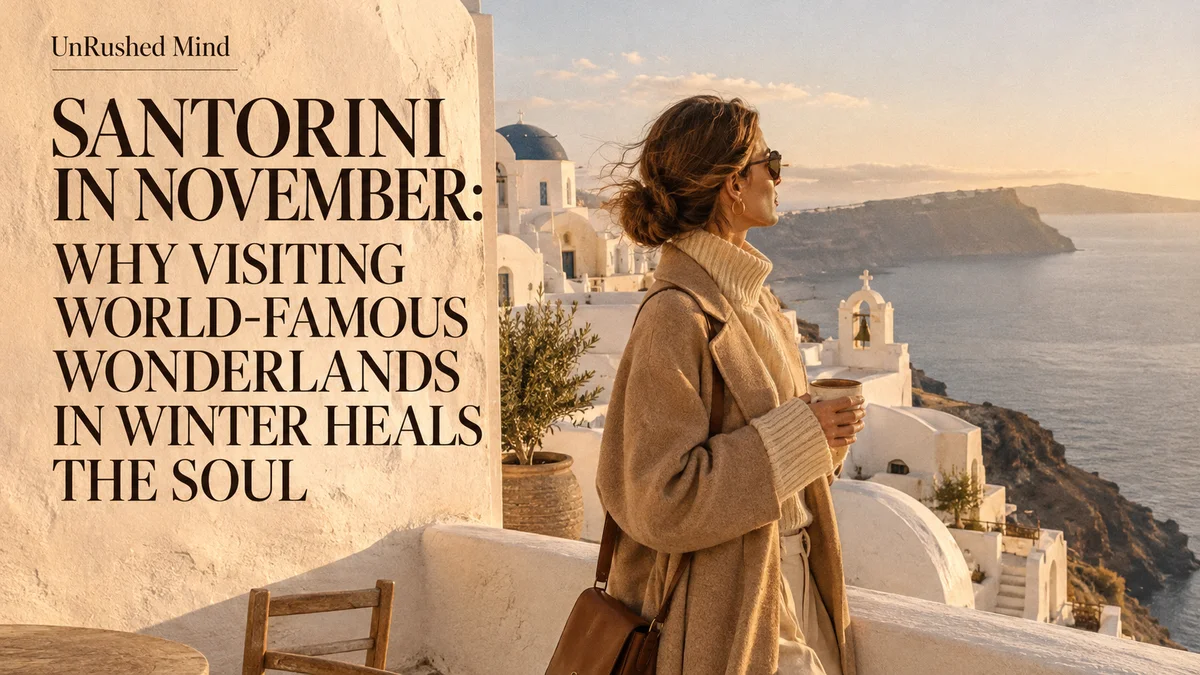
When the calendar turns to November, an astonishing silence descends across the Aegean. The monstrous cruise ships vanish from the horizon, souvenir stalls shutter their doors, and Santorini gently returns to itself.
The world-famous blue domes and whitewashed cliffside dwellings no longer serve as decorative stage backdrops. In the crisp winter light, they become quiet shelters etched into volcanic stone.
Without thousands of strangers competing for the same square foot of panoramic terrace, the atmosphere undergoes a profound chemical shift.
You are suddenly granted permission to stop rushing, to loosen your grip on time, and to experience an ancient island as a living land rather than a playground.
Peak Summer Spectacle vs. Winter Caldera Solitude
To understand why off-season exploration mends deep exhaustion, compare how your senses encounter the landscape across seasons:
| Dimension | Peak Summer Spectacle | Winter Caldera Solitude |
|---|---|---|
| Acoustic Environment | Roaring tour buses, megaphone chatter, pop music | Whispering Aegean winds, distant surf, solitary church bells |
| Sensory Load | Glaring concrete heat, visual clutter, constant dodging | Crisp saline air, soft low-angled sun, open sightlines |
| Pacing of Movement | Hurried marches between ticket gates and scenic lookouts | Aimless slow flânerie, pausing wherever intuition leads |
| Psychological State | Performative comparison, crowd anxiety, mental fatigue | Parasympathetic grounding, quiet contemplation, deep presence |
| Connection to Place | Consuming an engineered commercial attraction | Entering an intimate dialogue with ancient geological memory |
Attention Restoration and the Volcanic Void
Environmental psychologists have long documented the phenomenon of directed attention fatigue. When we navigate crowded urban hubs or packed vacation resorts, our minds work overtime to filter out extraneous stimuli.
Every sudden noise, passing drone, and jostling elbow forces your prefrontal cortex to maintain a protective state of alertness.
To recover, we require what researchers call soft fascination—environments that gently hold our attention without demanding cognitive effort.
Standing along the three-hundred-meter volcanic rim in November offers this restorative medicine in its purest form. There are no lines, no shouting tour guides, and no urgency to move.
Before you lies the vast Caldera basin, carved by cataclysmic eruptions thousands of years ago. The sheer scale of deep geological time effortlessly dwarfs your everyday anxieties.
As your gaze wanders over the still waters of the submerged crater, the internal chatter of accumulated stress begins to quiet down.
You realize that awe is not something you chase through a camera lens. It is a state of reverent presence that arrives only when the world stands still.
“When the artificial theater of tourism falls away, a landscape stops being merchandise. It becomes a quiet mirror reflecting the unsettled chambers of your own mind.”
Three Gentle Protocols for Off-Season Exploration
If you feel called to experience iconic places away from the noise, these intentional practices will anchor your days:
✦ The Unhurried Rim Walk: Walk the ten-kilometer footpath between Fira and Oia on a cool November morning. With empty cliff trails stretching ahead, allow the rhythmic strike of your boots against volcanic gravel to steady your breathing.
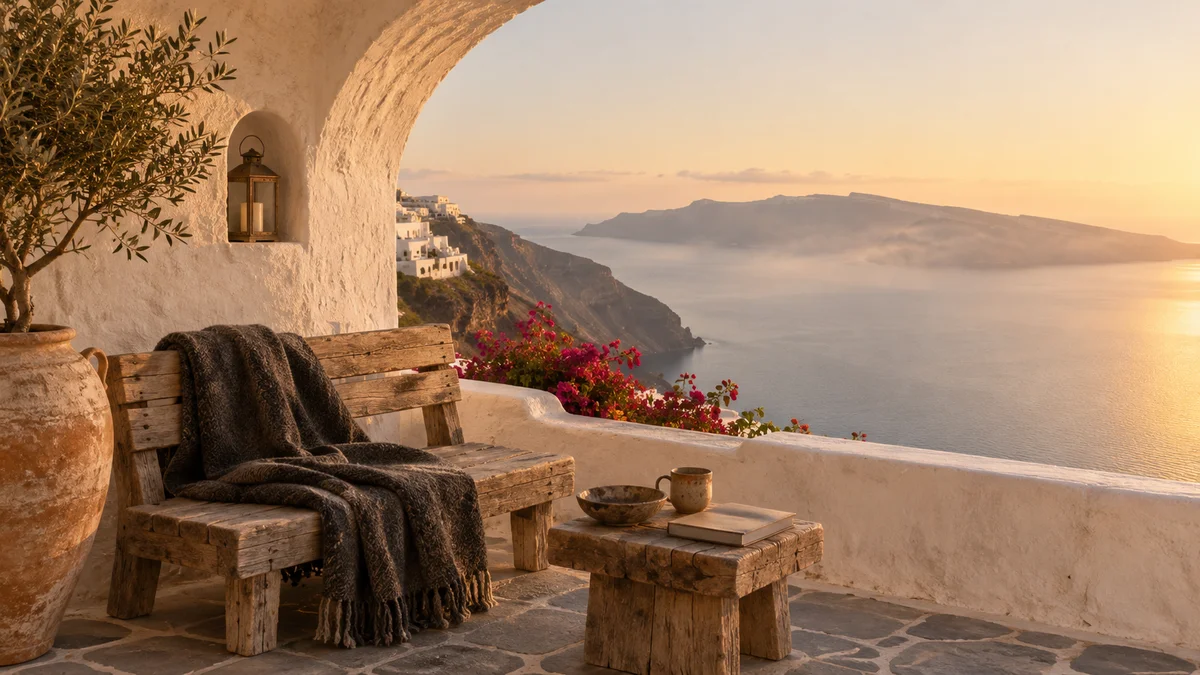
✦ Inhabiting the Stillness: Choose a solitary stone bench facing the Aegean at dusk. Wrap yourself in a heavy woolen coat and watch the sky shift from pale amber to indigo without lifting your phone to photograph it.
✦ Conversations with Local Island Keepers: Seek out modest neighborhood tavernas that remain open for residents. Savor warm yellow fava and fresh sourdough while listening to stories of island life that exist far beyond summer postcards.
Moving Through the World Without Hurrying
Traveling in winter teaches us that the greatest landscapes do not exist for our entertainment. They possess an inner life that only reveals itself when the crowd goes home.
When you permit yourself to visit famous destinations in their dormant months, you honor the rhythm of natural rest. You discover that quietness is not emptiness—it is the foundation where wonder lives.
By stepping out of the collective rush, you cultivate an unhurried perspective that accompanies you long after you return home.
You carry the wide horizons and volcanic stillness of the Aegean within your chest, knowing that restorative calm is always available whenever you choose to stop rushing.
Frequently Asked Questions