Your eyes sting from hours under harsh artificial light, and your thoughts refuse to quiet down. Inside the heated room, the air feels stagnant, heavy with the weight of unfinished projects and endless hypothetical scenarios. Every time you attempt to sit in stillness, your mind races faster, frantically trying to solve problems that do not […]
Your eyes sting from hours under harsh artificial light, and your thoughts refuse to quiet down.
Inside the heated room, the air feels stagnant, heavy with the weight of unfinished projects and endless hypothetical scenarios.
Every time you attempt to sit in stillness, your mind races faster, frantically trying to solve problems that do not even exist yet.
You feel trapped inside your own skull, suffocated by an internal dialogue that insists you must figure out the rest of your life before morning.
Conventional self-help urges you to force your brain into submission—to sit rigidly in meditation, or to blast through a punishing workout to sweat away the dread.
Yet for an exhausted nervous system, forceful interventions often feel like throwing kerosene onto an open flame.
Foggy winter walks act as a natural sensory dampener that visually dissolves the distant horizon, liberating the overstimulated brain from future-oriented predictive anxiety while suspended moisture droplets muffle harsh ambient noise, gently confining your conscious awareness to the immediate three steps ahead.
The Vanishing Horizon: How Winter Mist Acts as a Natural Sensory Shield
When you step outside into a dense winter fog, the first thing that strikes you is the absolute erasure of distance.
The distant skyscrapers, far-off hills, and bustling arterial roads are softened into gentle, milky silhouettes.
Human vision is biologically wired to scan the horizon for looming threats and distant opportunities.
In our hyper-connected lives, that ancient scanning reflex has transformed into chronic predictive fatigue.
Your prefrontal cortex spends nearly all its waking energy trying to forecast weeks ahead, constantly calculating what could go wrong.
Winter mist tenderly revokes your ability to gaze into the distance, offering your brain immediate neurological relief.
You cannot fret about what lies five miles down the road when your eyes can only perceive the cobblestones five paces before you.
In this softened visual field, the future is temporarily dissolved, leaving you with no choice but to inhabit the sacred simplicity of right now.
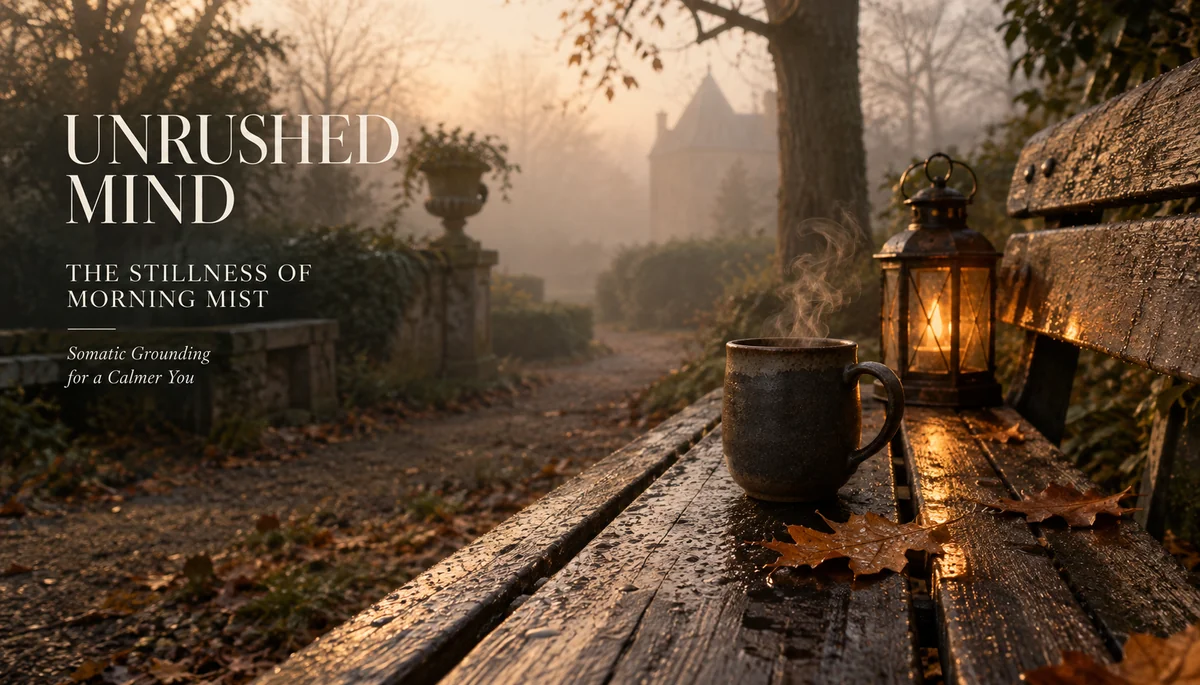
Equally transformative is the phenomenon of acoustic dampening that occurs during misty mornings.
Fog is not merely cold air; it is billions of microscopic water droplets floating silently through space.
These tiny liquid spheres absorb and scatter sound waves, deadening the harsh screech of automobile tires and metallic urban dissonance.
The world outside feels as though it has been wrapped in thick wool, creating a natural cathedral of silence.
When external volume diminishes so radically, the persistent screaming inside your head suddenly has nothing left to compete with, allowing your thoughts to slow to an unhurried drift.
As we explored in our reflection on the cost of ignoring burnout, your nervous system rarely heals through intellectual effort; it heals when sensory demands are substantially reduced.
Winter Flânerie vs. The Hustle Walk: Wandering Without an Agenda
In a society obsessed with metrics, even the humble stroll has been corrupted by the cult of efficiency.
We strap on smartwatches, obsess over achieving ten thousand steps, and listen to podcasts at double speed so that our movement remains “productive.”
This is what we call the hustle walk—an anxious physical march where the body is moving, but the mind remains chained to performance.
To experience true healing in the winter mist, one must resurrect the historic art of the flâneur.
Originating in nineteenth-century Paris, the flâneur was an unhurried spectator who strolled through boulevards without a destination or an agenda.
Winter flânerie is not exercise; it is an unhurried pilgrimage into atmospheric solitude.
When you walk without a map or a quota, your brain shifts out of executive function and enters the soothing waters of the art of doing nothing.
Furthermore, walking in cool air provides a powerful somatic medicine known as bilateral stimulation.
The rhythmic, alternating cadence of your left and right footfalls stimulates both cerebral hemispheres in steady synchronization.
This bilateral rhythm, combined with cool facial exposure, activates the mammalian dive response through thermal receptors on your cheeks, sending an immediate signal down the vagus nerve to decelerate heart rate.
To help you recognize your habitual movement patterns during times of mental overload, examine the following table:
| Walking Archetype | Dominant Inner Dialogue | Physical Pace & Posture | Somatic Nervous System State |
|---|---|---|---|
| The Frantic Speed-Walker | “I must hit my daily step goal and burn calories quickly before my next task.” | Rapid cadence, clenched shoulders, rigid forward-leaning posture. | Sympathetic arousal; adrenaline remains elevated despite physical movement. |
| The Paralyzed Indoor Ruminator | “It’s too cold outside; I need to stay inside and fix these problems first.” | Sedentary, shallow breathing, slumped posture over warm screens. | Dorsal vagal freeze; mental exhaustion paired with physical stagnancy. |
| The Distracted Screen-Scroller | “I’m technically outside, but let me check this notification and listen to audio.” | Uneven gait, head tilted downward, eyes glued to glowing glass. | Sensory dissociation; disconnection from physical environment and bodily cues. |
| The Sanctuary Winter Flâneur | “I have nowhere I need to be. I am simply walking alongside this quiet morning.” | Unhurried stride, relaxed jaw, soft panoramic gaze receptive to the mist. | Ventral vagal safety; deep grounding, parasympathetic restoration, and mental spaciousness. |
Breaking free from hurry sickness starts with granting your feet permission to wander without a scorecard.
When you stop treating a stroll as a chore to check off, putting one foot in front of the other becomes an altar of quiet contemplation.
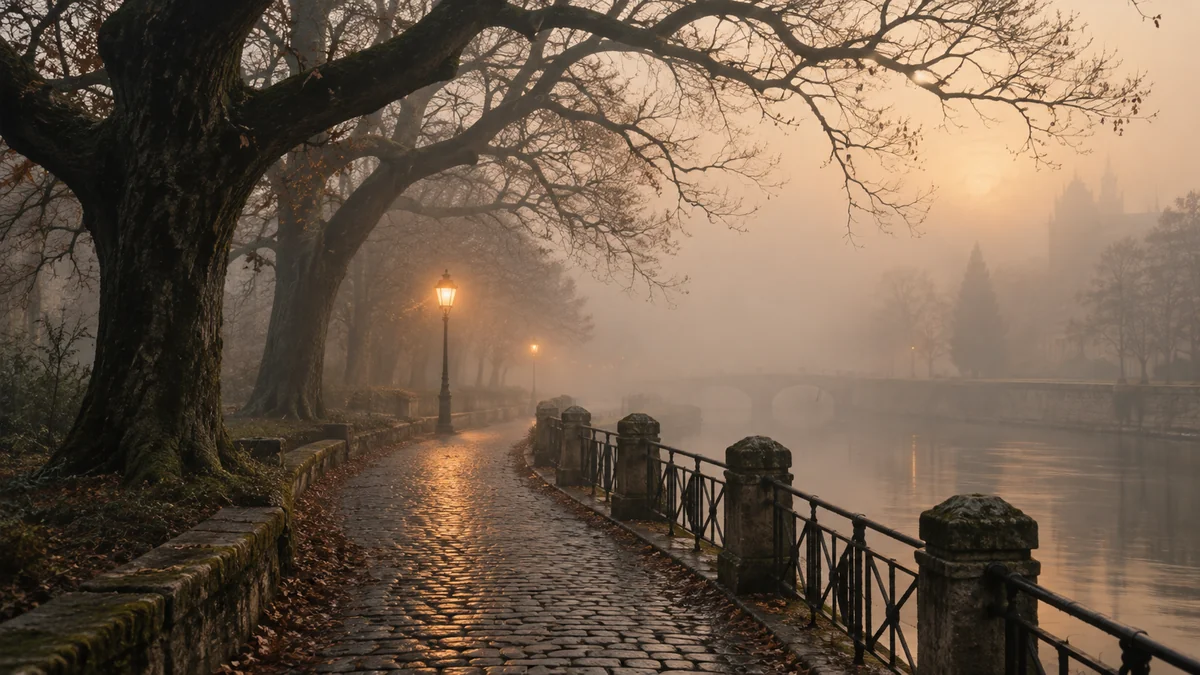
As we detailed in our guide to urban wandering and slow exploration, the true gift of the flâneur is not what they see, but who they become when they refuse to rush.
You do not need to solve the puzzle of your life today; you only need to accompany yourself through the fog.
The Winter Flânerie Sanctuary Protocol: Four Steps to Soften an Overthinking Brain
To transform a cold, misty walk into a restorative somatic sanctuary, you do not need complex equipment.
You only need to protect your solitude through this four-step contemplative practice:
1. The Unscheduled Threshold Crossing
Leave your fitness tracker and step counters behind, and tuck your phone into an inner pocket on silent.
Before stepping across the threshold, pause for a single breath and release any intended destination.
Let your body choose whether to turn left or right at each corner based purely on quiet curiosity rather than habit.
2. The Soft-Focus Sensory Anchoring
As you enter the chilly air, consciously soften your gaze from a narrow tunnel focus to a wide, panoramic field of view.
Notice how the fog dissolves sharp architectural edges into gentle watercolor washes.
Draw a slow breath through your nose, tuning into the subtle aroma of damp earth, fallen leaves, and wet stone.
Feel the crisp air against your cheekbones, acknowledging the contrast between the cold exterior and the steady warmth inside your chest.
3. The Bilateral Somatic Cadence
Slow your usual walking pace by thirty percent and let your hands rest deep within your coat pockets.
Release any clenching in your jaw, tongue, and shoulders as your boots connect rhythmically with the damp ground.
If anxious thoughts resurface, do not fight them; simply imagine setting them down upon a damp stone wall as you stroll quietly past.
4. The Warm Sanctuary Re-Entry
When your body signals that it has absorbed enough cold air—usually after twenty to thirty minutes—turn toward home with unhurried steps.
Do not immediately rush to open your laptop upon returning inside.
Hang up your cold coat, boil fresh water for herbal tea, and sit in warm 2700K lamplight for five minutes to savor the calm stillness.
This gentle transition embodies the art of savoring, anchoring the walk deep into your somatic memory.
Navigating Cold and Misty Days