


There is an unexamined vertigo that quietly defines modern adulthood. We spend sixteen hours a day suspended two inches above the earth, sealed inside shock-absorbing foam, hardened rubber, and compressed leather. Our feet remain trapped inside dark, sensory deprivation chambers from morning until night. Meanwhile, our minds spin in high-speed digital feeds, caught in chronic, […]
There is an unexamined vertigo that quietly defines modern adulthood.
We spend sixteen hours a day suspended two inches above the earth, sealed inside shock-absorbing foam, hardened rubber, and compressed leather.
Our feet remain trapped inside dark, sensory deprivation chambers from morning until night.
Meanwhile, our minds spin in high-speed digital feeds, caught in chronic, disembodied vigilance.
We feel perpetually ungrounded and mentally scattered, yet we rarely realize our biological anchor has been physically amputated from the living soil.
The soles of human feet house more than 200,000 high-density mechanoreceptors, wired directly to the sensory cortex. When you walk barefoot on living earth, these receptors transmit textured neural feedback that silences amygdalar hyperarousal, activating parasympathetic tone and restoring somatic stability.
The Sensory Blindfold of Cushioned Footwear
For hundreds of thousands of years, the human foot operated as our primary antenna for negotiating reality.
Neurologically, the plantar surface contains an informational density rivaled only by your tongue and fingertips.
Four classes of mechanoreceptors—Merkel discs, Meissner’s corpuscles, Ruffini endings, and Pacinian corpuscles—map every micro-gradient of texture, slope, and moisture.
Yet modern footwear has turned these sensory organs into dormant biological blocks.
When you place rigid foam beneath your heels, your central nervous system loses its baseline reference for where you stand in space.
Deprived of ground-truth signals, the cerebellum must guess at balance, keeping the autonomic nervous system locked in subtle, simmering alert.
Your mind races simply because your soles cannot feel the ground.
“The human foot is an exquisite sensory masterpiece. When we insulate it from the earth, we do not merely protect the sole; we sever the mind from its oldest stabilizing anchor.”
What Happens When Bare Skin Meets Living Soil
The instant you strip off your socks and step barefoot onto unpaved earth, a profound neurobiological cascade begins.
Cool morning soil or damp moss fires thousands of dormant mechanoreceptors simultaneously.
Afferent neural signals surge along the posterior tibial nerve, flooding the somatosensory cortex with uncompressed topographical data.
Tactile immersion through the feet creates an immediate shift toward alpha brainwave coherence.
Your prefrontal cortex relinquishes its obsessive grip on control.
The nervous system realizes you are no longer teetering on an artificial platform, disarming the autonomic alarm system faster than conscious thought.
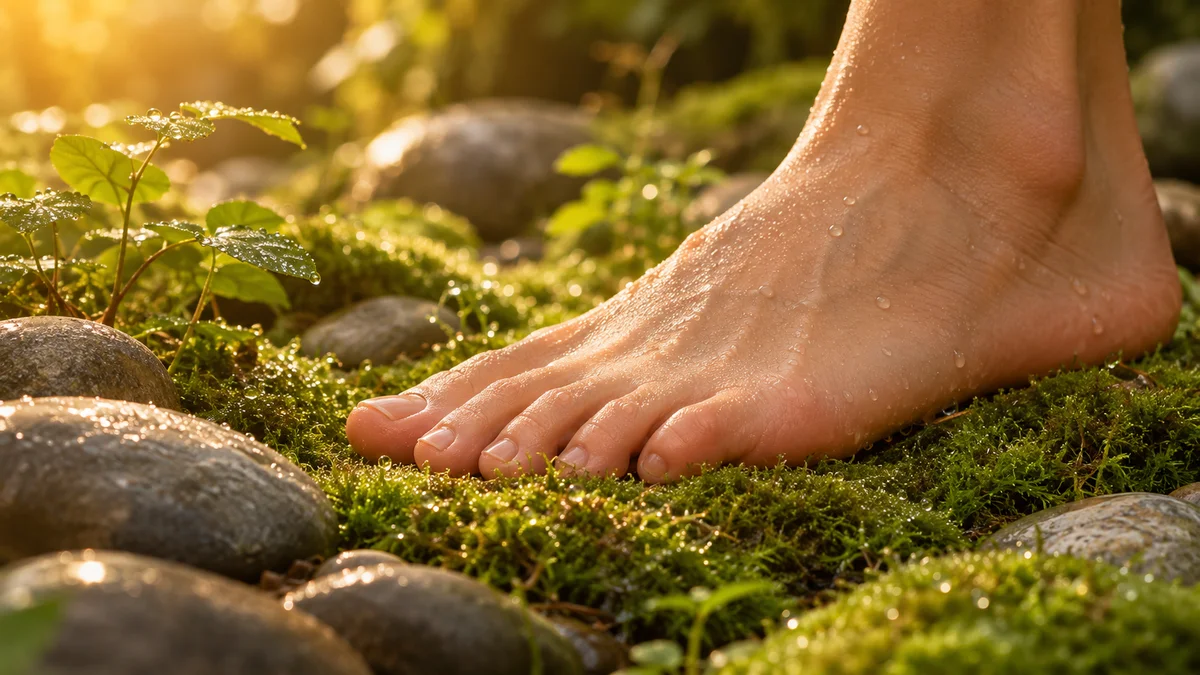
The Cushioned Void vs. The Proprioceptive Ground
Understanding the contrast between footwear insulation and sensory grounding illuminates why modern anxiety feels so bodily:
| Sensory Dimension | The Cushioned Isolation Trap | The Grounded Mechanoreceptor Haven |
|---|---|---|
| Plantar Nerve Activation | Muffled by uniform, synthetic foam | 200,000 receptors fire in dynamic cadence |
| Postural Stabilization | Ankle instability compensated by neck tension | Natural micro-adjustments via foot intrinsics |
| Cerebellar Processing | Guesswork due to sensory lag | Effortless equilibrium and somatic certainty |
| Autonomic State | Low-grade sympathetic vigilance | Down-regulated parasympathetic restoration |
| Cognitive Experience | Disembodied mental exhaustion | Grounded spaciousness and calm presence |
When your feet accurately read the terrain, your body stops bracing against an invisible fall.
Your jaw softens, breathing descends into the lower abdomen, and your physical perimeter feels secure.
✦ The 60-Second Somatic Anchor: Waking Dormant Receptors
Before reaching for another screen, step barefoot onto raw wood, cool tile, or living grass.
- Fan the Ten Toes: Lift and spread your toes wide, creating breathing space across each metatarsal head.
- Shift the Gravity Triangle: Slowly rock weight between your heel, big toe base, and outer foot blade.
- Register the Temperature: Inhale for four counts while feeling the coolness or warmth beneath your arches.
- The Somatic Release: Exhale for six counts through soft lips, affirming: “My soles hold the ground; my mind releases the tension.”
Three Micro-Practices for Daily Sensory Grounding
You do not need to abandon modern life to restore plantar intelligence.
Sustainable grounding is an intentional, tactile daily ritual of reclaiming biological connection:
✦ The Morning Dew Threshold: Step barefoot onto dewy lawn grass or unvarnished deck wood for just three unhurried minutes before checking email. Moisture amplifies tactile conductivity across your nerve endings.
✦ Texture Diversity Over Distance: Modern floors are flat and monotonous. Spend five minutes walking across varied textures—smooth river stones, pine mulch, or woven jute rugs—to wake neglected foot intrinsics.
✦ The Slow Heel-to-Ball Unroll: When walking without shoes, abandon the aggressive heel-strike of athletic sneakers. Let the outer edge of your midfoot meet the surface with gentle awareness before shifting your full weight.

Walking as an Act of Gentle Homecoming
Walking barefoot upon the earth is an act of quiet rebellion against an over-engineered culture.
It is a deliberate acknowledgment that you are an earthly mammal, designed to converse with soil and stone.
When life feels chaotic, the answer is rarely found in thinking harder or moving faster.
Sometimes, the most restorative step toward mental peace is simply peeling off your socks, pressing bare feet against cool ground, and letting two hundred thousand nerves carry you home.
Frequently Asked Questions