


There comes a moment when your mind feels like a shallow mountain pond whipped by an endless gale. Every ping from your phone, every deadline, and every unresolved conversation stirs up dark silt from the bottom. You try desperately to think your way into clarity, but every frantic effort only churns the water into thicker […]
There comes a moment when your mind feels like a shallow mountain pond whipped by an endless gale.
Every ping from your phone, every deadline, and every unresolved conversation stirs up dark silt from the bottom.
You try desperately to think your way into clarity, but every frantic effort only churns the water into thicker mud.
What your exhausted nervous system craves is not more information, but an unruffled horizon.
You long for a landscape so vast and still that it demands absolutely nothing from your attention.
When October settles over the Salzkammergut lake district in Upper Austria, the world turns into precisely that medicine.
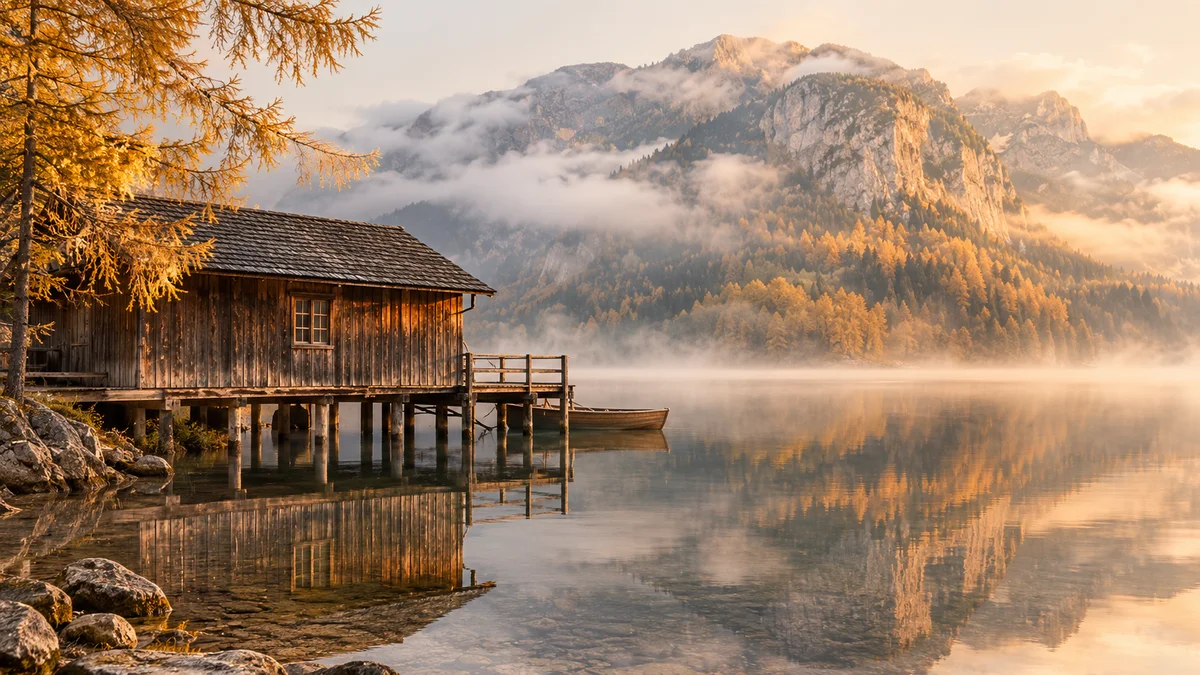
The summer crowds have vanished, leaving behind ancient limestone waters cradled by mist and golden larches.
Here, surrounded by glassy alpine mirrors, you finally remember how to let your own turbulent thoughts settle into stillness.
✦ Quick Answer: The alpine stillness of Austria’s Salzkammergut lakes in autumn restores overstimulated minds by activating parasympathetic nervous recovery through reflective waters and cold-air horizons. By ceasing internal agitation, mental silt settles naturally, revealing profound emotional clarity.
The Geometry of Still Water: Why Mountains Heal the Restless Mind
Salzkammergut holds seventy-six glacial lakes cradled by the limestone bastions of the Dachstein massif.
During summer, these shores hum with crowds, but autumn brings a reverent, cathedral-like hush.
At Lake Gosausee, early morning air drops near freezing, calming all thermal breezes and turning the surface into liquid glass.
When you stand on the shoreline, the summit of Dachstein reflects so pristinely that the boundary between sky and water dissolves.
Environmental psychologists refer to this restorative visual phenomenon as soft fascination.
Unlike the aggressive attention demanded by screens, watching unbroken reflections requires zero cognitive effort.
The vast symmetry of mirrored mountains gently disarms your threat network, quieting the hyperactive amygdala.
Neurobiologists find that panoramic water horizons trigger alpha brain waves, inducing wakeful inner calm.
You are no longer fighting the current; you are simply resting within the quiet expanse of the world.
The Turbid Soul vs. The Mirrored Alpine Horizon
In modern culture, we are trained to fix agitation with frantic action.
Yet the ancient wisdom of water teaches us that clarity is a consequence of non-interference.
| Experiential Dimension | The Turbid Mind Trap | The Alpine Stillness Haven |
|---|---|---|
| Internal Atmosphere | Constant mental chatter and agitated churn | Expansive hush and emotional space |
| Biological State | High cortisol, shallow breath, clenched jaw | Deep diaphragmatic pacing, relaxed eyes |
| Relationship to Thought | Forcing solutions and stirring the sediment | Letting silt settle through non-action |
| Perception of Reality | Distorted by personal projections and fear | Mirroring reality clearly without drama |

✦ The 60-Second Somatic Anchor: Becoming the Unruffled Water
When the noise of the day clouds your perception, borrow the quiet composure of an alpine lake.
You do not need to be in Austria to access this internal reservoir of calm.
Lower your gaze toward the floor and soften your peripheral vision until sharp edges gently blur.
Place both hands lightly over your lower ribs and feel your breath expand horizontally like ripples across a smooth pond.
Inhale cool air slowly through your nose for four steady counts, picturing the motionless surface of Lake Hallstatt.
Exhale gently through parted lips for six counts, releasing any impulse to solve or manage this present second.
Whisper quietly to your racing mind: “I do not fight the wind; I let the waters clear themselves.”
This simple tactile pause interrupts your stress cycle and reminds your body that stillness is always available.
Three Mindful Micro-Actions for Autumn Clarity
The quiet lakes of Salzkammergut offer three gentle principles for navigating an overwhelmed modern life.
These are not demanding chores, but restorative permissions to let go.
✦ 1. Cease the Stirring
The philosopher Lao Tzu observed that mud settles only when water is left completely undisturbed.
When you feel emotionally muddled, resist the temptation to immediately dissect the problem.
Step away from the screen, refuse to send that reactive message, and grant your thoughts twenty minutes of non-interference.
When you stop poking at the turbulence, your psychological sediment drops naturally, revealing quiet truth.
✦ 2. Seek Cold, Still Horizons
Warm weather often invites frenetic activity, whereas the crisp chill of autumn naturally turns attention inward.
Step outside into the brisk morning air and let the cool breeze touch your cheeks without reaching for a distraction.
Cold alpine air acts as a natural neurological tonic, stimulating the vagus nerve and halting circular rumination.
Make space each week for quiet walks beside cold water, whether an autumn stream or a mist-covered park.
✦ 3. Reflect Without Grasping
A mountain lake reflects the granite peaks above it, yet it never attempts to hold onto their stone weight.
When a dark storm passes overhead, the water reflects the gray tempest fully, and when the sun returns, it reflects gold.
The water does not resist the clouds nor cling to the light; it simply remains pure awareness.
Practice meeting your daily emotions with that same spacious detachment, allowing feelings to drift across you without clinging.
Frequently Asked Questions