To step barefoot onto the frosted cedar boards of a mountain onsen in northern Japan is to experience a sudden, shocking moment of pure truth. The winter air at twilight is merciless and sharp, hovering just below freezing as fresh snowflakes settle softly against your bare skin. Every instinct in modern life screams at you […]
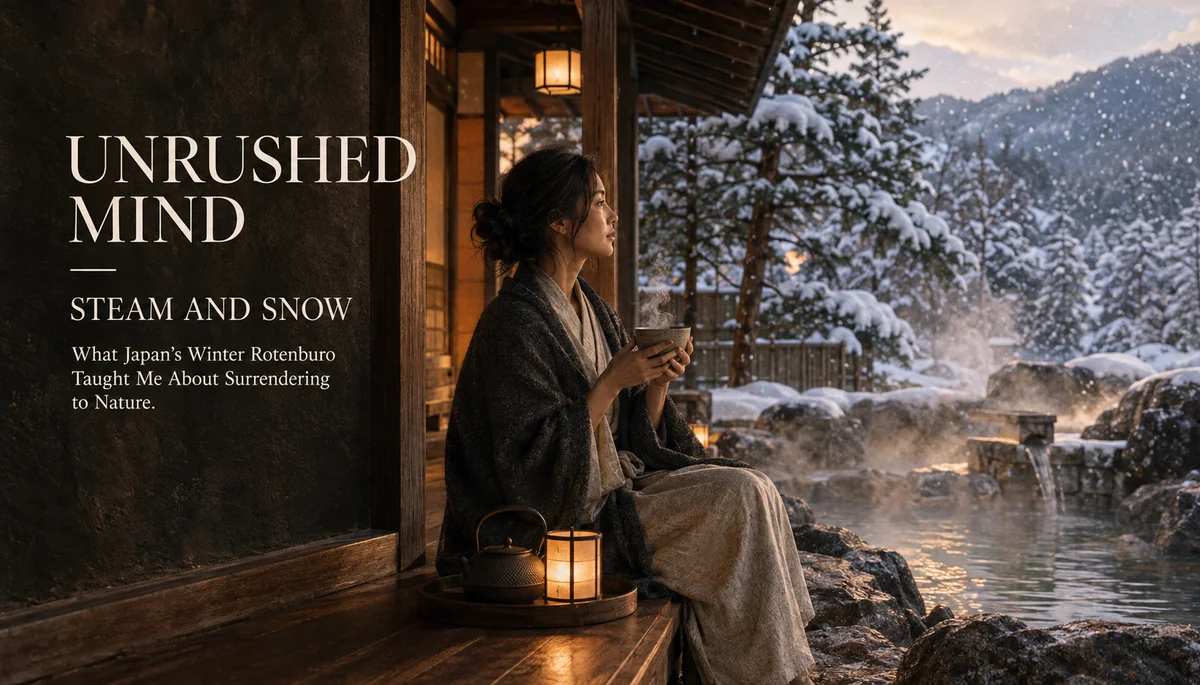
To step barefoot onto the frosted cedar boards of a mountain onsen in northern Japan is to experience a sudden, shocking moment of pure truth.
The winter air at twilight is merciless and sharp, hovering just below freezing as fresh snowflakes settle softly against your bare skin.
Every instinct in modern life screams at you to tense your shoulders, curl your torso inward, and retreat into the familiar fortress of mental defence.
For months, perhaps years, your autonomic nervous system has been locked in an exhausting posture of constant bracing.
You have been trying to steer the uncontrollable currents of work, relationships, and time, carrying an invisible armor that has quietly worn your spirit down to the bone.
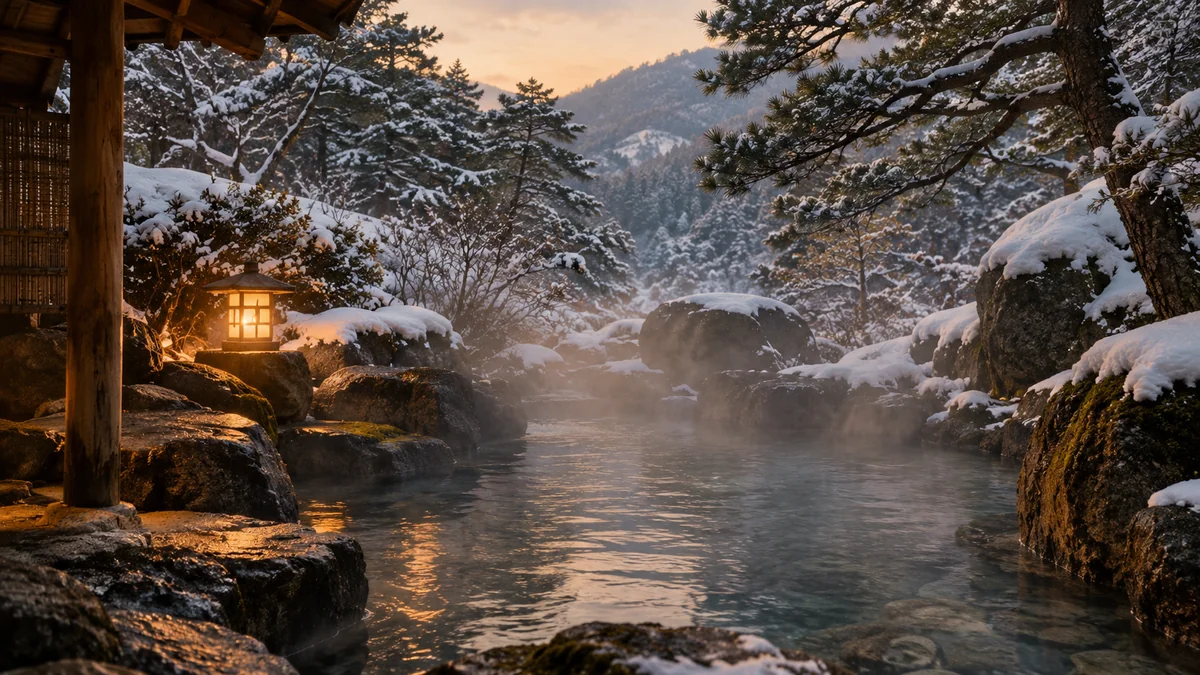
Yet a few feet ahead of you, dark volcanic boulders cradle a pool of pure, geothermal mineral water rising from the deep belly of the earth at forty-one degrees Celsius.
Clouds of white mineral steam billow into the twilight, creating a dreamlike sanctuary where the boundary between cold sky and liquid warmth completely dissolves.
Surrendering to nature in a winter rotenburo is the somatic practice of yielding personal control to the elements, allowing contrast thermal mineral waters to dissolve chronic muscular bracing while snow falls gently on your brow in silent contemplation.
It is the moment you finally stop fighting the weather of your existence and allow the earth to hold you without condition.
The Exhaustion of Control: Why We Brace Against the Cold of Life
The modern psyche suffers from a chronic and unacknowledged disease: the illusion that safety can only be manufactured through unrelenting control.
We carry our anxieties as physical tensions—a clenched jaw during commutes, shallow breathing during meetings, and an unyielding tightness across the upper back and neck.
We treat life not as a living ecology to participate in, but as an adversarial storm that must be outsmarted, organized, and dominated at all costs.
When unexpected changes arrive, our immediate somatic reflex is to brace harder, as if rigid resistance could somehow stop the winter wind from blowing.
Yet this constant muscular and cognitive vigilance carries a devastating biological tax.
It traps the body in chronic sympathetic overdrive, depleting vital endocrine reserves and leaving us feeling perpetually exhausted yet strangely unable to truly rest.
We forget that nature never survives winter by fighting the frost with furious effort.
The ancient pines simply bend beneath the weight of falling snow, trusting their deep roots and waiting with patient majesty.
The Paradox of Rotenburo: Heat Below, Snow Above
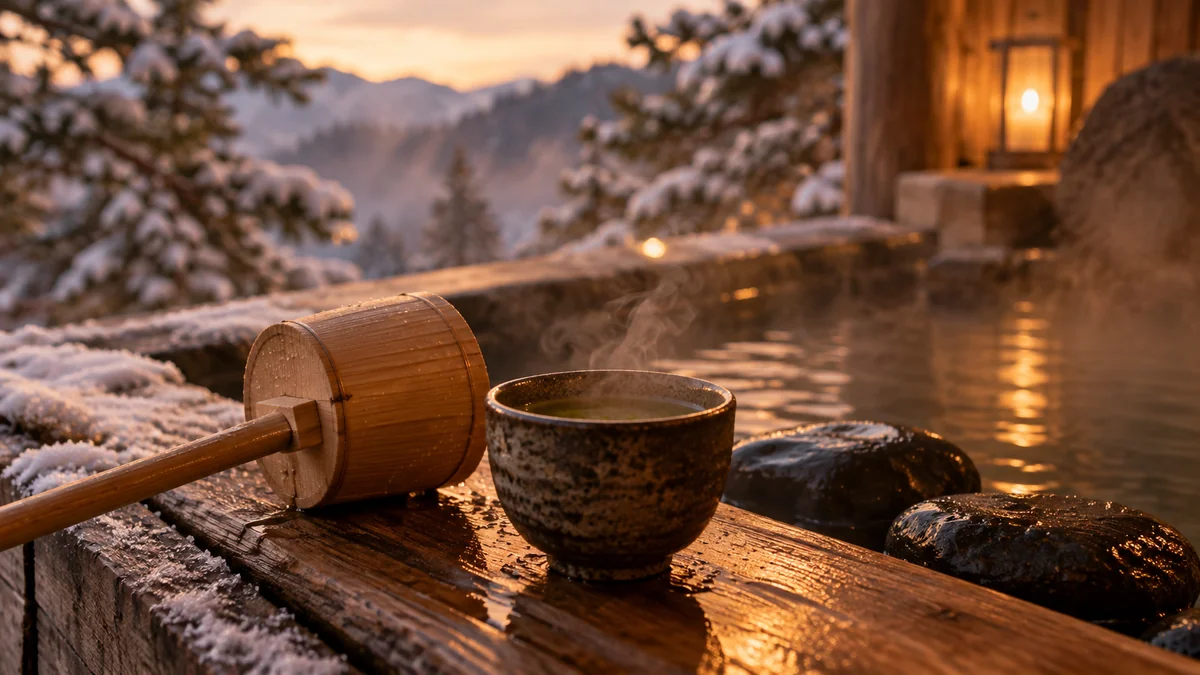
A rotenburo—an outdoor hot spring bath nestled directly within natural topography—is not a luxury spa distraction.
In Japanese bathing culture, it is a sacred somatic medicine designed to teach human beings the quiet wisdom of contrast and surrender.
When you step off the freezing timber ledge and submerge your body into the steaming thermal water, an extraordinary physiological phenomenon takes place.
Within seconds, the intense heat envelops your legs, your spine, and your chest, forcing the tightest fascial tissues to immediately release their chronic contractions.
Yet because your head remains elevated above the water in the sub-zero winter air, your brain avoids the claustrophobic dizziness often felt in indoor steam rooms.
A gentle snowflake lands upon your warm forehead and melts in a microsecond into pure, refreshing water.
In neuroscience and somatic therapy, this profound duality acts as a master reset for the vagus nerve and the autonomic nervous system.
The contrast between geothermal warmth holding your body and crisp alpine air cooling your breath triggers an instant parasympathetic brake.
Your heart rate slows to a deep, grounded cadence, your blood vessels dilate into wide rivers of warmth, and your mind is stripped of its restless impulse to calculate the future.
You realize with startling clarity that you cannot negotiate with the falling snow, nor can you alter the temperature of the sky.
All that is required of you—all that has ever been asked of you—is to let go of the edge of the pool and let the water carry your weight.
Diagnostic Table: The Archetypes of Resistance vs. The Rotenburo Surrenderer
Most people struggle to experience deep rejuvenation because their internal habits of control sabotage the process of rest.
Review this comparative diagnostic table to identify how your mind typically handles vulnerability, and explore the somatic shift that turns surrender into profound emotional power:
| Archetype Pattern | Internal Monologue | Somatic Reality | Rotenburo Surrender Shift |
|---|---|---|---|
| The Iron Controller | “If I let my guard down for even one moment, things will spiral out of control.” | Chronic neck tightness, shallow thoracic breathing, high resting cortisol. | Acknowledges that true sovereignty is knowing what is beyond personal control. |
| The Restless Sightseer | “I have soaked for ten minutes; what is the next landmark on my schedule?” | Agitated motor restlessness, scanning environment for quick stimulation. | Trades consumer itineraries for the sacred depth of lingering in unhurried stillness. |
| The Numb Escapist | “I just want to forget everything and stop feeling the pressure inside.” | Sensory dissociation, disconnect between physical sensations and mental awareness. | Moves from avoidance into somatic presence, allowing thermal sensations to anchor the soul. |
| The Rotenburo Surrenderer | “I release the wheel. The mountain, the water, and the cold hold me completely.” | Deep diaphragmatic breath, fascial decompression, integrated nervous system calm. | Embodies biological trust: resting fully inside the unfolding rhythm of nature. |
The Winter Rotenburo Surrender Protocol: 4 Steps to Yielding to Nature
Whether you find yourself soaking in a secluded mountain ryokan in Nagano or recreating thermal hydrotherapy in your own home sanctuary, the art of surrender follows an ancient, intentional cadence:
1. The Physical Shedding of Armour
Before entering the outdoor waters, you must strip away far more than your clothing.
Leave behind your phone, your watch, your mental to-do lists, and the subtle social persona you maintain for the outside world.
At the washing station, scrub your skin thoroughly with warm water and simple soap, treating the physical cleansing as a sacred ritual of washing away mental residue.
When you step out toward the snow, remind yourself: I have nothing left to defend, nothing left to prove, and nowhere else I need to be.
2. The Contrast Immersion & Vagal Reset
Approach the natural rock pool without rushing or hesitation.
Lower yourself smoothly into the steaming water, feeling the liquid heat climb past your knees, your hips, and finally settling across your collarbones.
Rest the back of your neck against a smooth, snow-dusted river boulder.
Close your eyes for the first two minutes and pay singular attention to the somatic clash: the intense mineral warmth anchoring your limbs below, and the crisp winter air brushing your temples above.
This deliberate contrast shocks the mind out of repetitive rumination, forcing awareness directly into your immediate bodily presence.
3. The Mindful Surrender to Cold Breath
Open your eyes and gaze out into the snowy landscape without trying to capture or photograph it.
Notice the rising vapor swirling in the wind, mimicking the natural rhythm of your own exhalations.
Watch how each snowflake drifts without urgency, making no sound as it touches the mineral water and vanishes into the steam.
Practice breathing in the freezing mountain air through your nose, feeling the cool current enter your chest, and releasing a long, audible sigh through your mouth into the warm mist.
With every out-breath, mentally drop one thing you have been frantically trying to control: an outcome at work, someone else’s opinion, or an unresolved past mistake.
4. The Integration Engawa Stillness
When your core body temperature has been thoroughly warmed, rise slowly from the bath without scrubbing your skin dry with harsh towels.
Allow the natural volcanic minerals—sulfur, silica, magnesium—to remain on your skin like an invisible protective veil.
Wrap yourself in a loose linen yukata, pull a heavy wool haori over your shoulders, and sit quietly on the covered wooden engawa veranda.
Sip a steaming cup of freshly brewed sencha green tea, listening to the soft thump of snow falling from heavy pine branches in the stillness.
Do not rush back into digital screens or intellectual stimulation.
Sit for twenty uninterrupted minutes, letting your nervous system memorize the exquisite, unshakable peace of being completely supported by the earth.
The Lasting Peace of Being Held
We live in a culture that treats yielding as weakness and equates exhaustion with honor.
We run through life trying to outpace the myth of falling behind, trapped in the frantic speed of modern demands.
We wear our hyper-independence like a badge of pride, forgetting that no living organism was ever meant to survive entirely by its own force of will.
Yet sitting in a steaming winter rotenburo amidst silent mountain snow teaches a lesson that books and productivity frameworks can never convey.
You do not have to hold up the entire sky with your bare hands.
There is a vast, ancient intelligence built into the fabric of this earth that knows precisely how to melt snow into spring rivers, how to store green shoots beneath the frost, and how to warm cold water beneath the granite mountains.
When you practice the art of slow travel and allow yourself to wander with the unhurried mindset of mindful exploration, travel ceases to be consumption and becomes restoration.
Like the ancient Zen lessons found in Kyoto’s quiet temples or the grounding medicine of forest bathing among ancient trees, thermal immersion reminds us of our true nature.
It reconnects with the cleansing philosophy of Hakone’s healing onsen traditions and teaches us to go where nobody knows our name to find our real self.
It echoes the Stoic peace of Amor Fati—loving the fate you were handed—and the transient beauty of Ichigo Ichie, cherishing this unrepeatable moment.
It heals the constriction of cold-weather nervous system dysregulation and softens winter dopamine hunger.
It gives you the somatic foundation to embody the grace of saying ‘no’, to cherish sacred winter solitude, and to embrace winter hygge without guilt.
Tonight, wherever you find yourself, soften the tension in your jaw and drop your shoulders two inches away from your ears.
The water is warm, the night is quiet, and you are entirely safe to let go.
Somatic & Mindful Travel Note: Thermal spring bathing (onsen) offers profound somatic relaxation and vagal tone support. However, individuals with cardiovascular conditions, high blood pressure, or who are pregnant should consult a physician before using high-temperature thermal baths (above 40°C). Always stay well hydrated, never bathe while intoxicated, and honor your personal physical boundaries by exiting the water if lightheadedness occurs.
Frequently Asked Questions About Winter Rotenburo and Thermal Healing
What makes an outdoor rotenburo in winter different from a standard hot bath?
A winter rotenburo provides an exquisite somatic contrast: your entire body is submerged in 40–42°C geothermal mineral water, while your head and lungs breathe crisp, sub-zero outdoor air. This natural thermoregulatory contrast prevents the cardiovascular fatigue and lightheadedness typical of enclosed indoor steam rooms, allowing for deeper nervous system decompression.
How does thermal spring bathing promote psychological surrender?
High-heat mineral water immediately triggers vasodilation, relaxes chronic fascial bracing, and reduces sympathetic nervous system tone (fight-or-flight). Immersed in an ancient natural setting with snow and rising steam, the mind naturally detaches from artificial deadlines and surrenders to the sensory presence of the natural elements.
Can I experience the somatic benefits of a winter onsen at home?
Yes. You can recreate this nervous system reset by soaking in a hot bath (around 40°C) infused with magnesium-rich Epsom salts or Japanese yunohana bath minerals, while cracking open an adjacent window to allow cool winter air into the room. Keep lighting at 2700K amber warmth and practice slow, diaphragmatic breathing.
What is the essential mindful etiquette when visiting an onsen in Japan?
Traditional onsen culture emphasizes reverence, stillness, and communal cleanliness. Always wash thoroughly at the seated washing stalls before entering the communal water. Keep your small modesty towel out of the bathwater (placing it on your head or the rock edge), avoid splashing or swimming, and maintain a quiet, whispering tone of voice to preserve the sanctuary of contemplation for all bathers.